
Given current market turmoil, it’s useful to review historical crashes in gold and silver and—more importantly—to understand what their recoveries can tell us about the road ahead.
Despite frightening price moves, the behavior of gold and silver today is not unprecedented. Throughout history both metals have experienced sharp downturns for a variety of reasons, with differing depths and durations.
What matters most is the consistent pattern: they recovered. Always. The only variables are how long recovery took and how high prices ultimately climbed.
I examined three historical periods that most closely resemble aspects of today’s situation: the Great Recession (2008), the 1970s, and the Great Depression. I intentionally excluded declines that followed long bull markets, since that scenario does not match the present context.
Below I summarize the severity, duration, and subsequent recoveries of these three major crashes and the lessons they offer.
The 2008 Financial Crisis
The 2008 crisis was a different kind of fear—largely deflationary—but gold and silver suffered steep losses during the panic. The most intense stock-market decline occurred in October 2008, and precious metals fell sharply as investors and institutions scrambled for liquidity.
In gold’s case, the price lost nearly one-third of its value in roughly seven months. That episode prompted widespread questioning of gold’s safe-haven status.
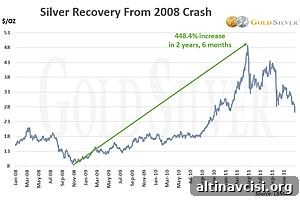
Silver’s decline was even more dramatic: it lost more than half its value in that same seven-month window.
Those collapses, however, set the stage for very strong recoveries. After the initial shock subsided and forced margin selling eased, investor demand returned with force.
From the lows, gold rose about 166% in under three years, while silver surged around 448% over roughly two-and-a-half years. The takeaway from 2008–2011 is that sudden crashes can be followed by powerful rallies as investors seek refuge and capital rebounds into the metals.
The 1970s
The 1970s were turbulent: runaway inflation, rising unemployment, volatile equities, an energy crisis, and geopolitical shocks. In the mid-1970s gold and silver experienced a pronounced selloff that puzzled many observers, especially because it began shortly after U.S. citizens were again allowed to own gold (January 1, 1975).
Gold fell nearly 50% over a period of about a year and eight months. Silver declined somewhat less in percentage terms but with greater volatility and a longer duration of weakness.
Despite the confusing backdrop, the selloff proved temporary. As economic and political pressures persisted and investor appetite for tangible stores of value grew, both metals rebounded dramatically. Gold bottomed in late summer 1976 and then rose roughly 440% over the following three-plus years, much of that appreciation concentrated in the final year of the advance. Silver performed even more strongly, climbing more than ninefold over about four years, with the largest gains also concentrated toward the end of the move.
The lesson mirrors that of the 2008 episode: metals can drop sharply amid shock and uncertainty, but sustained crises tend to draw increasing investor demand and lead to large recoveries for those willing to hold through the turmoil.
The Great Depression
Examining the Great Depression requires nuance. The U.S. was on a gold standard and, in April 1933, private ownership of gold bullion became illegal—so U.S. investors couldn’t buy the metal directly. Instead, they bought gold stocks, which served as a proxy for exposure to the metal.
From 1929 through January 1933, shares of major gold producers performed exceptionally well: Homestake Mining rose about 474% and Dome Mines rose about 558% while the Dow Jones Industrial Average plunged roughly 73%. Had investors bought those stocks at mid-1920s prices, they would have realized gains approaching 1,000% over five years. Remarkably, both companies increased dividends during the Depression, which underlined strong cash flow amid falling costs and a fixed, government-set gold price.
Looking at a longer span, Homestake outperformed broad equities by a wide margin from 1925 to 1940, rising roughly tenfold while the Dow stagnated. Notably, during the worst portion of the crash when the Dow fell dramatically, the gold stock more than doubled.
Although we can’t observe how an untethered gold price would have behaved during that deflationary period, the gold-stock performance shows that when forced liquidations subside, capital can and did move aggressively into gold-related assets.
Are Gold & Silver Done Falling?
No two selloffs or recoveries are identical; this cycle will have its own characteristics. Still, the three historical examples above share a clear common outcome:
- Gold and silver ultimately responded to each era’s crisis by rising substantially.
These rebounds occurred in both inflationary and deflationary environments, though precious metals typically perform best during inflation. More importantly, they rose in direct response to prolonged crisis conditions.
That is relevant today. While prices have fallen in the current selloff, history suggests that sustained crisis dynamics will increasingly attract investors to gold and silver, which can lead to significant price appreciation once the period of forced liquidation and panic fades.
Also consider that demand isn’t solely from typical investors. Much of the eventual pressure on gold and silver comes from monetary forces: policy decisions, balance-sheet expansions, and the public’s faith in monetary systems. When monetary strains become apparent, they can drive a powerful shift into tangible stores of value.
For those exposed to precious metals or considering exposure, the historical record favors patience. Staying the course and ensuring you are prepared for the volatility is a prudent approach given how recoveries have unfolded in past crises.