
Kevin Warsh had a clear objective in his first Jackson Hole keynote as Fed chair: tell markets which side of the Fed’s dual mandate—price stability or maximum employment—he finds more concerning. He did not mince words. “On the price-stability side of our mandate, the numbers are more concerning,” he said, and gold promptly sold off within minutes.
What Did Warsh Actually Say About Inflation?
Gold traded near $4,469.61 an ounce after the speech, down about 2.9% from the morning’s open. The decline accelerated following Warsh’s remarks and widened during the session. Silver fell even more sharply, trading near $66.74 and down roughly 3.7%. The gold-silver ratio expanded to about 66.97, above its long-run average near 60. Because silver has larger industrial demand, it is more sensitive to repricings that anticipate higher-for-longer rates.
Warsh’s language mattered. “We must be confident that underlying inflation is moving to our objective, clearly and at sufficient speed,” he told the Kansas City Fed symposium. This was his first extended public address since taking the chair in May. “Otherwise, we have work to do.” While recent inflation readings this summer surprised on the upside of expectations, Warsh argued those prints “do not tell me that underlying trends have meaningfully improved.”
That phrasing is as close as he has come to defining his reaction function since assuming office. After the speech, markets quickly repriced the odds of a September rate hike: September rate-hike odds rose sharply, reflecting the sense that a more hawkish stance is possible if inflation data fail to continue improving.
The Edge Every Investor Needs
Smarter precious metals investing starts here. The Nuggets Newsletter brings essential market insights, Fed updates, global trends, educational videos, and timely commentary.
Why Did Warsh Say Financial Conditions Aren’t Restrictive?
Warsh supported his hawkish tone with tangible data that many summaries have glossed over. Business investment in equipment and intangible assets is growing at a pace not seen since 2021, with a substantial portion linked to AI-related spending. S&P 500 corporate profits remain well above year-ago levels, and credit spreads are near the low end of their historical range. The labor market, with unemployment around 4.1%, is described in his remarks as “consistent with full employment.”
It is notable that a Fed chair explicitly cited the AI-driven capital expenditure boom when explaining why inflation pressures may persist. That ties support for future rate action to a specific economic channel rather than relying solely on generic warnings. It also reinforces his broader view that policy must respond to evolving economic trends rather than delivering predictable forward guidance.
Warsh reiterated his break from recent Fed practice by avoiding explicit forward guidance or a specific reaction function. “We should not indulge a regime in which market participants are looking primarily to the Fed for their next trade,” he said, arguing for a less market-driven Fed posture. That stance contrasts with past chairs who used Jackson Hole to hint at policy pivots.
What Happened to Treasury Yields After the Speech?
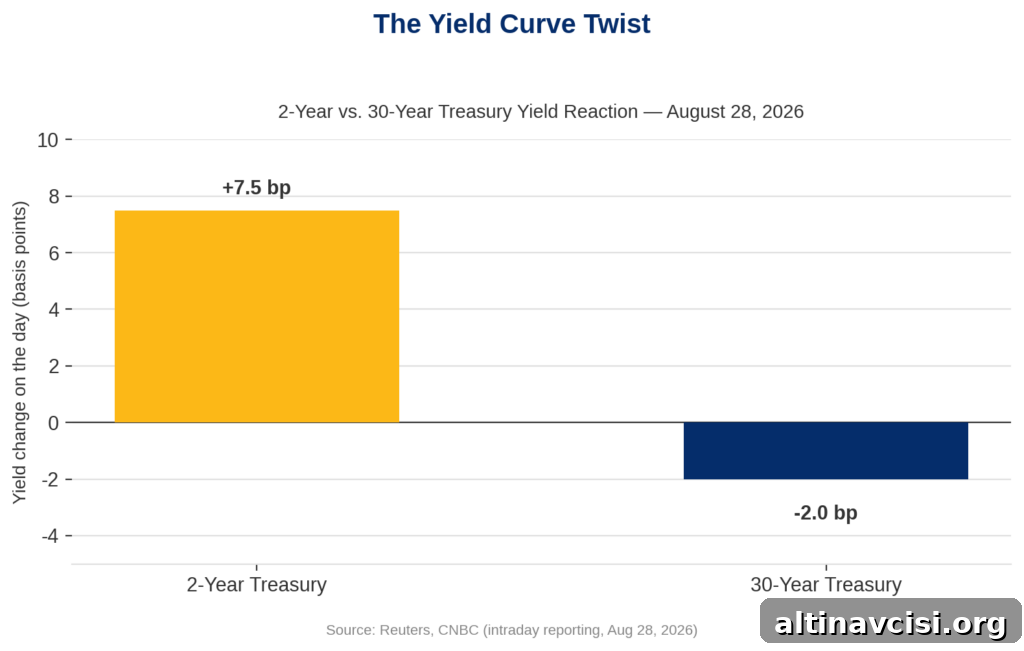
The bond market reaction was more nuanced than a simple uniform rise in yields. The 2-year Treasury yield climbed to a one-month high, rising roughly 7–8 basis points to about 4.30% as traders priced in a higher chance of additional tightening. At the same time, the 30-year yield ticked down a couple of basis points. That pattern is a curve twist rather than a synchronized move higher across maturities.
Part of that divergence reflects separate policy forces at work: the Treasury’s recent efforts to manage long-term borrowing costs through targeted buybacks of older, long-dated securities can press the long end lower even as Fed-related short-term yields move up. In practice, a hawkish Fed stance and a Treasury program that suppresses long-term yields can coexist, producing the kind of mixed yield-curve signals observed after Warsh’s remarks.
What Does This Mean for Gold and Silver Investors?
None of this undermines the long-term case for owning gold and silver as stores of value and hedges against policy-induced volatility. However, it does explain the short-term price reaction: the dollar index rose about 0.4%, which raises the opportunity cost of holding non-yielding assets like gold in the near term. When markets reprice toward higher expected rates, safe-haven metals often sell off.
There is a deeper, structural point: when one arm of government signals a tougher stance on inflation while another actively intervenes to suppress certain interest rates, policy objectives can pull in different directions. That tension creates an environment where purchasing power absorbs the conflicts between tools, and day-to-day price swings in assets like gold and silver reflect those frictions rather than long-term viability.
What Should Investors Watch Next?
Investors should monitor several near-term signals. The Fed’s next decision is scheduled for September 15–16, and while Warsh emphasized that his remarks “don’t necessarily signal” an imminent hike, markets will watch incoming data closely. Track market-implied rate odds and whether the Treasury further expands buybacks if long-end yields rise. Most importantly, watch the next PCE inflation release—the Fed’s preferred gauge—which will test whether Warsh’s “we have work to do” assessment is borne out by the data or needs revision.
Stay On Top of Gold & Silver Prices
Get important market alerts sent straight to your inbox.
SOURCES
1. Federal Reserve Board — official transcript of Chairman Warsh’s keynote remarks.
2. Associated Press — reporting on Warsh’s quotes about inflation and “work to do.”
3. CNBC — coverage of the speech, Treasury moves, and shifts in rate-hike odds.
4. Reuters — reporting on Treasury yield curve moves and dollar index reaction.
5. Additional market commentary and live coverage from major financial outlets.
Disclaimer: This article is for informational purposes only and does not constitute investment advice. Past performance is not indicative of future results. Always consult a qualified financial advisor before making investment decisions.
You May Also Like:
- Five Things That Moved Gold and Silver This Week — Only One Was Kevin Warsh.
- The Treasury’s Next Move Isn’t a Rate Cut. It’s a Large Treasury Account and Buybacks.
- What First Notice Day Reveals About Paper Claims Versus Physical Silver.
- Five Signals for Gold That Matter Beyond Today’s Price Action.
- Historical Patterns from Previous Warsh Speeches and Market Reactions.