China’s AI Stocks Just Lost Nearly 40%. Does Gold Rise With the Panic, or Fall With It?

Gold: $4,056.80/oz (+0.99% today). Silver: $54.28/oz (+0.57%). Gold-silver ratio: 74.75. Prices as of 2:00 p.m. ET, October 27, 2026.
Key Takeaways
- China’s STAR50 index has fallen nearly 40% in six months. Reports today put the value lost at roughly $480 billion, a figure still single-sourced and worth treating as directional.
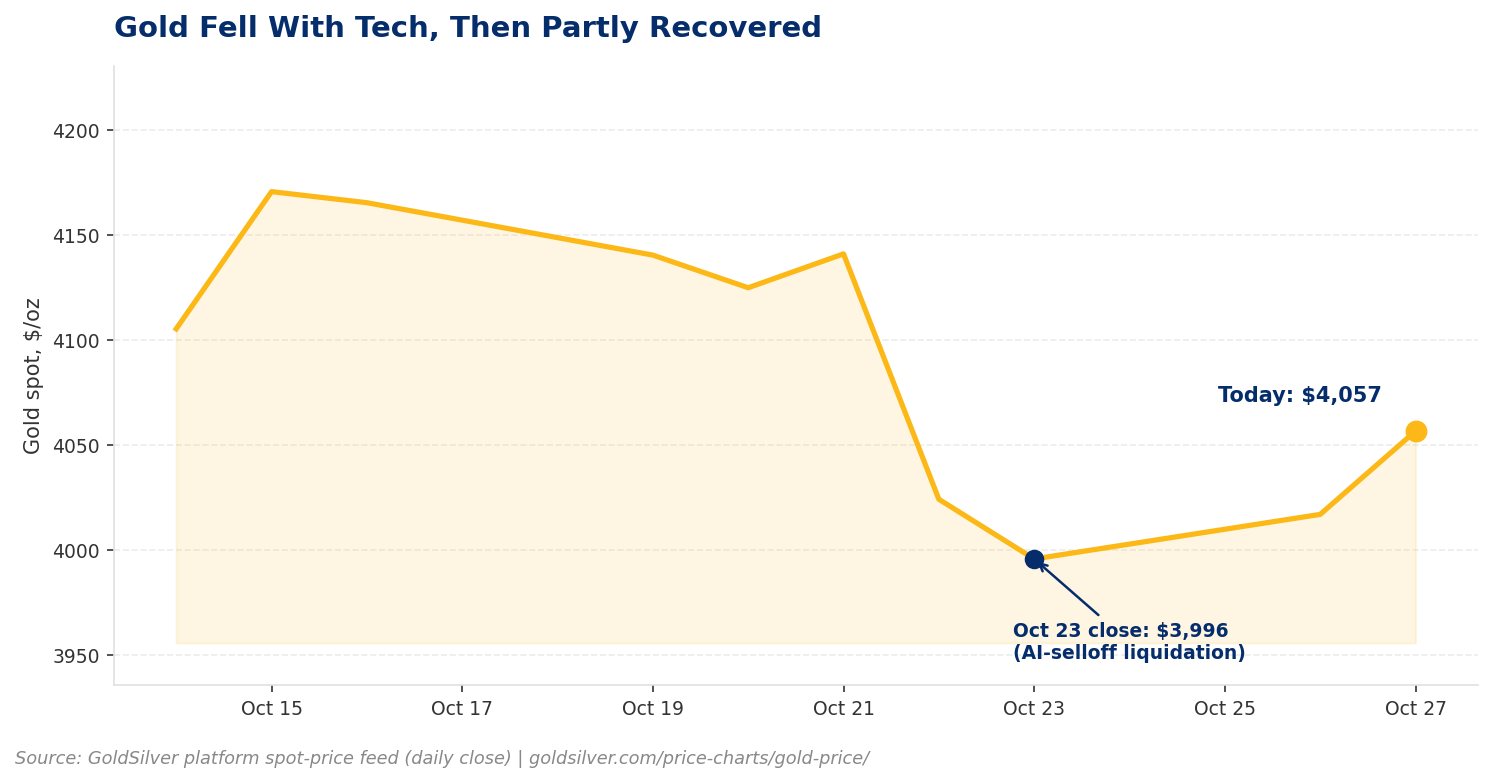
- Gold did not hedge last week’s U.S. version of this story. It fell almost 3% on October 22, the day Meta dropped 7% and the Nasdaq had its steepest one-day decline since June.
- The reason, per Reuters and Bloomberg sources, was liquidity. Investors sold gold to cover margin calls elsewhere. They did not sell because they’d lost confidence in it.
What Happened to China’s AI Stocks This Week?
China’s STAR50 index is the closest thing Shanghai has to a Nasdaq. It has dropped close to 40% over the past six months, following a rally of as much as 75% between April and June. Reports today put the total value lost at around $480 billion. That figure traces to a single wire-sourced estimate so far. A better-corroborated number: net outflows through the Hong Kong trading link hit an estimated 90 billion yuan, or about $13.5 billion, in the third quarter, the largest in a year. Even after the drop, the STAR50 still trades at more than 40 times forward earnings. The Nasdaq 100, by comparison, trades at roughly 30 times.

The Edge Every Investor Needs Smarter precious metals investing starts here. The Nuggets Newsletter brings you essential market insights, Fed updates, global trends, educational videos, and much more.
Did Gold Rise When US Tech Stocks Fell Last Week?
No. On October 22, Meta dropped about 7%, its worst day since July. The Nasdaq Composite fell 2.60%, to 26,008.86, its steepest one-day decline since June. Gold fell alongside it, losing almost 3% that same day. By the next morning, bullion had touched an intraday low of $3,986.85, its first break below $4,000 since July. The selloff did not stay contained to stocks and metals, either. Japanese 10-year bond yields fell as much as 10 basis points. Global corporate bond spreads widened to their most since May 2025, by Bloomberg’s count. Silver did not bottom on these two days. It was still near $55 on October 22. It only slid to its actual 11-month low, near $53, several sessions later, on October 26 and 27.
Why Would Investors Sell Gold During a Stock Selloff?
Justin Lin, an analyst at Global X ETFs, called it a “liquidity-driven selloff.” His point: in a sharp downturn, investors sell whatever they can sell fastest to cover losses elsewhere. Gold is deep, liquid, and easy to exit. Nicky Shiels, head of metals strategy at MKS PAMP SA, made the same point to Bloomberg. Margin calls forced some investors to exit commodity positions, including metals, specifically to raise liquidity. Morgan Stanley’s Amy Gower had called $4,000 a floor for gold just three weeks earlier. She built that case on central bank buying, falling bond yields, and cheaper oil. The floor broke anyway, because none of those three factors drove the actual selling. A fast equity deleveraging event did.
Is Gold’s Safe-Haven Case Broken?
Not on this evidence. Central banks kept buying straight through the drop. Goldman Sachs estimates roughly 79 tonnes of official-sector purchases in August alone. Silver’s futures positioning was also already unusually light going in. The most recent CFTC report put speculative net-long silver positions at the 7th percentile of their past 60 weeks of readings, among the most washed-out levels this measure has shown all year. That limits how much further a wave of forced selling can mechanically push price down.
A reader holding gold for the multi-year case is looking at a different question than a trader asking whether Tuesday’s close holds. That case rests on central bank reserve diversification and the slow erosion of what a dollar buys. A days-long liquidity squeeze and a multi-year allocation decision are not the same test.
The Federal Reserve’s two-day meeting ends Wednesday with a rate decision at 2:00 p.m. ET, and this week’s durable-goods data was already overshadowed by it. Thursday brings the September PCE inflation report. The sharper question to track is narrower: does this round of AI-related deleveraging stay contained to the stocks most exposed to it, or does it keep forcing sales in unrelated, liquid assets, the way it did on October 22 and 23? That is a flow-of-funds question, not a verdict on gold as a long-term store of value. Silver’s own positioning backdrop is covered in more depth in this month’s Silver Price Outlook.
Stay On Top of Gold & Silver Prices
Get important market alerts sent straight to your inbox.
SOURCES
1. Bloomberg — Gold Retreats as AI Selloff Spurs Margin-Call Selling
2. NewsBytes — Gold Prices Fall Below $4,000 for First Time Since July
3. FourWeekMBA — After Meta’s 7% Drop, AI Selloff Moves Bonds, Credit, Gold
4. Daily Sabah — China’s Stock Plunge Signals AI Bubble May Be Bursting
5. CoinoTag — Gold Breaks Below $4,000 First Time Since July
6. Altinavcisi — Silver Price Outlook October 2026
7. Altinavcisi — Live Gold and Silver Price Charts
Disclaimer: This article is for informational purposes only and does not constitute investment advice. Past performance is not indicative of future results. Always consult a qualified financial advisor before making investment decisions.