Gold Rebounds Above $4,130: What Changed for Owners?

Key Takeaways:
- Gold rebounded on October 15 after a 1.3% decline in the previous session.
- September inflation reached 3.7% annually, while shifting bond yields and dollar moves influenced bullion prices.
- The rebound changes today’s purchase price. However, it does not automatically change a long-term physical ownership plan.
Gold rebounded above $4,130 on October 15, after an inflation-driven selloff the previous day. Altinavcisi’s recorded spot price reached $4,131.41 at 12:30 UTC. Silver stood at $56.38 at the same time. These were intraday observations, not closing prices (Altinavcisi Price Charts, October 15, 2026).
The prior session was particularly volatile. Gold closed October 14 at $4,105.48, down 1.3%. Earlier that day, two consecutive readings fell $60.04 in 15 minutes. By 12:45 UTC on October 15, gold had recovered to $4,145.99. That was about 0.99% above the October 14 close (Altinavcisi Price Charts, October 14–15, 2026).
So, what changed? Market expectations shifted as investors reassessed inflation, Treasury yields, and the dollar. However, a two-day price reversal does not impact the longer-term case for owning physical gold.
Why Did Gold Rebound After the Inflation Selloff?
The immediate backdrop was September’s U.S. inflation report. Consumer prices rose 0.6% in September and 3.7% over 12 months. Meanwhile, core inflation, excluding food and energy, increased 2.6% annually (U.S. Bureau of Labor Statistics, October 14, 2026).
Higher inflation can complicate Federal Reserve decisions. Investors may expect interest rates to stay elevated, or even rise. That can pressure gold because bullion pays no interest.
However, market conditions changed as the session unfolded. Bond yields eased, and the dollar weakened amid broader financial-market uncertainty. A Reuters report described gold gaining as the dollar and yields softened (Reuters, October 15, 2026). The report link remains pending direct verification.
The mechanism matters. Lower yields can reduce the opportunity cost of holding gold. Similarly, a weaker dollar can make dollar-priced bullion more affordable to international buyers. Neither relationship guarantees a price increase.
The reversal therefore illustrates how quickly markets can reprice expectations. For more context, Altinavcisi explains what the Gold Volatility Index (GVZ) reveals about market expectations. However, the rebound does not prove that inflation risks have disappeared or that gold will keep rising.
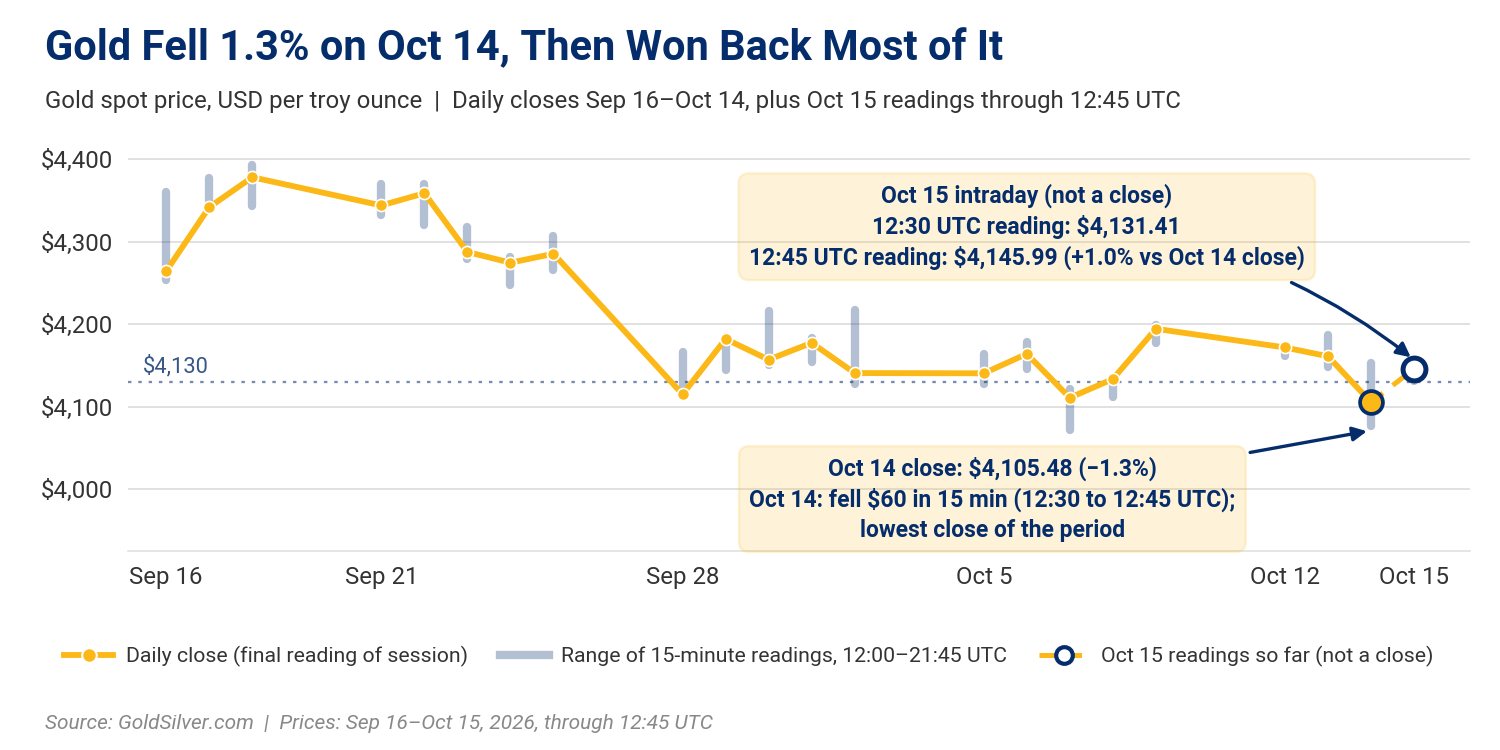
Gold closed October 14 at $4,105.48, the lowest close across the 21 completed sessions shown. By 12:45 UTC on October 15, it had recovered to $4,145.99. October 15 readings are intraday, not closes. Source: Altinavcisi Price Charts.
What Does the Reversal Mean for Physical Gold Owners?
For traders, a move of nearly 1% can be significant. For long-term owners, the relevant questions are different.
Physical gold is a scarce asset that does not depend on an issuer’s promise to pay. Some investors therefore use it to diversify financial exposure. Others consider its potential role in preserving purchasing power over longer periods.
Still, gold is not a guaranteed inflation hedge. Prices can fall sharply, even when consumer inflation remains high. In fact, the October 14 selloff shows why inflation headlines do not translate directly into higher gold prices.
Consequently, owners should distinguish market noise from changes in their financial plans. A shift in liquidity needs or portfolio concentration may justify action. A single rebound may not.

The Edge Every Investor Needs Smarter precious metals investing starts here. The Nuggets Newsletter brings you essential market insights, Fed updates, global trends, educational videos, and much more.
Does the Rebound Change the Decision to Buy Gold?
The rebound affects the price of a new purchase. However, it does not determine whether gold suits an investor’s circumstances.
Physical bullion often carries a premium above spot. Selling can also involve a dealer spread. Therefore, investors should consider total transaction costs, not only the quoted gold price.
Storage also matters. Owners should review security, insurance, access, and the legal terms of custody. For example, allocated storage identifies specific metal for a customer. Altinavcisi explains how to check whether your gold storage is allocated. Other arrangements may create a claim against a provider instead.
Before selecting a vault, investors can also review the questions to ask a gold storage provider. These decisions support a long-term strategy more directly than trying to predict tomorrow’s price.
What Should Gold Owners Watch Next?
Inflation releases, Federal Reserve communication, Treasury yields, and dollar movements remain useful signals. In particular, real yields measure interest rates after accounting for inflation. They help explain gold’s opportunity cost.
Nevertheless, investors need not trade whenever those indicators move. Periodic reviews of allocation, liquidity, purchase costs, and storage may be more productive.
Gold’s October 15 rebound recovered much of the previous day’s decline. Yet the broader questions about inflation and purchasing power remain open. The price changed quickly. A sound ownership plan does not have to.
Stay On Top of Gold & Silver Prices
Get important market alerts sent straight to your inbox.
SOURCES
1. U.S. Bureau of Labor Statistics – Consumer Price Index, September 2026 – October 14, 2026
2. Altinavcisi – Gold Spot Price Charts and Historical Price Data – October 14–15, 2026
Disclaimer: This article is for informational purposes only and does not constitute investment advice. Past performance is not indicative of future results. Always consult a qualified financial advisor before making investment decisions.