
Last verified: September 2026
On Wednesday, the Federal Reserve raised its benchmark interest rate for the first time since 2023. On Thursday, the Bank of England opted to hold rates steady. By the time both announcements hit the market, the Fed’s new floor matched the BoE’s rate exactly.
Gold trades near $4,363 an ounce today, up about 2.3% on the session. Silver is near $65.63, up roughly 4.2%. Both metals are extending this week’s rebound as two major central banks respond differently to the same global shock.
Key takeaways:
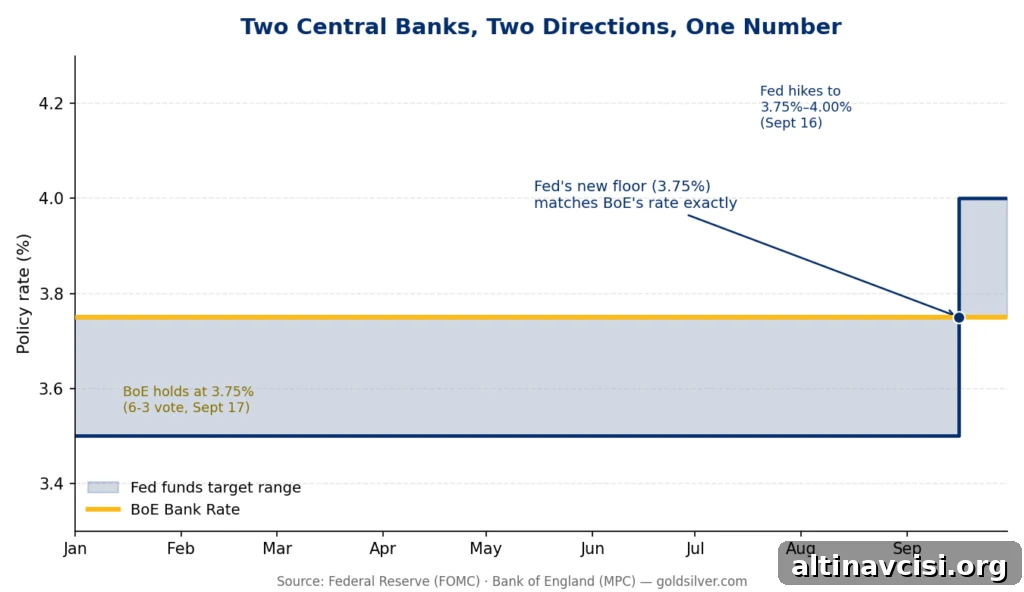
- The Fed hiked 25 basis points to a 3.75%–4.00% target range on Sept. 16 in a unanimous 12-0 vote — its first increase since 2023. The Bank of England held Bank Rate at 3.75% on Sept. 17 in a 6-3 vote, marking its sixth straight meeting without a change. The Fed’s new lower bound now equals the BoE’s rate.
- Both central banks attribute recent inflation pressures to an energy shock driven by conflict in the Middle East — a factor that monetary policy cannot directly reverse.
- Gold prices respond to real yields (nominal yields minus inflation expectations). Historically, a 25-basis-point swing in real yields moves gold roughly $40–$60 per ounce.
Two Decisions, One Day Apart
The Federal Open Market Committee voted 12-0 to lift its target range a quarter point to 3.75%–4.00%. The Fed described inflation as “too high,” noting price gains above 3% in multiple categories and raised its median year-end projection to 4.1% from 3.8% in June — the clearest signal yet that officials expect at least one more hike this year.
A day later, the Bank of England’s Monetary Policy Committee voted 6-3 to keep Bank Rate at 3.75%. That decision came despite UK inflation rising to 3.1% in August. Three members — Megan Greene, Catherine Mann, and Huw Pill — dissented, preferring an immediate 25-basis-point increase to 4.00%.
Why are both central banks blaming the same thing?
Both banks point to the same external factor: an energy-price shock stemming from conflict in the Middle East. This spike in energy costs lifts inflation on both sides of the Atlantic in ways that monetary policy can’t directly reverse. The Fed moved because US underlying inflation was already elevated before the shock. The BoE chose to hold, betting that a softer labor market would help bring inflation down without an immediate hike.
The BoE also acknowledged that its own quantitative tightening — the runoff of a large gilt portfolio — has added to market-rate pressure. At this meeting, the Bank slowed the planned pace of gilt sales to roughly £46 billion a year from £70 billion and paused active sales for six months. That step eases one channel of tightening going forward even as headline Bank Rate remains unchanged.
For gold and silver, the relevant measure is the real yield: nominal interest rates minus expected inflation. While a nominal hike typically pushes yields up and creates a headwind for gold, simultaneous rises in inflation expectations can leave real yields little changed or even lower. That dynamic helped metals avoid a selloff on the Fed’s hike day.
What does this mean for savers?
Savers face what looks like financial repression: policy rates held below levels suggested by an energy-driven inflation shock because higher rates would risk damaging growth. Cash returns in either currency are unlikely to keep pace with the inflation both central banks expect to persist. Precious metals, by contrast, are outside rate-setting mechanisms — their supply isn’t set by a committee vote — so they respond differently to real-yield shifts and inflation expectations.
What’s the real story here?
The notable fact is not the procedural difference — a hike versus a hold — but that both central banks agree on the cause of inflation while disagreeing on the policy tool. Each acknowledged that the main inflation driver is outside their direct control. One bank tightened to build room to act if necessary; the other held to avoid inflicting a larger hit on growth. Neither suggested its decision would directly fix the energy-driven spike.
Looking ahead, two dates matter: the Fed’s projections imply another quarter-point move is possible before year-end, likely in December. The BoE’s next decision on Nov. 5, paired with a new Monetary Policy Report, will test whether UK inflation above 3% prompts a shift among policymakers toward tightening. Traders and savers should monitor how markets price gold and silver as those dates approach.
Stay On Top of Gold & Silver Prices
Get important market alerts sent straight to your inbox.
People Also Asked
Why did the Fed raise rates while the Bank of England held?
Both central banks reacted to an energy-price spike tied to the Middle East. The Fed judged US underlying inflation was already elevated and raised rates to 3.75%–4.00% on Sept. 16. The BoE opted to wait on Sept. 17, betting that a looser labor market would cool inflation without an immediate hike.
What is the Fed’s interest rate after the September 2026 decision?
After the Sept. 16 decision, the federal funds target range is 3.75%–4.00%. The Fed’s own projections suggest officials expect the rate to reach about 4.1% by year-end, implying another quarter-point move is possible.
What is the Bank of England’s rate after the September 2026 decision?
The BoE held Bank Rate at 3.75% on Sept. 17. The committee also slowed planned gilt sales to about £46 billion a year and paused active sales for six months. Three members voted for an immediate rise to 4.00%.
Why are gold and silver prices rising this week?
Metals have rebounded after earlier weakness and gained further on the Fed’s hike and the BoE’s hold. The fact that gold and silver held up through a Fed hike suggests markets are pricing rising inflation expectations alongside higher nominal rates, leaving real yields little changed and reducing the opportunity cost of holding precious metals.
What is a “real yield,” and why does it matter for gold?
Real yield equals a bond’s nominal rate minus expected inflation. Gold yields nothing, so when real yields fall, gold becomes comparatively more attractive. Historically, a 25-basis-point move in real yields has shifted gold by roughly $40–$60 per ounce.
What should investors watch next?
Watch the Fed’s meetings and projections for signs of an additional hike, likely by December, and the BoE’s Nov. 5 decision and Monetary Policy Report to see if persistent UK inflation prompts a policy shift. Monitor gold and silver pricing for how markets trade the balance between nominal yields and inflation expectations.
SOURCES
1. Federal Reserve – Federal Reserve Issues FOMC Statement (Sept. 16, 2026)
2. Bank of England – Monetary Policy Summary and Minutes, September 2026 (Sept. 17, 2026)
3. Bank of England – Asset Purchase Facility: Gilt Sales, Market Notice (Sept. 17, 2026)
4. CNBC – Fed Rate Decision September 2026 (Sept. 16, 2026)
5. CNBC – Bank of England Defies Fed’s Rate-Hike Lead (Sept. 17, 2026)
6. Euronews – Bank of England Holds Rates at 3.75% (Sept. 17, 2026)
7. Bloomberg – BOE Scraps Long-End Gilt Sales (Sept. 17, 2026)
Disclaimer: This article is for informational purposes only and does not constitute investment advice. Past performance is not indicative of future results. Always consult a qualified financial advisor before making investment decisions.
You May Also Like:
- Jobless Claims Just Beat Estimates. Gold Rallied Anyway. Here Are 4 More Signals Behind It.
- Gold and Silver Rip Higher as the Fed-Hike Selloff Reverses
- The Fed Just Hiked. 16 of 18 Officials Say It’s Not Done.
- $603 Million Left the World’s Biggest Gold ETF. It Didn’t Leave Gold.
- Texas Just Made Gold Legal Money. Four More Non-Fed Stories Followed.
- Silver Is Outperforming Gold by a Third This Morning. The Fed Hasn’t Even Voted Yet.