
Gold and silver market update — April 30, 2026
Key Takeaways
- The BEA removed investment silver from GDP trade data for the third consecutive quarter, indicating physical silver flows have reached a scale that affects official statistics.
- COMEX registered silver has remained below the 15% coverage-ratio stress threshold for six months. First Notice Day passed quietly; the critical metric to watch now is the registered inventory pool.
- The paper price ($73.68 on April 30) and activity in the physical market diverge. The BEA footnote, COMEX inventory trends, and a 762 million ounce stockpile drawdown independently point to the same structural shift.
The Bureau of Economic Analysis (BEA) released its Q1 2026 GDP advance estimate this morning. The headline—2.0% annualized growth, below the 2.2% consensus—weakened the dollar and pushed gold above $4,600 while silver rose 3.32% to $73.68.
Beyond the headline, the BEA again removed investment silver bar exports from the national accounts. That adjustment is made when silver flows are judged to be investment-related rather than industrial trade. This recurring change is a notable signal: physical silver is moving in volumes large enough to distort trade statistics, which the BEA now treats as capital flows rather than output.
Why Does the BEA Remove Silver From GDP Data?
GDP measures final economic output and excludes purchases of investment assets. Buying a gold or silver bar reallocates wealth rather than producing it, so such flows are often stripped out of GDP. When large volumes of physical silver cross borders, Census trade figures show sharp export or import swings. The BEA must determine whether those flows reflect industrial use or investment activity.
The BEA has taken this step across consecutive reports:
- Q1 2025 (imports): Unusual volumes of silver entering U.S. vaults were noted.
- Q4 2025 (exports): Silver bar exports were flagged as investment flows and removed.
- Q1 2026 (exports): The same determination was made in the latest advance estimate.
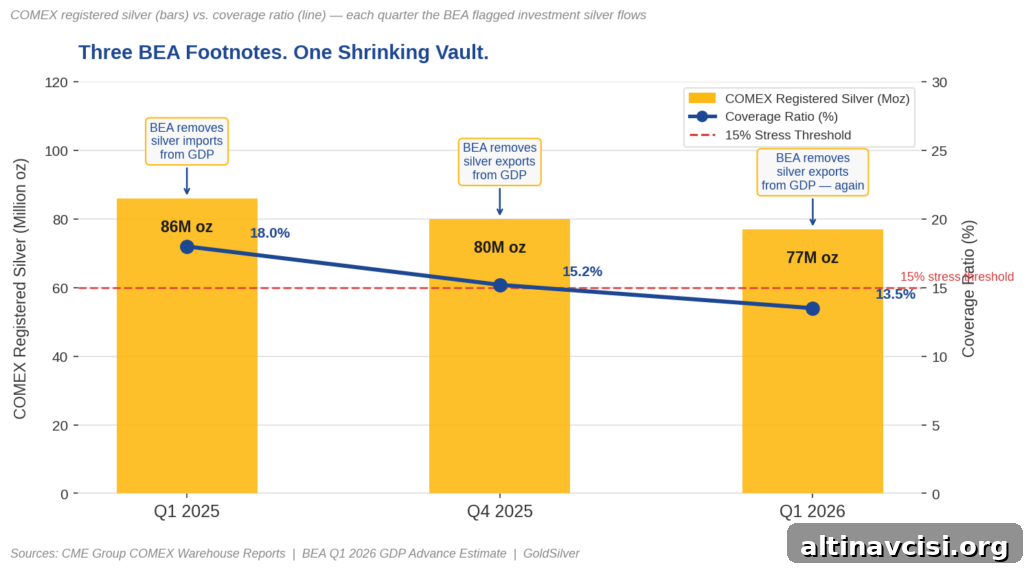
Repeated removal of investment silver from GDP is not a routine tweak; it points to a structural change in how silver is being used and held globally.
What Is the COMEX Coverage Ratio — and Why Does It Matter Today?
The BEA release coincided with First Notice Day for COMEX May silver contracts, the earliest date a futures holder can be required to take delivery. At First Notice Day holders typically close positions, roll to a later month, or prepare to take delivery.
The COMEX coverage ratio compares registered, deliverable silver in approved warehouses with outstanding paper contracts. A ratio below 15% is considered stressed. As of April 27, about 134.8 million ounces of May contracts were open while 75–77 million ounces were registered and deliverable, producing a coverage ratio around 13–14% (CME Group). This ratio has stayed below the stress threshold for six consecutive months.
Most May contracts rolled to July as expected, so First Notice Day itself passed without drama. The important thing now is whether registered inventory holds steady or falls further. A sustained decline in registered metal would confirm the underlying pressure implied by recent data.
Has Silver Crossed the Line From Industrial Metal to Monetary Metal?
Gold has long been treated as both an industrial input and a monetary asset, with nonmonetary gold routinely excluded from GDP trade totals. Historically, silver behaved mainly as an industrial metal, recorded like copper or aluminum in trade statistics.
That distinction appears to be changing. The BEA’s repeated footnote indicates silver is now moving in volumes consistent with investment demand, not just industrial consumption. In practice, this means silver is increasingly functioning as a monetary asset: its price and flows respond to trust in paper alternatives and to demand for physical metal as a store of value.
When government statisticians repeatedly remove investment silver from national accounts, they are implicitly acknowledging that a significant portion of market participants view silver as more than a commodity.
What Did the Financial Press Miss in Today’s GDP Report?
Most coverage focused on the 2.0% GDP print and its implications for monetary policy and recession risk. What received far less attention was the BEA’s silver footnote. The BEA states plainly: “BEA identified and removed an increase in exports of silver bars used as a form of investment in the first quarter.” That terse wording, when viewed alongside persistent COMEX inventory pressure and the World Silver Survey’s reported stockpile declines, paints a clearer picture: silver is increasingly behaving like money.
What Does This Mean for You?
No single indicator should dictate investment decisions. Still, these combined signals merit attention:
- Institutions, sovereigns, and funds have taken physical delivery of silver at an elevated pace for fifteen consecutive months (CME Group warehouse data).
- Above-ground silver stocks have fallen by roughly 762 million ounces over five deficit years, according to the World Silver Survey 2026 (Silver Institute / Metals Focus).
- The U.S. statistical agency has, three quarters running, flagged investment silver flows as large enough to remove from GDP trade figures.
How Are Major Institutions Responding?
The futures or “paper” price—$73.68 on April 30, 2026 (Trading Economics)—reflects contract values. The BEA footnote and related inventory trends suggest the physical market is signaling something the paper price doesn’t fully incorporate. Institutional moves support that view: central banks and major funds have been increasing purchases of physical precious metals, and large investment vehicles expanded capital-raise efforts to acquire silver.
These developments are not sensationalist; they are practical evidence observed in official data and market flows. Reading the footnotes and inventory trends offers insight into market dynamics that headlines alone can miss.
SOURCES
1. Bureau of Economic Analysis — GDP Advance Estimate, 1st Quarter 2026
2. U.S. BEA — GDP Advance Estimate, 4th Quarter and Year 2025
3. U.S. BEA — Gross Domestic Product Data Archive (Q1 2025)
4. CME Group — COMEX Silver Warehouse Stocks and Delivery Notices
5. Silver Institute / Metals Focus — World Silver Survey 2026
6. Sprott Asset Management — Sprott Physical Silver Trust updates and capital activity
7. Trading Economics — Silver Spot Price, April 30, 2026
Disclaimer: This article is for informational purposes only and does not constitute financial or investment advice. Consult a qualified financial adviser before making investment decisions.
You May Also Like:
- PCE at 3.5%, GDP Miss: Why This Is Bullish for Gold
- How Warsh’s Inflation Measure Could Move the Gold Price
- Gold Is Down 19%. This $3.8B Bet Says It Doesn’t Matter
- Gold, Oil, and the Fed: Why the Old Rules Don’t Apply
- Why Turkey Sold Its Gold Reserves — And What It Proves About Sound Money
- Why Gold Spikes Every Time Hormuz Opens — And Why It Never Holds
- Oil Hits $100 and OPEC Is Fracturing. Gold Knows Why
- How China Restricts Silver Supply Without Touching Silver
- Powell Press Conference: What It Means for Gold