Key Takeaways
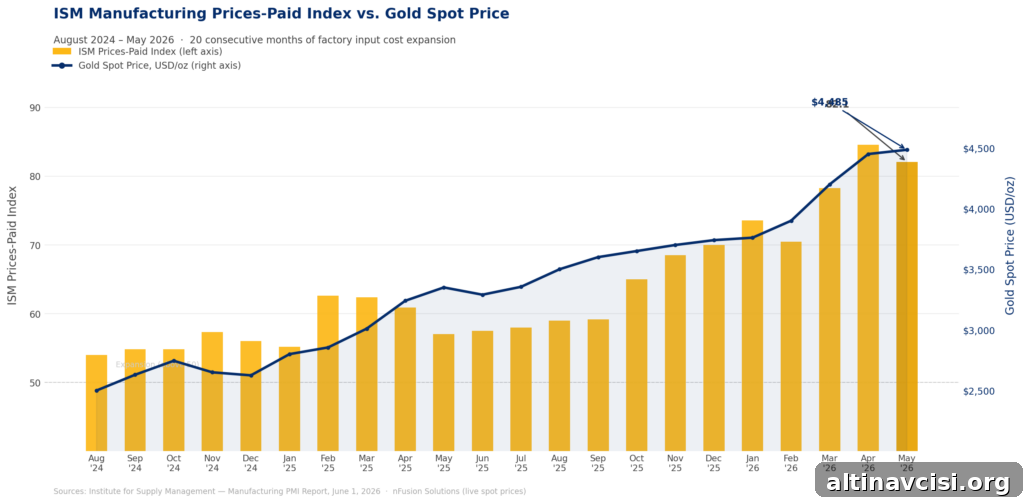
- The ISM Manufacturing Prices‑Paid Index printed 82.1 in May 2026 — the 20th consecutive month of rising factory input costs — confirming that inflation is entrenched, not fading, per the ISM’s June 1 report.
- The Federal Reserve enters its June 16–17 meeting constrained: it cannot cut into hot inflation, and it cannot raise rates aggressively without risking a fragile manufacturing recovery that has only recently re-accelerated.
- Gold held above $4,460 throughout the session despite a strong labor-market print, suggesting the structural case for physical metal depends less on a single catalyst and more on a Fed that remains cornered.
Last Monday’s ISM Manufacturing PMI made headlines at 54.0 — the strongest factory reading since May 2022 and the fifth month in a row of expansion. New orders and production both rose, signaling a genuinely healthy US manufacturing sector by the most-watched industry measure.
But the prices‑paid sub-index tells a different, more concerning story.
Notably, gold has held above $4,460 all session. That support has proven durable through some of the year’s most challenging labor and inflation readings.
What Is the ISM Prices‑Paid Index Actually Telling Us?
The ISM Manufacturing Prices‑Paid Index registered 82.1 in May 2026 — one of the highest readings since April 2022 — according to the ISM Manufacturing PMI report published June 1, 2026. Factories are expanding while paying sharply more for inputs. Three main factors are driving this: higher steel and aluminum costs, tariffs on imported inputs, and elevated petroleum prices related to disruptions around the Strait of Hormuz. In May, 42% of manufacturing respondents cited the Iran conflict as a direct influence.
Importantly, 82.1 is not an isolated spike; it is part of a trend: March 78.3 → April 84.6 → May 82.1. Raw‑material price pressures have now persisted for 20 consecutive months. Meanwhile, the ISM Services Prices‑Paid Index, which covers roughly 70% of the economy, held at 70.7 in April — tied for its highest reading since October 2022 — with all 18 service industries reporting higher input costs. The May Services figure is due June 3.
Both surveys point to the same conclusion: input inflation is not abating. It is entrenched.
The Edge Every Investor Needs
Smarter precious metals investing starts here. The Nuggets Newsletter brings essential market insights, Fed updates, global trends, educational videos, and more.
Why Does an 82.1 Prices‑Paid Reading Matter for Gold?
The Federal Reserve meets June 16–17 for its first session under Chair Kevin Warsh. Markets currently assign a very high probability of no rate change for that meeting, but they also price a significant chance of a rate hike later in the year. That creates a policy bind: the Fed cannot credibly cut into persistent input inflation, and it cannot tighten decisively without risking the nascent manufacturing recovery.
Gold sits outside that dilemma. It preserves purchasing power regardless of which policy path the Fed chooses. If policymakers pause, real yields remain depressed against a roughly 4.5% PCE baseline and the opportunity cost of holding metal stays low. If the Fed tightens and growth slows, stagflationary pressures would strengthen the structural demand for gold. Either scenario supports the metal’s case.
Why Is This the Environment Sound Money Was Built For?
This environment is not defined by war or financial collapse alone, but by a central bank with no clean choices. Your savings face erosion from elevated inflation near 4.5% annually while the institution tasked with defending purchasing power confronts conflicting pressures: high input inflation and a fragile recovery. Physical gold and silver sit outside that framework; they don’t require the Fed to act correctly, only to remain unable to resolve the tradeoffs.
What Does ISM Prices‑Paid at 82.1 Mean for Summer Inflation?
Most attention focused on the headline PMI of 54 — a clear growth signal. But the Prices‑Paid sub‑index is forward‑looking: higher manufacturing input costs typically translate into consumer prices with a three‑to‑six‑month lag. The May 82.1 reading will feed into CPI measures this summer, exactly when the Fed must decide whether inflation is truly under control or merely in a temporary lull.
ISM Services Chair Steve Miller warned in March 2026 that prices would remain elevated for several more months even under a swift resolution of the Iran conflict. With Services Prices‑Paid at 70.7 in April and Manufacturing Prices‑Paid printing 84.6 and 82.1 in the two most recent months, the data arriving on Warsh’s desk through June, July and August is already baked into factory costs today. That structural backdrop is a key reason gold has held above the $4,460 mark: not momentum, but a central bank boxed in by its own arithmetic.
Three Dates to Watch
- Tomorrow, June 3 — May ISM Services PMI (10am ET). Focus on the Prices‑Paid component. A rise from April’s 70.7 toward the low‑ to mid‑70s would indicate manufacturing cost pressures flowing into services. A surprise decline would be a meaningful relief signal.
- Friday, June 5 — May Nonfarm Payrolls. April’s JOLTS showed job openings surged to 7.6 million, well above expectations. A strong NFP print would make it harder for the Fed to argue for easing. Gold’s $4,460 floor is the level to watch.
- June 16–17 — Warsh’s First FOMC Meeting. The decision itself may be largely priced in; the real focus will be the statement and the dot plot — the Fed’s projections for the path of rates. Those communications will signal how Chair Warsh intends to lead policy.
Stay On Top of Gold & Silver Prices
Get important market alerts sent straight to your inbox.
Disclaimer: This article is for informational purposes only and does not constitute financial or investment advice. Always consult a qualified financial adviser before making investment decisions.
You May Also Like:
- Gold at $4,500: What Fort Knox, China, and Silver Are Telling You
- Silver Has Two Engines. Stagflation Is the One Condition That Fires Both at Once.
- The Buyer List for Gold Just Got Longer. These Countries Have Never Bought Before.
- PCE Hit 3.8%. GDP: 1.6%. Gold Went Up. Here’s the Mechanism.
- Gold Targets Are Falling. The $8,000 Forecast Isn’t.
- Gold Radar: 5 Stories the Price Chart Isn’t Telling You
- Silver Lost 3.3% While Gold Lost 1.6%. That Gap Is Not Random.
- Gold Down 1.2%, Silver Down 2.8% — The Floor Holds
- UBS Just Cut Its Gold Target by $400. The Part They Kept Is the Real Story.