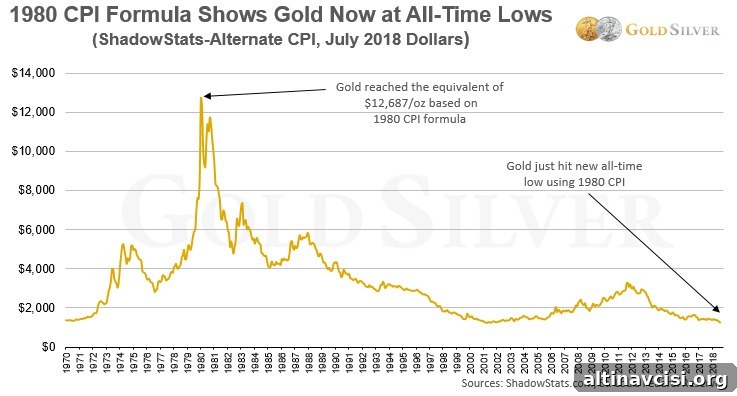
I’ve been tracking this indicator all year, and after the recent pullback in gold and silver I checked it again.
As I expected, when prices are adjusted for inflation using a more consistent measure than the modern CPI, gold and silver are now cheaper than they were when private ownership became legal in the United States.
This inflation adjustment does not rely on the government’s Consumer Price Index, which has had its methodology changed many times since 1980. As John Williams of ShadowStats has pointed out, those changes have consistently produced lower official inflation readings.
How much trust can you place in an inflation series that has been revised repeatedly—on average every few years—and in every case altered to report lower inflation? At best it raises questions; at worst it suggests statistical bias and manipulation. Because of that, using the current CPI to adjust precious metals prices can obscure their true purchasing-power value.
John uses the inflation methodology that existed in 1980, before those subsequent adjustments. Applying that older formula produces very different results: for example, the official CPI reading in July showed 2.9% inflation, while the ShadowStats alternate CPI indicated 10.75%. Which better reflects real-world experience? Many everyday costs—like gasoline, which has risen substantially since 2017—are not fully represented by core CPI measures that exclude food and energy. For many people, the higher alternate inflation reading aligns more closely with their experience.
Gold: Cheaper Than in 1970
I asked John to inflation-adjust the gold price using the 1980 formula. The result is striking.
That recent dip pushed the inflation-adjusted gold price to a modern low. In other words, on a constant-1980-dollars basis, gold is trading below its 1970 level—back when private ownership of gold was still illegal in the United States.
Using July 2018 data, the 1980 peak for gold corresponds to an equivalent of about $12,687 per ounce. That comparison highlights both how undervalued gold is today and how high it could rise if it replicated the inflation-adjusted ascent of the 1970s bull market. By that math, gold would need to climb roughly 960% from current levels to reach the 1980 peak in real terms.
Silver: Deeper Undervaluation and Big Upside Potential
John performed the same 1980-based inflation adjustment for silver, and the result is even more dramatic.
On a 1980-dollar basis, today’s silver price sits below any level seen in the past 50 years.
Priced in July 2018 dollars, silver’s 1980 high equals roughly $683.22 per ounce. That implies a large upside: silver would need to rise about 4,711% from current prices to match its 1970s peak on an inflation-adjusted basis.
I’m not predicting that silver will reach nearly $700 an ounce. What this shows is that silver appears significantly undervalued now and carries substantial upside potential if it were to approach the performance it delivered during the 1970s mania.
No matter your view on markets, economies, or currencies, adjusting gold and silver for inflation using the earlier methodology shows they represent notable value at current prices. If the future unfolds in a way some analysts expect, buying these metals today could prove highly consequential for investors.