Originally posted by mybudget360
Many people struggle to see how inflation slowly eats away at purchasing power. Over time, prices creep up and consumers begin to accept higher costs as normal. A $2 movie ticket decades ago can become an $8 ticket today. Packaged goods may shrink while the price stays the same. The cost of a college education has risen from something manageable to an expense often funded by large student loans. Inflation is commonly described as a monetary phenomenon: too much money—nowadays including abundant credit—chasing too few goods. In our economy, rising debt amplifies inflation. Evidence of this shows in housing, autos, and higher education, where borrowing has driven prices upward. The core problem is that incomes are not keeping pace with increasing expenses. Over long periods, inflation can be highly destructive. To illustrate this, it helps to compare typical costs from 1938 with those in 2015.
Comparing 1938 to 2015
A year or so ago we examined older cost-of-living data and found readers appreciated the long-term perspective. I updated that comparison to show where prices stood in 2015. The snapshot from 1938 offers a striking contrast to modern expenses. Many Americans today, focused on getting from paycheck to paycheck, have little sense of living costs before World War II.
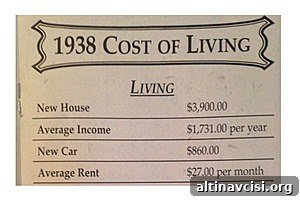
Here is a view of the 1938 cost of living:
Source: Reddit
The key point is income relative to living costs. In 1938 a new home cost roughly twice the average annual income. In 2015 the median household income was around $50,000 while a typical new home price was about $298,000—nearly six times annual income compared with two times in 1938. A new car in 1938 cost about $860, roughly half of an annual income; today a standard new car can cost around $32,000 and is often financed. Harvard tuition in 1938 ran about $420 per year; by 2015 total costs with room and board approached $62,000:
Source: Harvard website
Put another way, a typical family in 2015 would need nearly a full year’s income plus debt to send one child to Harvard, while an average family in 1938 could have afforded to send multiple children without straining the household budget. College tuition is among the most inflated expense categories.
Adjusting various costs for inflation
To provide perspective, I assembled a table and adjusted several historical prices for inflation.
I also updated several figures to reflect typical 2015 values:
New house: $298,000 (Source: Census)
Average income: $28,000 (Social Security)
New Car: $32,000 (Bankrate)
Average Rent: $950
Tuition to Harvard: See above
Movie ticket: $8
Gasoline: $1.99
US Postage Stamp: $0.49
Nearly every category has risen, with gasoline an exception due to the 2014 oil price collapse. But gasoline’s decline is small compared with the biggest household expenses: housing, food, medical care, transportation, and education. Housing alone takes the largest share of most household budgets. Consider how quickly prices climbed since 2000.
Medical care costs rose by more than 70 percent, and housing climbed over 40 percent even accounting for the housing market crash. Apparel and recreation held roughly steady, but median incomes did not keep up with rising costs.
If you feel poorer today than in the past, the data explains why: slow but steady inflation has reduced real purchasing power. While the Federal Reserve may downplay inflation, the rising cost of housing, healthcare, tuition, and groceries makes the effect clear for many working families.