China Ends Paper Gold Trading July 24: Why Physical Holders Win

In four days, the world’s largest bank will stop offering retail clients the ability to trade paper gold. The decision was quietly announced in Beijing last month and represents one of the most consequential structural changes in the global gold market this year — a move that has received surprisingly little attention in mainstream coverage.
Industrial and Commercial Bank of China (ICBC), the largest bank in the world by assets, announced on June 24, 2026 that it will terminate individual retail paper gold trading products linked to the Shanghai Gold Exchange (SGE) after the clearing session on July 24, 2026. Several other major banks followed suit with identical wind-down notices: Postal Savings Bank of China, Ping An Bank, and China Guangfa Bank. China Construction Bank announced a similar decision weeks earlier. Retail customers have three options before the deadline: close positions, liquidate holdings, or take physical delivery. After July 24, retail trading access for these products will be disabled in mobile banking, online banking and at branch counters.
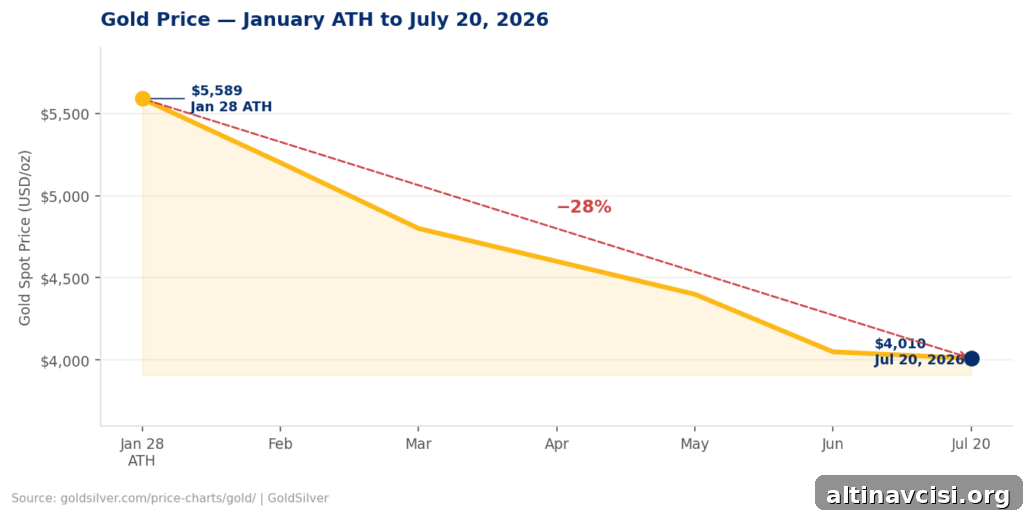
As of Monday, July 20, gold was trading around $4,010 per ounce — roughly 28% below its January 28 all-time high of $5,589.38. That coordinated suspension of retail paper-gold channels is a major structural explanation for the correction, a factor that much of the coverage has overlooked.
To be clear: the banks are ending leveraged, bank-intermediated retail trading tied to the SGE. They are not banning physical gold purchases, exchange-listed gold ETFs, or institutional SGE operations. For long-term physical holders, this is confirmation of an existing structural case for owning bullion rather than a threat to bullion demand.
Why Did China’s Banks Exit Paper Gold Trading?
Officially, regulators and banks have framed the move as investor protection. The gold price surged to near $5,589 in January 2026 and then dropped below $4,000 by June — a roughly 30% decline in five months. Such volatility places retail margin accounts under severe stress, turning leveraged positions into immediate financial emergencies. In response, some banks raised margin requirements dramatically — to 140% in some cases — which effectively eliminated practical leverage and preceded the decision to close the channel entirely.
A deeper reason lies in institutional memory. In April 2020, Bank of China’s “Crude Oil Treasure” retail product exposed customers to West Texas Intermediate (WTI) futures and collapsed when WTI briefly traded negative. Many retail accounts were wiped out; the bank absorbed significant losses, reported at roughly RMB 7 billion. That episode prompted high-level government intervention and public statements urging banks to tighten controls on complex retail products. China’s regulators learned that volatile commodity markets combined with retail leverage can shift the downside risk from individual investors to the banking system. The 2026 gold correction presented a second opportunity to apply that lesson — and this time regulators and banks acted preemptively rather than reactively.
What Does This China Paper Gold Trading Shutdown Actually Affect?
The suspension applies specifically to leveraged, bank-mediated retail products connected to the Shanghai Gold Exchange, including spot-style contracts such as Au99.99 and deferred-delivery margin contracts like Au (T+D). These products let ordinary retail investors place leveraged bets on gold prices through bank accounts.
Crucially, the change does not affect physical bullion purchases in China. Bars and coins remain freely available to retail buyers. It also does not impact exchange-traded gold funds, which are traded on stock exchanges without the same leveraged, bank-intermediated structure. Institutional SGE operations and physical delivery channels continue to function normally. China’s central bank gold purchasing appears unchanged as well; the People’s Bank of China maintained reported reserve additions through June 2026, according to public data.
Physical demand remains a powerful force: the World Gold Council reported that China’s bar and coin demand hit a record 207 tonnes in Q1 2026. That strong physical demand occurred even as other markets, such as India, experienced temporary headwinds over import duty concerns. In short, the retail paper channel has been narrowed, while the physical channel remains intact and active.
How Did Paper Speculation Affect Gold’s Price — and What Changes Without It?
Many reports miss a key point: leveraged retail trading does more than follow the gold price — it amplifies it. In January 2026, millions of retail accounts were likely net long gold via margin products. That collective leverage added upward momentum to a market already buoyed by central-bank buying and geopolitical concerns. When the price reversed, those same leveraged positions became forced sellers, magnifying the down move.
Removing that amplifier changes market dynamics. Without the large cohort of leveraged retail positions, gold pricing becomes more influenced by genuine owners: households buying bars and accumulation-plan units, institutional buyers moving physical bullion, and sovereign reserve managers. These buyers are less likely to liquidate in response to short-term margin calls or weekly economic data, which reduces mechanical downside pressure and tends to compress volatility. Over time, a market priced more by physical ownership than by speculative, leveraged paper positions should show a stronger structural bid and steadier price behaviour.
This mechanism mirrors global dynamics observed in Q2 2026, when paper-market sellers coincided with sovereign and central-bank buyers who continued to add to reserves even as prices fell. Central-bank purchases were sizeable in early 2026, reinforcing the idea that durable, nonleveraged demand can stabilize price levels that speculative paper flows had previously overstretched.
What Does This Mean for Investors Who Already Own Physical Gold?
For long-term holders of physical gold and silver, the July 24 deadline should be reassuring rather than alarming. The instability and counterparty risk inherent in bank-intermediated paper products are the very reasons many investors prefer allocated physical bullion. A retail product tied to a bank carries counterparty, settlement and regulatory exposure; a properly stored bar under allocated custody avoids those specific banking-linked risks.
China’s action signals a structural shift: retail channels are being redirected away from leveraged speculation and toward outright ownership. That structural change should progressively remove the paper-driven amplification that contributed to January’s price spike and the subsequent correction. Over time, a market dominated by actual owners rather than leveraged traders tends to produce more durable pricing and a stronger physical foundation.
Short-term market moves will still be driven by macro catalysts. For example, the U.S. Federal Open Market Committee meeting scheduled for July 28–29, 2026 and the June PCE inflation release on July 30 are likely to cause near-term volatility. Those events matter for immediate price action; the structural change in China, however, matters more for the long-term profile of gold’s volatility and demand base.
SOURCES
1. Industrial and Commercial Bank of China (ICBC) — Suspension of individual SGE precious metals trading announced June 24, 2026 (industry reports)
2. South China Morning Post — Major Chinese banks suspend individual trading on Shanghai Gold Exchange amid volatility, June 25, 2026 (reporting)
3. NAI500 — Coverage of ICBC halting retail gold trading, June 25, 2026 (industry summary)
4. South China Morning Post — Bank of China’s losses from plunging oil in 2020 and related policy responses (May 2, 2020 reporting)
5. World Gold Council — Gold Demand Trends Q1 2026 report (data on bar and coin demand)
6. Live gold spot price snapshots and market data (price reference as of July 20, 2026)
7. CME Group — FedWatch tool for July 2026 FOMC rate probabilities (market pricing indicator)
Disclaimer: This article is for informational purposes only and does not constitute financial or investment advice. Always consult a qualified financial adviser before making investment decisions.
You May Also Like:
- Silver Is Up 1.5% Today. Oil Is Up 3%. Those Two Moves Shouldn’t Coexist. Here’s Why They Do.
- Hong Kong Just Ran Its First Gold Settlement. The Banks Who Did It Also Run London’s.
- Consumer Inflation Expectations Just Fell to 4.2%. Gold Fell Too. The Survey Missed the Oil Spike.
- Gold Fell 3.4% This Week. The Long-Term Case Didn’t.
- Manufacturing Just Had Its Best Month of 2026. Gold Just Had One of Its Worst Days.
- Warsh Told Wall Street to Stop Watching the Fed. Gold Already Knew.
Popular Topics
Picked from the archive
-
01
 Topics
Gold Price Cycles Explained: A Four-Time-Horizon Framework
-
02
Topics
Gold Repricing Underway: 5 Major Institutions Confirm
-
03
Topics
How Dalio, Buffett and Jim Rogers Invest in Gold
-
04
Topics
How Gold Prices Move During a US Dollar Crash
-
05
Topics
5 Factors That Drive Gold Spot Prices
-
06
Topics
August CPI: Sticky Inflation Unlikely to Stop Fed Rate Cuts
-
07
Topics
Institutions Are Buying as Bond Yields Rise: What It Means
-
08
Topics
Why a Stalled Federal Reserve Matters for Gold Prices