Junk Silver: Dimes and Quarters Worth Nearly 50x Face Value
Key Takeaways
- “Junk silver” refers to circulated U.S. dimes, quarters, and half dollars minted in 1964 or earlier that are 90% silver; the term describes condition, not metal value.
- The U.S. Mint’s standard: $1 in face value of 90% silver coins contains about 0.715 troy ounces of pure silver, regardless of whether those dollars are in dimes, quarters, or halves.
- The Coinage Act of 1965 removed silver from dimes and quarters and reduced half-dollar silver because silver’s market value exceeded the coins’ face value.
- Junk silver trades with lower premiums than newly minted bullion because it carries no numismatic premium and requires no complex assay.
- A standard $1,000 face-value bag weighs roughly 55 pounds, so storage and handling are important practical considerations.
“Junk silver” is the common name for circulated U.S. coins—dimes, quarters, and half dollars—minted before 1965 in a 90% silver, 10% copper alloy. The descriptor “junk” refers to condition and lack of collector value, not to poor metal quality. Because these coins trade close to their melt value, pricing is straightforward: about 0.715 troy ounces of pure silver per dollar of face value.
What Is Junk Silver?
Junk silver is a practical, liquid form of physical silver: ordinary circulated coins that contain real silver but no numismatic premium. Unlike rare or graded coins, which sell for collectible value in addition to metal content, junk silver is valued almost entirely for its silver weight. This simplicity keeps pricing transparent and easy to verify in everyday transactions.
Common examples include Mercury dimes (1916–1945), Roosevelt dimes (1946–1964), and Washington quarters (1932–1964), plus Walking Liberty, Franklin, and 1964 Kennedy half dollars. These coins were produced in vast quantities and remain widely available and easily recognizable today, making them convenient for buyers and sellers who want physical silver without collectible premiums.
The Knowledge That Changes Everything

Two essential guides — free. Learn why gold matters and the long-term risks to fiat currency.
Which Coins Actually Count as Junk Silver?
Date matters more than appearance. The coins that typically qualify are:
- 90% silver (standard junk silver): Dimes, quarters, and half dollars dated 1964 or earlier.
- 40% silver: Kennedy half dollars minted from 1965 through 1970, plus a small San Francisco-minted run of 1976 collector pieces. Most Bicentennial coins struck for circulation at Philadelphia and Denver are copper-nickel and contain no silver.
- 35% silver (“war nickels”): Jefferson nickels issued 1942–1945; these show a large mint mark above Monticello on the reverse.
Anything dated 1965 or later in the standard dime and quarter series is copper-nickel clad and contains no silver, even when the difference is not obvious at first glance. That single date—1965—separates coins with bullion value from those with only face value.
How Much Silver Is in a Junk Silver Coin?
Each 90% silver coin contains a fixed amount of pure silver:
- Dime: about 0.0723 troy ounces of pure silver.
- Quarter: about 0.1808 troy ounces of pure silver.
- Half dollar: about 0.3617 troy ounces of pure silver.
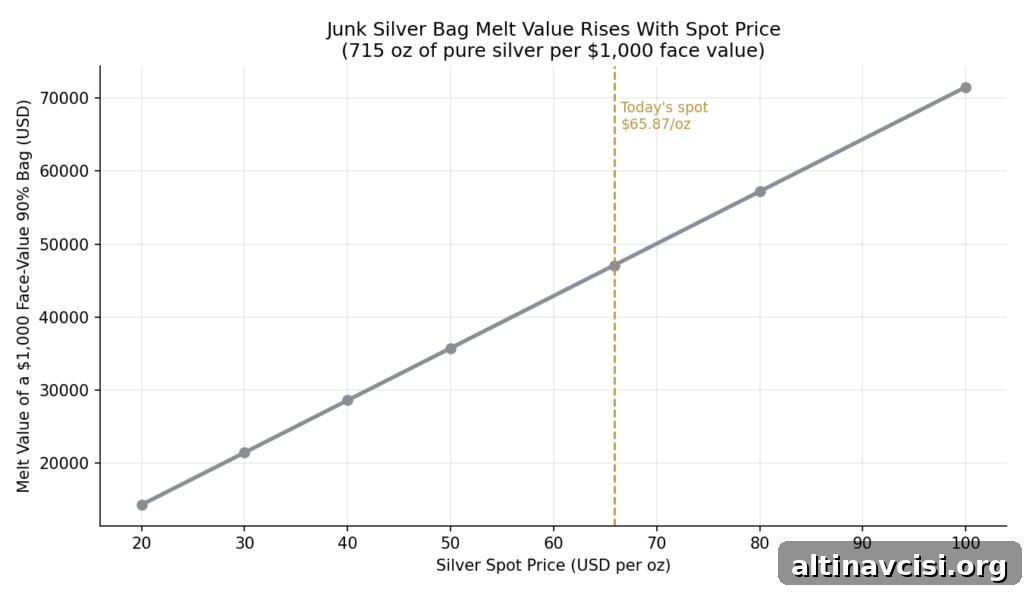
A single, useful constant ties these values together: $1 in face value of 90% silver coins contains approximately 0.715 troy ounces of pure silver. That makes valuation simple. A standard $1,000 face-value bag therefore contains roughly 715 troy ounces of silver, regardless of the mix of denominations.
Using that conversion, the melt value of a $1,000 bag rises and falls with the spot price of silver. For example, at $30 per ounce a bag would be worth about $21,450; at $50 it would be roughly $35,750. Because the math is linear and transparent, buyers and dealers can price junk silver quickly by multiplying ounces by the current spot price and applying a modest dealer premium.
Why Did the U.S. Government Remove Silver From Coins?
By the early 1960s, silver had become more valuable as a raw metal than as the face value stamped on coins. Industrial demand and rising prices made it profitable to melt coins for their metal content, which led to shortages in circulation. In response, Congress passed the Coinage Act of 1965, which removed silver from dimes and quarters and reduced the half dollar’s silver content. Subsequent legislation removed silver from the half dollar beginning in 1971. Since then, circulating U.S. coins have been produced in copper-nickel clad compositions with no intrinsic silver value.
How Is Junk Silver Priced and Traded?
Junk silver typically trades in standard face-value increments, most commonly $1,000 bags. Dealers also sell half-bags, quarter-bags, and smaller lots for buyers who want lower entry points. Because these coins carry no collectible premium and are simple to verify, they usually trade at lower markups over spot than newly minted rounds or bars.
The tradeoff is physical bulk and uniformity. A mixed bag of worn coins occupies more space and is less uniform than the same metal value in bars or one-ounce rounds. Buyers who prioritize portability and compact storage may prefer bars, while those valuing divisibility and easy recognition often choose junk silver.
Is Junk Silver a Good Way to Own Physical Silver?
Junk silver can be a good choice for part of a physical silver allocation. It is widely recognized, easily divisible into small denominations, and simple to authenticate without specialized testing. These features support liquidity: many dealers, refiners, and pawn shops accept pre-1965 coins without needing an assay.
On the downside, coins are heavier and bulkier ounce-for-ounce than bars because they are only 90% silver and contain copper. For an investor seeking the densest storage of silver per cubic foot, bars and rounds are usually more efficient. For everyday divisibility and broad recognition, junk silver remains practical.
What About Taxes and Reporting on Junk Silver Sales?
Selling junk silver for more than the purchase price typically produces a capital gain that should be reported on your tax return. Dealers may have reporting obligations in certain situations, and industry practice often treats a single sale of more than $1,000 face value of 90% coins as meeting common reporting thresholds. Tax rules change and can be transaction-specific, so anyone selling a meaningful quantity should consult a qualified tax professional to confirm current obligations.
Where and How Do You Store Junk Silver?
Storage is a key practical consideration. A standard $1,000 face-value bag weighs about 55 pounds, so a substantial holding can add up quickly in both weight and volume. Storage options include a heavy-duty home safe rated for coin weight, a bank safe-deposit box (subject to access limitations), or a professional vaulting service designed for bullion storage. Before accumulating a large position, plan where it will be kept, how it will be insured, and how you will verify authenticity if needed.
Stay On Top of Gold & Silver Prices
Get important market alerts sent straight to your inbox.
People Also Ask
No. The term “junk” refers only to the coins’ worn condition and absence of collector premium. The silver content is real and has the same purity characteristics as comparable silver bullion of the same fineness.
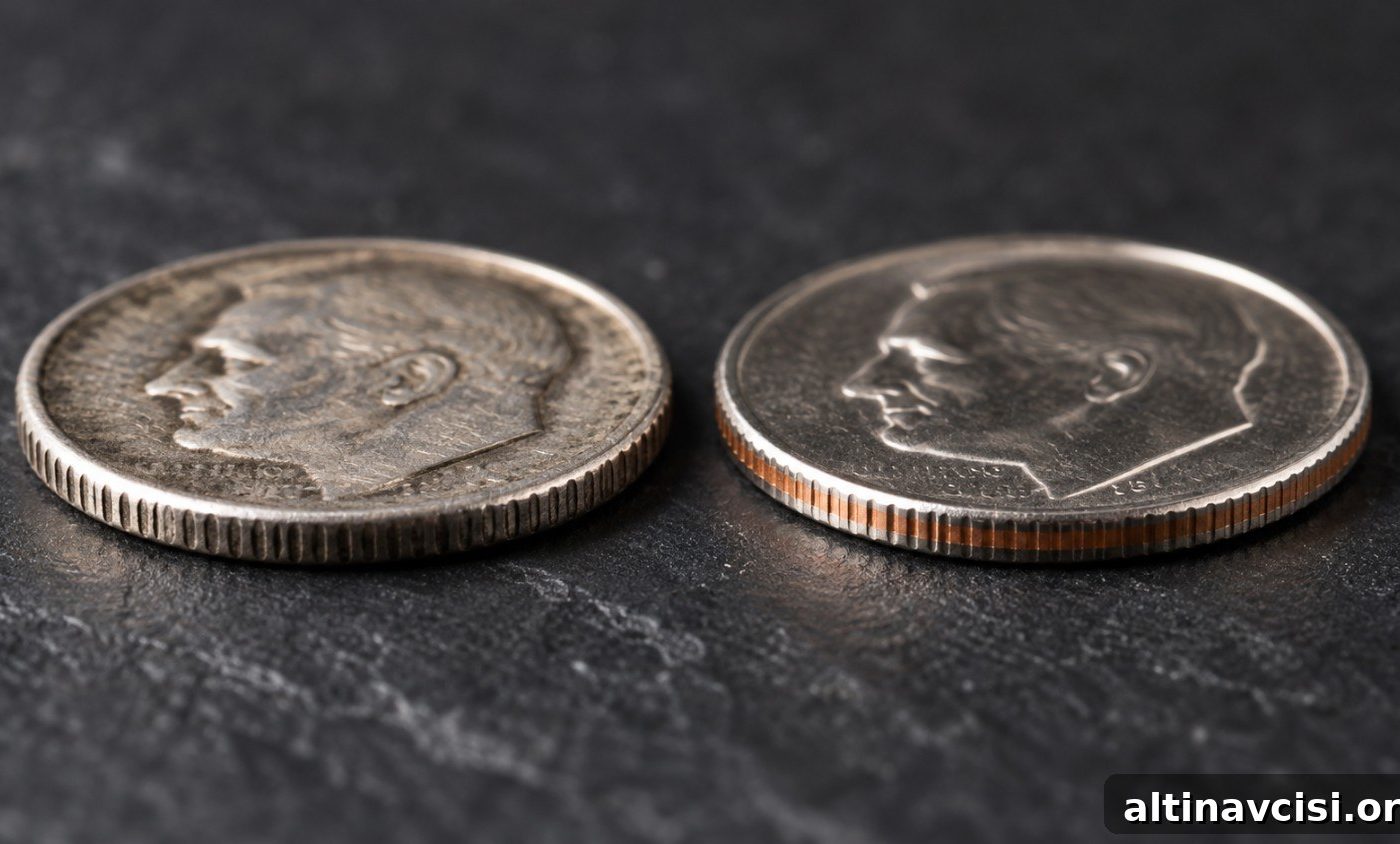
Check the date: dimes and quarters dated 1964 or earlier are 90% silver; 1965 or later are copper-nickel. Silver coins show a silvery edge rather than a copper stripe and produce a higher-pitched ring when tapped.
A standard bag contains $1,000 face value in 90% silver coins and weighs roughly 55 pounds. Dealers commonly offer smaller amounts—$500, $250, or $100 face value—for buyers who prefer lower entry points.
Morgan and Peace dollars are 90% silver, but they often carry numismatic premiums and therefore are usually treated separately from small-denomination junk silver. They also contain more silver per dollar of face value, so the 0.715-ounce-per-dollar rule does not apply to them.
Yes. Pre-1965 dimes, quarters, and half dollars remain legal tender at their face values, although their melt value is typically far higher than the face denomination.
Some sellers prefer the term “constitutional silver” as a more polished alternative. The phrase references the U.S. Constitution’s historical role in defining monetary metals; it refers to the same pre-1965 90% silver coins commonly called junk silver.
SOURCES
1. U.S. Mint — Timeline of the U.S. Mint
2. U.S. Mint — One Hundred Years of Silver Dollar Coinage (1878–1978)
3. U.S. Mint — First Striking of New Half Dollars
4. Internal Revenue Service — Correction to the 2025 and 2026 Instructions for Form 1099-B
5. CME Group — Silver Price Reference
Disclaimer: This article is for informational purposes only and does not constitute investment advice. Past performance is not indicative of future results. Consult a qualified financial advisor before making investment decisions.
You May Also Like:
- Why Is Silver Demand Tied to AI Data Centers?
- The Copper Mine That Isn’t Trying to Mine Silver Just Explained the Whole Deficit
- Inherited Gold IRA: Beneficiary Rules & the Step-Up Basis Gap
- The Cantillon Effect: Why Money Printing Makes Some People Rich First
- Silver Price Outlook September 2026: The Hike Is Priced In. The Positioning Isn’t.
- Gold Is About to Face Its First Rate Hike of the Cycle. Here’s Why It Isn’t Scared.
- How Much Gold Should You Own at 25, 45, or 65?
Popular Topics
Picked from the archive
-
01
 Topics
Five Gold Signals This Week Unrelated to Today’s Gold Price
-
02
Topics
How Silver Powers AI Models and Infrastructure
-
03
Topics
Gold Remonetization: 6 Forces Reviving Gold as Money
-
04
Topics
Why Gold Rallyed Despite Lower Jobless Claims: 4 Key Signals
-
05
Topics
What Really Happens When You Sell Gold Without Taking Delivery
-
06
Topics
Key Indicator to Watch for Gold Ahead of Fed Decision
-
07
Topics
Federal Reserve Confirms 9-3 Vote Split, Signals Major Shift
-
08
Topics
Peak Gold: Why Gold Mine Output Can’t Meet Demand