Gold/Silver Ratio Sep 2026: 12-Week Signal for Investors

The gold/silver ratio stands at 66.3 today. Three months ago it read 61.7, and five weeks ago it climbed to 70.4 before retracing. Between those points the ratio moved across nearly the same range twice. That pattern is not random noise; it illustrates how gold and silver behave relative to one another and why the ratio matters beyond any single-day price move.
What is the gold/silver ratio doing today?
Gold is down roughly 0.7% on the day, trading near $4,400 per ounce as rising real yields ahead of the Federal Reserve meeting weigh on demand for non-yielding assets. Silver is largely unchanged, holding near $66.30. Because gold has given back ground while silver has held steady, the ratio has moved toward the lower end of its recent range rather than the high end.
That relationship has persisted for weeks: when rate expectations push gold lower, silver often shows greater price resilience; when gold rallies, silver frequently delivers larger percentage gains. The two metals do not move in lockstep. The gold/silver ratio simply quantifies how much one metal is outperforming or underperforming the other.

The Edge Every Investor Needs
Smarter precious metals investing starts here. The Nuggets Newsletter delivers concise market insights, Fed updates, global trends, and educational content.
Why did the gold/silver ratio swing from 61.7 to 70.4 and back?
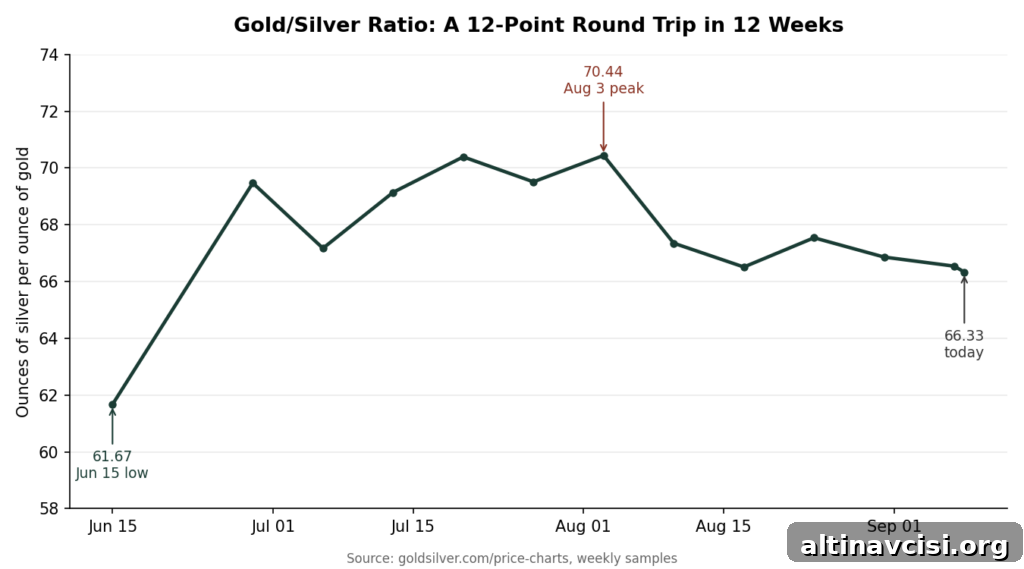
In mid-June the ratio sat near 61.7, one of its tightest readings of the year, indicating that silver was relatively expensive versus gold by recent standards. By early August the ratio widened to about 70.4, signaling that silver had become relatively cheaper. Five weeks later the ratio returned to roughly 66.3.
A 12-point swing in a ratio that typically moves by single digits over a comparable period signals volatility rather than a permanent shift in intrinsic value. Silver’s investable market—measured by mine supply and the dollar value of above-ground stocks—is much smaller than gold’s. The same dollar of buying or selling pressure will therefore move silver’s price by a larger percentage than it moves gold’s. The ratio does not gravitate toward a single “correct” number; it reflects the fact that silver’s market is smaller and thinner than gold’s, so swings are amplified.
What mechanism is driving both metals right now?
Short-term movements in gold are largely governed by real yields—the return on Treasury securities after accounting for expected inflation. As real yields rise ahead of major central bank decisions, demand for non-yielding assets like gold tends to ease. Silver faces the same macro headwinds from rate expectations, but supply and demand differences give it distinct behavior.
About half of silver’s demand derives from industrial uses—solar panels, electronics, and other applications for which substitutes are limited at scale. That industrial floor offers support to silver prices even when monetary factors pressure both metals. The industrial component helps explain why silver did not fall as much as gold during recent rate-driven moves.
Both metals also play a role outside the banking system: neither can be created by central bank balance-sheet expansion, and both have been used as stores of value that can help preserve purchasing power over time. The gold/silver ratio does not invalidate that broader case. Instead, it clarifies whether recent portfolio gains or losses are concentrated in the silver side or the gold side of a metals allocation.
What should this round trip change about how you hold gold and silver?
When a single ratio swings 12 points in twelve weeks, the simplest interpretation is that silver behaves like a higher-beta asset inside a lower-beta one. In a metals allocation, silver tends to amplify joint moves: it captures more upside when both metals rally and gives back more when they pull back. Investors should size silver positions with that asymmetry in mind rather than treating any single ratio reading as a trigger to switch entirely from one metal to the other.
A balanced approach—allocating to both metals while respecting silver’s higher volatility—will usually be more durable than repeatedly chasing short-term ratio extremes. The recent cycle from 61.7 to 70.4 and back toward 66.3 underscores why treating silver as a higher-beta complement to gold, rather than a standalone replacement, makes practical sense for many portfolios.
Gold and silver prices cited are contemporaneous with this article. Ratio history is compiled from weekly market data covering June 15 through September 8, 2026.
SOURCES
1. GoldSilver — Small Market, Big Swings: Why Silver Is More Volatile Than Gold (Mar 31, 2026)
2. GoldSilver — The Fed Just Priced Out Half a Rate Hike. Gold Barely Noticed. (Sep 3, 2026)
3. GoldSilver — Silver Industrial Demand: Solar, EVs, and the Supply Gap (May 22, 2026)
4. GoldSilver — Gold Portfolio Allocation: Why Wall Street Is Rewriting the 60/40 (May 28, 2026)
5. Yahoo Finance — Silver Prices Today, Tuesday, September 8, 2026 (Sep 8, 2026)
6. Yahoo Finance — Gold Prices Today, Tuesday, September 8, 2026 (Sep 8, 2026)
7. Fortune — Current Price of Gold: September 8, 2026 (Sep 8, 2026)
8. TradingEconomics — Silver Price, Chart, Historical Data (Sep 8, 2026)
Disclaimer: This article is for informational purposes only and does not constitute investment advice. Past performance is not indicative of future results. Consult a qualified financial advisor before making investment decisions.
You May Also Like:
- Gold Is Falling Today. Four Other Signals Say the Hard-Assets Trade Isn’t.
- Gold Is Falling for a Reason Most Investors Have Backwards
- Even Central Banks Don’t Trust Someone Else’s Vault Anymore
- Gold’s Dip Below $4,400 Didn’t Scare Wall Street. Here’s Why.
- China Just Broke Its Own Gold-Buying Record. Then Broke It Again.
- The BLS Revised April Up 64,000, Then Down 31,000. Gold Traded the First Print.
- Gold’s Drop Was the Easy Story. The Bond Market’s Non-Reaction Is the Real One.
Popular Topics
Picked from the archive
-
01
 Topics
Five Gold Signals This Week Unrelated to Today’s Gold Price
-
02
Topics
How Silver Powers AI Models and Infrastructure
-
03
Topics
Gold Remonetization: 6 Forces Reviving Gold as Money
-
04
Topics
Why Gold Rallyed Despite Lower Jobless Claims: 4 Key Signals
-
05
Topics
What Really Happens When You Sell Gold Without Taking Delivery
-
06
Topics
Key Indicator to Watch for Gold Ahead of Fed Decision
-
07
Topics
Federal Reserve Confirms 9-3 Vote Split, Signals Major Shift
-
08
Topics
Peak Gold: Why Gold Mine Output Can’t Meet Demand