U.S. Sanctions Target Iran’s Gold Sector, Prices Slide
Gold is down about 2% today, trading near $4,357 an ounce, while silver has dropped roughly 2.6% to around $64.79. That move might seem tied to recent news: the U.S. Treasury designated gold as one of five sectors of Iran’s economy exposed to secondary sanctions this week, and Treasury Secretary Scott Bessent is meeting G20 counterparts in Asheville, North Carolina, to press enforcement. Yet neither event is the main driver of today’s price action. The market is reacting to interest-rate expectations.
What Did the U.S. Just Sanction in Iran’s Gold Sector?
On August 24, the Office of Foreign Assets Control published a determination applying Executive Order 13902 to five Iranian sectors: aviation, digital assets, gold, shipping, and technology. The determination warns that anyone worldwide who participates in Iran’s gold trade or knowingly conducts significant transactions linked to it risks U.S. sanctions. The effort, described by Treasury as “Operation Economic Outcast,” targets channels that allow value to move outside formal banking systems.
Gold is singled out because physical gold can transfer value without banks, wires, or access to SWIFT when traditional correspondent banking is cut off. Closing that channel is precisely what regulators aim to do. It’s also the same characteristic that has attracted central banks and other state actors to gold in recent years.
The Edge Every Investor Needs
Smarter precious-metals investing starts with timely analysis. The Nuggets Newsletter delivers market insight, central-bank developments, global trends, and educational resources straight to your inbox.
Why Are Central Banks Buying the Same Asset Iran Is Being Sanctioned For Using?
A clear precedent helps explain the overlap: after Western institutions froze roughly $300 billion in Russian central-bank reserves following the 2022 invasion of Ukraine, several emerging-market central banks publicly said they would reduce dollar exposure and increase gold holdings. The logic is straightforward: a claim denominated in a foreign currency can be restricted by another government, while physical gold held domestically cannot be seized through financial channels.
Iran’s use of gold to work around sanctions and central banks’ accumulation of gold to hedge against sanctions risk are two sides of the same mechanism. Both are responses to a shared concern about the conditional nature of access to dollar-based systems and the political risks attached to them.
What Is Happening at the G20 Meeting in Asheville Today?
The G20 finance ministers’ meeting in Asheville is the diplomatic layer of this broader story. Secretary Bessent, who is coordinating the U.S. finance track, has urged major buyers of Iranian oil — including China and India — to cut financial ties to Tehran. His comments signal that the U.S. sees restrictions on dollar-system access as an effective lever. For reserve managers watching global policy, the message reinforces a multi-year consideration about trust in the dollar-based financial architecture.
So Why Are Gold and Silver Actually Falling Today?
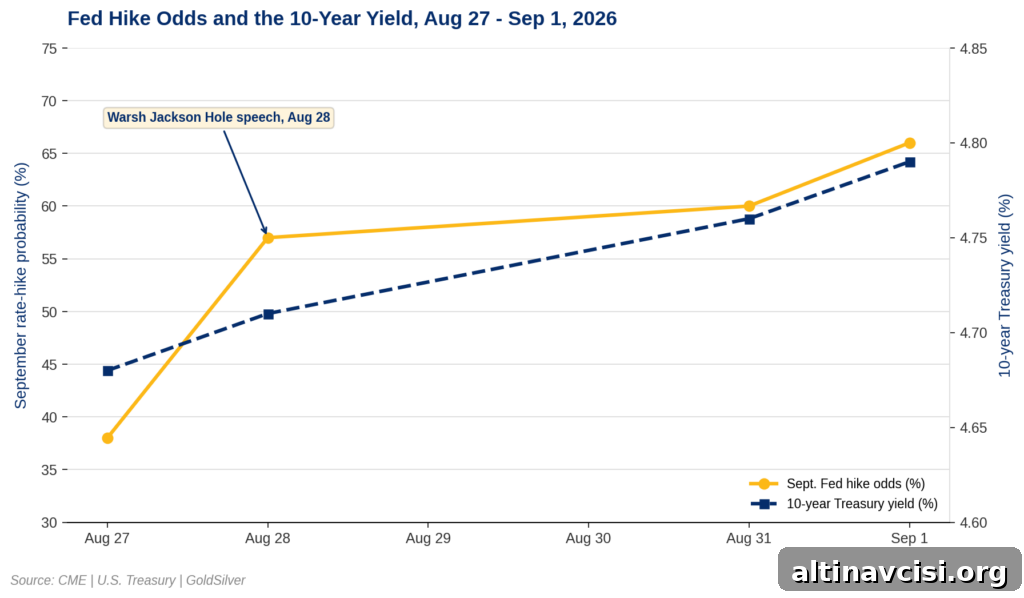
Despite the sanctions and G20 headlines, today’s declines in gold and silver are primarily a rates story. Kevin Warsh’s keynote remarks at Jackson Hole on August 28 emphasized that the Fed’s 2% inflation target remains “firm and fixed” and suggested the Fed should use unconventional tools like large-scale asset purchases “sparingly, if at all.” That rhetoric reduced expectations for extraordinary central-bank support and pushed markets to price in higher policy rates.
Market-implied odds for a 25-basis-point rate hike in September rose to roughly 65–68% from about 40% a week earlier. The 10-year Treasury yield moved higher for a fifth consecutive session to 4.79%, its highest level since January 2025. When expected policy rates rise, the opportunity cost of holding non-yielding assets such as gold increases, which helps explain today’s price decline.
This shift also reverses a short-term factor that had been pushing gold up: the Treasury’s move to expand long-dated bond buybacks to calm a bond-market selloff. That action briefly supported a “debasement” narrative. Warsh’s comments have pulled policy signals in the opposite direction, with the Fed appearing less interventionist while the Treasury takes measures to stabilize bond markets.
How Does Oil Connect the Sanctions Story to Today’s Selloff?
Oil links the sanctions narrative and market sentiment. Brent crude has traded above $91 per barrel and WTI above $86, with both up roughly 8–9% over the past month. Geopolitical tensions — including U.S. strikes on weapons near the Strait of Hormuz and Iranian responses — have contributed to that rise.
Higher oil feeds into inflation expectations, strengthening the case for a tighter Fed stance and adding downward pressure on gold and silver. Put simply: the same geopolitical conflict that prompted sanctions expansion can push gold in opposite directions — supporting demand via reserve diversification over the long term, while reducing prices in the near term as rate expectations rise and real yields climb.
Which Story Should Investors Actually Be Watching?
Investors should distinguish between two timelines. Today’s price action is dominated by rate expectations and upcoming economic data this week — including the August ISM Manufacturing PMI, July JOLTS, and the August jobs report — all of which will influence the Fed’s September 16 decision. Those readings are the near-term drivers of precious-metals moves.
The longer-term reserve-diversification story, by contrast, is a multi-year question about whether governments can rely on a currency whose issuer may restrict access. Designating gold as a sanctions target does not resolve that debate; it merely adds evidence to a broader argument for diversification away from dollar-denominated claims.
Stay On Top of Gold & Silver Prices
Receive timely market alerts and insights delivered to your inbox.
SOURCES
1. Federal Register, Aug. 27, 2026 — Publication of a Determination Issued Pursuant to Executive Order 13902 (Federal Register).
2. News reporting on G20 finance ministers’ meeting in Asheville, Aug. 31, 2026 (news outlets).
3. Federal Reserve, Aug. 28, 2026 — Chairman Warsh Keynote Remarks, Jackson Hole Economic Policy Symposium.
4. Reporting on 10-year Treasury yields and oil-driven inflation concerns (Aug. 31–Sept. 1, 2026).
5. Market commentary on silver prices, Sept. 1, 2026.
Disclaimer: This article is for informational purposes only and does not constitute investment advice. Past performance does not guarantee future results. Consult a qualified financial advisor before making investment decisions.
You May Also Like:
- Hike Odds Doubled This Week. Real Yields Didn’t.
- COMEX Registered Gold Just Fell Below 15 Million Ounces. It’s Still Refilling.
- Gold Isn’t Falling on a Hawkish Fed. Here’s Why.
- Gold and Silver Sink as Warsh Cites AI Boom to Justify More Fed Tightening
- Five Things Moved Gold and Silver This Week. Only One Was Kevin Warsh.
- The Treasury’s Next Move Isn’t a Rate Cut. It’s a $967 Billion Checking Account.
- Six Paper Claims, One Ounce of Silver: What First Notice Day Reveals
Popular Topics
Picked from the archive
-
01
 Topics
Solar Cuts Silver Use 19%: Why the Deficit Is Bullish for Silver
-
02
Topics
Fed 9-8 Split Drives Gold, Silver Prices Down Through July 14
-
03
Topics
Gold-to-Oil Ratio: How It Impacts the Economy and Portfolios
-
04
Topics
How COMEX Sets Gold Prices and Moves Global Markets
-
05
Topics
Why Fed Rate Hike Odds Reached 85% and Gold Climbed
-
06
Topics
Why M2 Money Supply Could Undermine Your Portfolio
-
07
Topics
Gold Price Up 1.5% as ADP, ISM and Beige Book Weigh on Fed
-
08
Topics
ADP Job Report Misses, Gold Holds Steady, Warsh Live in Sintra