Gold Pullback Driven by Treasury Buyback, Not ETFs

Data note: Market prices and intraday figures in this article reflect conditions as of roughly 9:30 AM ET on August 20, 2026. Prices may have changed. Last verified: August 20, 2026.
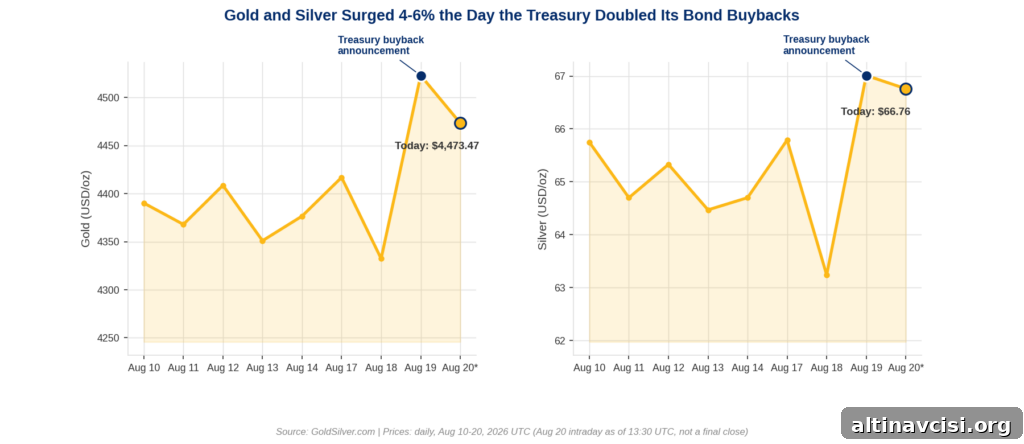
Gold is trading at $4,473 today, down about 1.1% from this morning’s open. Silver sits at $66.76, down roughly 0.4%. Both metals are pulling back after a sharp 4–6% surge earlier this week.
Key Takeaways
- The 4–6% rise in gold and silver this week traced to the U.S. Treasury expanding its long-bond buyback program (from $2 billion to at least $4 billion per operation) after a weak $16 billion 20-year auction. The buyback program, not ETF flows, was the primary market catalyst.
- The Treasury’s debt-management actions (fiscal policy) and the Federal Reserve’s interest-rate decisions (monetary policy) are separate. This week’s price moves were driven by the Treasury’s intervention, not a Fed policy shift.
- Real 10-year yields remain positive near 2.44%, a level that historically weighs on gold. This week’s rally therefore represents a divergence from the usual inverse relationship between real yields and precious metals.
What Actually Happened to Gold and Silver This Week?
If you followed financial social media, you likely saw the same explanation repeated: gold and silver rallied because of strong ETF inflows. That view is partly correct but incomplete. ETF inflows can move prices, but they were not the proximate trigger this week. The decisive event began in the long end of the Treasury market.
On Tuesday, the 30-year Treasury yield climbed to about 5.33%, its highest since June 2007. A $16 billion 20-year auction that day drew unusually weak demand, which market participants described as a “buyers’ strike” for long-dated government debt. That weak demand had been building since late June.
On Wednesday, the Treasury announced it would at least double the size of certain buyback operations — increasing capacity from $2 billion to at least $4 billion per operation for 10–20 and 20–30 year maturities, beginning September 9 and continuing through November 4. Within hours of the announcement, long-term yields fell: the 30-year dropped roughly 9–10 basis points to about 5.18–5.20%, and the 10-year fell about 5–6 basis points to roughly 4.63–4.65%.
Falling yields lowered the opportunity cost of holding non-yielding assets like gold and silver, and both metals surged: gold rose about 4.1% in a single day, while silver jumped roughly 6.4%.

The Edge Every Investor NeedsSmarter precious-metals investing starts here. The Nuggets Newsletter delivers market insights, Fed updates, global trends, and educational content.
So Why Did the Treasury Have to Step In?
A routine buyback would not be notable. This action was different because it followed a failed auction that revealed insufficient private demand for long-term Treasury issuance. The Treasury had already published its quarterly financing plan two weeks earlier, yet officials chose to expand buybacks rather than wait for the next scheduled update. As one market strategist put it, officials “didn’t like what was happening in the market at the time.”
In effect, the government intervened to support prices after private buyers rejected the available paper at the auction. Natixis estimates the larger buyback pace could amount to roughly $128 billion annually — close to 30% of projected issuance in the affected maturities — which is large enough to meaningfully influence long-end liquidity and yields.
$128 billion a year: Natixis’s estimate for the expanded buyback pace — roughly 30% of projected Treasury issuance in the targeted maturities.
How Does a Bond Buyback Push Yields Down and Gold Up?
When the Treasury repurchases long-dated bonds, it raises demand for those securities. The financing for those operations generally comes from issuing shorter-term bills rather than new long-term debt, so the net effect is greater demand concentrated in the long end. Higher bond prices mean lower yields. Lower yields reduce the opportunity cost of holding assets that do not pay interest, like gold and silver, which explains the metals’ immediate reaction to the announcement.
It’s important to distinguish the Treasury’s action from Federal Reserve policy. The Fed controls short-term interest-rate policy and manages its own balance-sheet operations. The Treasury manages debt issuance and buybacks. This week’s move was a debt-management response to market conditions, not a Fed-driven easing of monetary policy.
Why Does This Matter If You Hold Gold or Silver Long-Term?
A government stepping into the market to support its own debt can signal that borrowing dynamics are becoming a central driver of bond-market outcomes. Real 10-year yields are still positive, near 2.44% based on TIPS data — a level that normally weighs on gold. Yet the metals rallied strongly anyway, suggesting investors are pricing in factors beyond the standard real-yield relationship: primarily the growing role of fiscal decisions and Treasury interventions in shaping long-term yields.
For long-term holders, that matters because it indicates the market is responding not only to inflation and growth expectations but also to the government’s need and willingness to actively manage its debt profile. Such interventions can change the balance between supply and demand in specific maturities and, over time, affect broader perceptions of currency and fiscal risk.
What Should You Watch Next?
The expanded buyback program runs from September 9 through November 4, when the Treasury will reassess. Watch whether the operations keep the long end of the yield curve subdued through the fall or whether upward pressure resumes after the program ends. That calendar provides a clear window to observe the Treasury’s influence on long yields.
Separately, the Federal Open Market Committee’s July minutes, released this week, showed a 9-3 vote to hold rates at the July meeting, with three regional presidents dissenting in favor of a hike. That internal Fed division — the most divided vote since 2016 — sits alongside the Treasury’s easing action. The coexistence of a relatively hawkish Fed and an easing Treasury is a dynamic worth tracking in the coming weeks.
Stay On Top of Gold & Silver Prices
Get timely market alerts delivered to your inbox.
Frequently Asked Questions
Gold is down about 1.1% and silver about 0.4% as the market cools after a 4–6% surge earlier this week. That earlier surge followed the Treasury’s announcement to expand long-bond buybacks; today’s decline reflects profit-taking and the market digesting that intervention rather than a fundamental reversal in the case for precious metals.
A Treasury buyback is when the government repurchases its outstanding long-term bonds from the market, typically financed by issuing shorter-term bills. The buyback supports liquidity in less-active maturities; by increasing demand for existing bonds, it pushes prices up and yields down.
The Treasury acted after a $16 billion 20-year auction produced unusually weak demand and the 30-year yield rose to multi-decade highs. To prevent further dislocations in long-dated debt markets, officials expanded buyback capacity to shore up demand and help stabilize yields.
By pushing long-term yields lower, a buyback reduces the opportunity cost of holding non-yielding assets like gold and silver, making them relatively more attractive and often prompting price gains in the metals.
No. The Treasury is managing its debt issuance and buybacks; the Federal Reserve sets short-term policy and manages its own balance sheet. The Treasury’s operations are financed through debt-management tools, typically shorter-term bill issuance, and are distinct from Fed asset purchases or monetary policy decisions.
The July meeting minutes showed a 9-3 vote to hold interest rates, with three regional presidents voting for a hike. That internal divergence highlights differing views within the Fed about the pace of policy tightening if inflation fails to cool as expected.
SOURCES
1. GoldSilver.com — Price Charts (August 20, 2026)
2. CNBC — Coverage of Treasury yields and auction activity (August 19, 2026)
3. Business Standard — Reporting on U.S. long-term debt buybacks (August 19, 2026)
4. FRED, Federal Reserve Bank of St. Louis — 10-Year Real Yield (DFII10) (data as of August 17, 2026)
5. CNBC — Fed minutes coverage (August 19, 2026)
Disclaimer: This article is for informational purposes only and does not constitute investment advice. Past performance is not indicative of future results. Consult a qualified financial advisor before making investment decisions.
You May Also Like:
- The Fed Just Confirmed a 9-3 Split. Then It Said Something Bigger.
- Gold and Silver Are Climbing Today. The Textbook Says They Shouldn’t Be.
- Gold Jumped 1.9%. Silver Jumped 2.7%. The Fed Hasn’t Said a Word Yet.
- The Long Bond Hit a 19-Year High. Inflation Expectations Didn’t Move.
- FOMC Minutes Tomorrow. Jackson Hole in Nine Days. Here Is What Gold Needs From Both.
- Three Fed Officials Voted to Hike. What It Means for Gold.
Popular Topics
Picked from the archive
-
01
 Topics
Iran Rejects Talks as Gold and Silver Prices Slide
-
02
Topics
Use the 50-Day Moving Average to Read Gold and Silver Trends
-
03
Topics
Gold Prices Near $4,000 as Job Cuts Reach 20-Year High
-
04
Topics
Five Key Reports Shift Gold Prices and September Fed Pivot Odds
-
05
Topics
Gold Price Support Shifts After Ceasefire Violation
-
06
Topics
Gold Slumps 14% in March as Inflation Lingers
-
07
Topics
Gold vs Silver: How to Balance Risk and Role in Your Portfolio
-
08
Topics
Gold Radar: 5 Hidden Signals Your Price Chart Misses