Why Gold Belongs in Your Investment Portfolio
Gold has shifted from a crisis hedge to a foundational portfolio asset — and the data supports treating it that way permanently. In 2025, global gold demand exceeded 5,000 tonnes for the first time, while central banks purchased 863 tonnes even with prices at record highs. The long-term drivers of gold’s value — monetary debasement, persistent fiscal deficits, and the weakening of stock–bond diversification — remain firmly in place. Historically, a 5–15% allocation to gold has improved risk-adjusted returns across portfolio types without requiring investors to time short-term moves.
What Makes Gold a Core Asset Rather Than Just a Hedge?
A hedge is typically reactive: you buy it during panic and sell after the panic subsides. A core asset is different. It deserves a permanent position because it reliably reduces portfolio risk, preserves purchasing power, and retains value when other holdings falter. Gold is held for structural reasons rather than short-term timing decisions.
For much of the last four decades, investors treated gold as a tactical play. That view is now outdated. The conditions that once made bonds dependable ballast — low inflation, steady growth, and negative correlations with stocks — have changed. Bonds no longer diversify the way they used to; gold, by contrast, has repeatedly demonstrated low correlation with equities and can serve as genuine portfolio ballast.

Your Gold Buying Guide Many investors overpay when buying gold and again when selling. This guide explains which forms of gold make sense and why.
Subscribe to receive a detailed guide and practical tips for buying physical gold.
Why the 60/40 Portfolio Can’t Do the Job Alone
The classic 60/40 split assumed stocks and bonds would move in opposite directions, stabilizing portfolios during stress. That relationship worked for decades but has weakened. Structural fiscal deficits, rising sovereign debt loads, and an environment of higher interest rates mean bonds and equities can fall together during market shocks. The ballast investors relied on has been eroded.
Gold can fill that gap. Its correlation with U.S. equities over the last 20 years is roughly 0.14, effectively neutral. In practice, that means gold tends to hold value or rise when other assets are under pressure. Institutional behavior reflects this shift: recent surveys show European institutional investors increasing gold allocations to levels comparable with developed-market sovereign debt, treating gold as a mainstream anchor rather than a fringe position.
What Are Central Banks Telling Us About Gold?
Central banks are patient, long-term investors. They do not chase short-term momentum. When they buy gold consistently and at scale — even at record prices — it signals a deliberate strategic choice rather than a headline-driven reaction.
In 2025 central banks purchased 863 tonnes of gold, the fourth-largest annual expansion of official gold reserves on record and almost double the 2010–2021 annual average. Surveys show pronounced optimism about growing reserves, with a large majority of central banks expecting reserve increases in the near term. Later in 2025, gold became the world’s largest reserve asset by value, surpassing U.S. Treasuries for the first time since the mid-1990s.
Specific central bank actions illustrate the trend. Poland added 102 tonnes, lifting its holdings to 550 tonnes and increasing gold’s share of reserves substantially in a single year. Kazakhstan reported its largest annual purchase since the early 1990s, and Brazil resumed buying after a multi-year pause. Central banks prize gold for its liquidity and lack of counterparty or issuer risk — attributes that gain importance as geopolitical and fiscal pressures grow.
How Does Gold Actually Perform When Markets Turn?
Gold is not positioned to outperform equities during prolonged bull markets — stocks usually win in those environments. Gold’s role is defensive: preserving value when other asset classes fall. Historical examples demonstrate that function. In the 2008 financial crisis the S&P 500 plunged while gold ended the year slightly positive, outperforming most major asset classes. In 2020 gold rose strongly amid market turmoil. In 2025 total demand for gold exceeded 5,000 tonnes, generating around $555 billion in value, a substantial year-over-year increase.
Demand composition matters: in 2025 bar and coin investment reached a 12-year high, signaling that many buyers were patient, long-term holders rather than short-term traders. At the same time, jewelry demand fell as high prices constrained consumer volumes. When investment demand rises while consumer fabrication contracts, that suggests durable support underpinned by strategic buyers.
Gold’s appeal is structural: no credit risk, no issuer that can default, and no sovereign that can freeze it. In a world of persistent geopolitical fragmentation and rising sovereign liabilities, those characteristics increase gold’s utility as a permanent portfolio component.
What Is the Right Gold Portfolio Allocation?
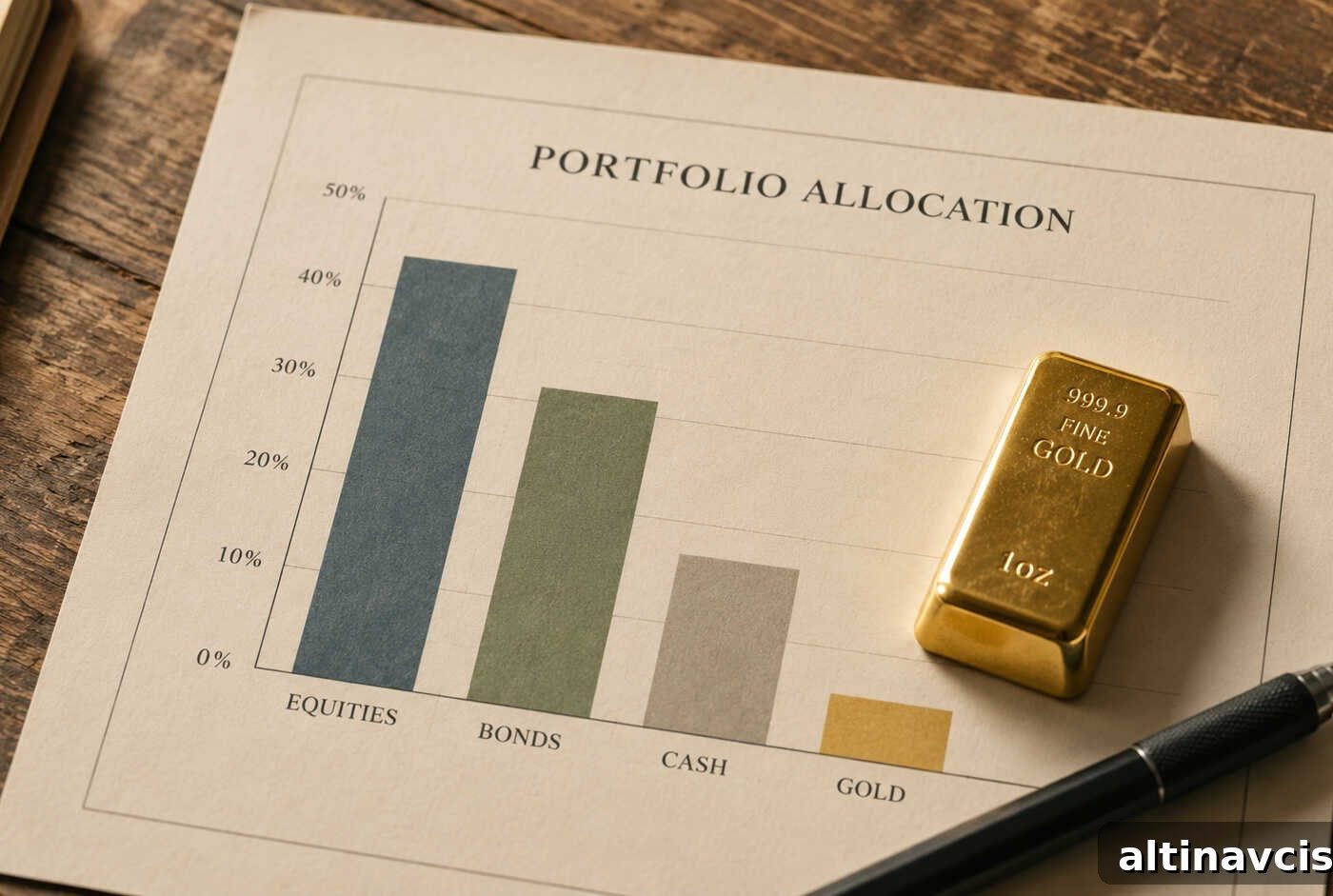
Research and institutional guidance generally point to a 5–15% allocation for many investors, yet most private portfolios fall short of this range. Studies show that adding 2.5%, 5%, 7.5% or 10% to a typical U.S. dollar portfolio over the last 20 years improved risk-adjusted returns and reduced maximum drawdowns. Even a modest 5% allocation has historically increased the Sharpe ratio and reduced downside risk.
Some institutions advocate higher allocations: certain asset managers recommend a permanent 10% allocation to physical gold, while other research identifies historically optimal allocations that can be considerably larger from a pure risk–reward perspective. Prominent investors have publicly cited figures in the double-digit range as well. J.P. Morgan and other firms have revised price outlooks upward in response to continued reserve diversification, underscoring that many institutional models now view larger allocations as prudent.
Yet allocation is only part of the story: consistency matters. A steady allocation maintained through volatility, with disciplined rebalancing, typically outperforms more opportunistic strategies that sell on the first significant drawdown. Gold rewards patience: a well-sized, permanent position will usually serve a portfolio better than frequent tactical trading.
Stay On Top of Gold & Silver Prices
Receive important market alerts delivered to your inbox.
Live price widget unavailable in this version. Subscribe for email alerts.
Enter your email on the live site to receive market updates and guides.
People Also Ask
Why is gold considered a core portfolio asset and not just a hedge?
Because gold consistently reduces portfolio volatility, limits drawdowns, and preserves purchasing power across full market cycles. Its near-zero long-term correlation with equities means it diversifies returns in normal environments as well as in crises, making it a core holding rather than a purely tactical hedge.
What are the benefits of including gold in a diversified investment portfolio?
Gold improves risk-adjusted returns without requiring market timing. Research demonstrates that allocations in the 5–10% range historically raised Sharpe ratios and reduced maximum drawdowns. Gold also offers structural protection against inflation, currency debasement, and geopolitical risk.
How does gold perform compared to traditional assets like stocks and bonds?
Over long equity bull markets, stocks typically outperform gold. But during periods of financial stress, high inflation, or currency weakness, gold often outperforms both stocks and bonds. Recent years have shown increased demand from strategic buyers and central banks, strengthening gold’s role as a defensive asset.
What percentage of a portfolio should be allocated to gold?
Most institutional research points to a 5–15% range for many investors. Even a modest 5% allocation has been shown to improve risk-adjusted outcomes in long-term historical data. The right allocation depends on your portfolio, time horizon, and risk tolerance, but the evidence favors including a meaningful, permanent position.
How does gold’s role change during economic uncertainty or market volatility?
In times of acute stress, gold’s correlation with equities often becomes mildly negative, so it tends to rise as stocks fall. Beyond crisis episodes, ongoing structural trends — fiscal expansion, monetary debasement, and reserve diversification — sustain gold’s relevance across many market environments.
The Shift Has Already Happened — Has Your Portfolio Caught Up?
Investor behavior and central bank actions show a real change in how gold is viewed. Central banks bought 863 tonnes in one year at record prices. Institutional allocations in some regions now match sovereign bond weights, and the 60/40 model’s diversification benefits have weakened. These are not forecasts — they are current realities.
Most private investors have not yet adjusted their portfolios to reflect this shift. A 5% allocation is a practical starting point that historical data shows can materially improve risk-adjusted returns. Short-term pullbacks should be judged against the long-term structural case: for long-term holders, dips can create attractive entry points.
If you are evaluating your allocation, seek factual research and consider how a permanent allocation to gold fits your objectives rather than attempting to time the market.
SOURCES
1. CBS News — What Is the Highest Gold Price in History?
2. WisdomTree — Rethinking the Golden Allocation
3. World Gold Council — Gold Demand Trends Full Year 2025: Central Banks
4. National Bank of Poland — Official statements and reserve data
5. World Gold Council — Gold Demand Trends Full Year 2025
6. World Gold Council — Portfolio Impact: Risk/Reward Profile
7. TheStreet / Reuters — J.P. Morgan Revises Gold Price Target for 2026
8. GoldSilver.com — Industry commentary and analysis
Disclaimer: This article is for informational and educational purposes only and does not constitute investment advice. Consult a qualified financial adviser before making investment decisions.
You may also like:
- Silver vs. Gold: A Clear 5-Year Investment Guide (2026–2031)
- $5,500 Gold by Q1 2027? The Central Bank Risk Driving It
- Why Gold Stabilizes — and Silver Amplifies
- COMEX Silver Coverage Ratio: Is Your Paper Silver Real?
- What the Gold Price Per Ounce Really Tells You
- The Gold Inflation Paradox Most Investors Miss
- Insurance vs. Upside: Balancing Your Portfolio with Gold and Silver
- Gold Bullion vs. Jewelry: Why Serious Investors Choose the Bar
Popular Topics
Picked from the archive
-
01
 Topics
Why Gold Hit $5,100: What’s Driving the Rally Next
-
02
Topics
Market Update: Gold Steady, Shoppers Cautious, Nvidia Scrutinized
-
03
Topics
Gold and Silver Prices Swing as Ceasefire Falters
-
04
Topics
Gold Prices Jump as Fed Rate-Cut Odds Climb to 74 Percent
-
05
Topics
How Real Interest Rates Drive Gold Prices: Investor Guide
-
06
Topics
When the Fed’s $2 Trillion Liquidity Buffer Reaches Zero
-
07
Topics
5-Year Silver Price Forecast: Data-Driven Scenarios
-
08
Topics
Gold and Silver Hold Ground as Bitcoin Falls Below USD 95K