Gold Price: What Could Drive It to $6,300?
Daily News Nuggets | Today’s top stories for gold and silver investors
March 6th, 2026 | Brandon Sauerwein, Editor
Gold Price Outlook: Metals Find Their Footing After January Rout
The start of the year was brutal for precious-metals investors. January produced some of the sharpest single-day declines seen in modern trading, prompting widespread profit-taking and panic selling. That intense volatility marked a jarring opening to 2026.
But the sell-off did not last.
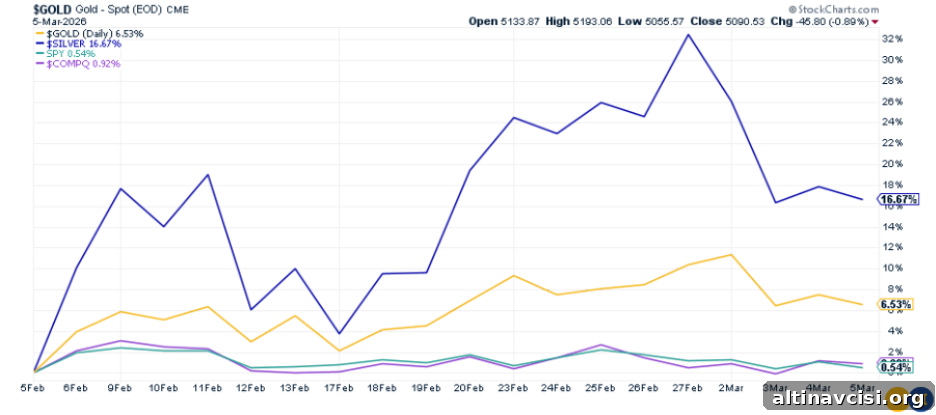
Over the last 30 days, gold has recovered roughly 6.5% while silver has rallied about 16.6%, easily outpacing the S&P 500 and the Nasdaq. The bounce reflects renewed investor conviction as geopolitical tensions rise and inflation pressures remain persistent. For many traders and longer-term holders, the metals’ strength signals a reassertion of safe-haven demand.
Last Month: Silver Up 16.6%. Gold Up 6.5%. SPY Up 0.54%.
Below we outline the current gold price outlook, the main drivers behind the rebound, and the factors investors should watch in the coming months.
Trump Eyes Regime Change in Iran and Cuba
President Trump has publicly discussed the possibility of regime change in both Iran and Cuba, a stance that adds a new layer of geopolitical uncertainty.
In Iran, those comments come amid active military operations aimed at degrading missile capabilities, weakening military leadership, and setting back nuclear progress. The administration is framing the current Tehran government as a persistent security threat and has encouraged internal political pressure on the regime.
Cuba has been targeted with tightened sanctions and stricter economic measures. The administration’s approach appears designed to intensify pressure until the Cuban government either negotiates or shows signs of systemic breakdown. Although the tactics differ between the two countries, the objective—transition of leadership or policy—appears consistent.
Markets are still assessing the long-term consequences. Historically, sustained geopolitical campaigns—especially those affecting energy-producing regions—tend to prolong uncertainty. Extended instability boosts volatility across risk assets and supports continued demand for safe-haven assets like gold and silver.

Oil’s 20% Week Is Sending a Warning
U.S. crude prices have climbed above $85 per barrel for the first time in nearly two years, and Brent crude rallied more than 20% in a single week. That magnitude of movement is more than routine volatility; it points to a market experiencing growing supply stress.
Supply was already tight before this surge. OPEC+ production discipline has left limited spare capacity, and recent disruptions to key shipping routes, rising insurance costs, and regional instability have removed the market’s usual buffers. With little room to absorb further shocks, prices can jump quickly.
Higher energy costs ripple through the economy. They raise transportation and manufacturing expenses and feed into consumer price indexes. A sustained oil price shock risks reigniting inflation pressures central banks have worked hard to control—an outcome markets may be underestimating.
A brief, isolated spike in oil is manageable. A longer-term structural supply problem layered on existing inflationary momentum would force a more difficult policy response, with implications for interest rates, equities, and currency markets.
The Fed Has a New Problem
After two years focused on taming inflation, the Federal Reserve now faces renewed inflationary risk from rising energy costs. Energy inflation tends to filter through supply chains and eventually shows up in consumer prices, complicating the Fed’s outlook.
If inflation accelerates again, cutting interest rates becomes harder to justify. Yet keeping rates high while the economy feels the drag from a geopolitical shock introduces the risk of tipping into slower growth. There is no easy policy path.
Market expectations have already shifted: traders have scaled back the number of rate cuts they expect this year. That adjustment occurred quickly, underscoring the market’s uncertainty about how central banks will respond to new inflationary pressures.
This environment is historically constructive for gold. The metal tends to perform best when inflation remains elevated while central banks are constrained or uncertain about easing policy—a scenario increasingly plausible in 2026. That backdrop is central to the gold price outlook for the remainder of the year.
The Edge Every Investor Needs
Smarter precious-metals investing starts here. The Nuggets Newsletter delivers market insights, Fed updates, global trends, and educational content directly to your inbox.
Subscribe to the Nuggets Newsletter on the publisher’s site for timely alerts and analysis.
Gold Is Piling Up in Dubai — and Selling at a Discount
Dubai, normally a major transit hub linking African production with buyers across Asia and the Middle East, is experiencing inventory congestion. Dealers report inventories building up as shipments slow amid regional conflict, airspace restrictions, and sharply higher insurance and logistics costs.
The physical disruption is producing a rare regional pricing divergence: gold traded in Dubai is sometimes below international benchmarks even while global spot prices remain elevated. Spot gold sits near $5,145 per ounce and silver around $84.35, signaling robust global demand despite localized price pressure.
This situation underscores an important reality: gold is not only a financial asset, it is a physical commodity that must be moved. When the infrastructure that transports bullion is impaired, market liquidity and pricing can fragment geographically. The same tensions that push investors toward gold can at the same time make it harder to move metal to where it’s needed most.
J.P. Morgan Just Tried to Kill the Gold Bull Case — and Couldn’t
J.P. Morgan Private Bank recently published a note that examined the principal bearish arguments against gold—high prices, crowded positions, and slowing central bank purchases—and found the criticisms insufficient to overturn the metal’s strategic case.
After testing those bear scenarios, the bank concluded that gold still serves as a strategic diversifier. Their analysis reinforces a bullish outlook amid ongoing geopolitical strain, persistent inflationary drivers, and continued reserve diversification by central banks away from dollar-only holdings.
J.P. Morgan’s projection calls for materially higher prices by late 2026, driven in part by ongoing reserve diversification and structural demand. Coming from a major private bank, that view adds weight to an already supportive set of macro and geopolitical dynamics.
Stay On Top of Gold & Silver Prices
Get important market alerts sent straight to your inbox.
Live price ticker available at the publisher’s website.
Subscribe via the publisher’s subscription page for alerts and analysis.
You May Also Like
- Gold and Silver Prices Today: Iran, Oil, and a $1.3B Bet
- Gold and Silver Are Climbing While the World Watches Hormuz
- Hormuz, the Fed, and the Battle for Safe-Haven Status
- Gold Prices Surge on Middle East Tensions
- Gold Above $5,200, Silver Above $90 — as Inflation Refuses to Fade
Popular Topics
Picked from the archive
-
01
 Topics
Gold Price Could Reach USD 5,000 by 2026: Institutional Forecast
-
02
Topics
Silver Squeeze Pushes Silver Prices Above $51
-
03
Topics
Gold Rises as Bitcoin Slips and Bubble Fears Grow
-
04
Topics
Bessent Urges 1.5% Rate Cut, Boosting Gold Prices
-
05
Topics
Tariff Deadline Fears Push Gold Prices Up as Other Metals Slide
-
06
Topics
Gold Fields Urges Major Miners to Boost Gold Exploration
-
07
Topics
Tech Giants Drive 90% of Earnings Growth Despite Trade War Fears
-
08
Topics
Brazil Threatens Retaliation After Trump Imposes 50% Tariff