Silver Prices Jump 100 Dollars as Geopolitical Tensions Escalate

Daily News Nuggets | Today’s top stories for gold and silver investors
January 15th, 2026
Metals Rally Hits New Records Amid Global Turmoil
Gold blasted past $4,600 per ounce this week while silver climbed to a fresh all‑time high above $90.
A wave of geopolitical shocks and growing uncertainty pushed investors toward safe-haven assets. Recent events — including the capture of Venezuelan leader Nicolás Maduro, deadly protests in Iran, and public threats of military action from U.S. political leaders — heightened risk perceptions and accelerated demand for precious metals.
The pressure is not only external. Washington itself has become a source of market anxiety. The Justice Department opened a criminal inquiry related to cost overruns on a Federal Reserve headquarters renovation that names Fed Chair Jerome Powell in connection with the probe. Powell has dismissed the inquiry as a politically motivated pretext to influence monetary policy.
That matters because the Fed’s perceived independence is a cornerstone of market confidence. When institutional stability appears fragile, investors often move capital into tangible assets. The result: a strong early-year rally in both gold and silver.
Performance so far in 2026: gold is up roughly 7% year-to-date and silver has surged around 26%. These gains reflect a mix of constrained supply, elevated industrial demand for silver, and eroding trust in traditional institutions. For investors tracking precious metals, the combination of macro risk and structural supply limits supports a bullish case for continued strength.

The Financial System Isn’t Safer — And You Know ItAs systemic risks rise, discover why gold and silver remain central to portfolios seeking crisis-resistant returns.
Subscribe for timely alerts on gold and silver prices and receive a free guide on protecting portfolio value in turbulent markets.
New Silver Trading Rules Could Push Prices Higher
The CME Group adjusted margin rules for silver futures this week, moving from fixed-dollar margins to percentage-based requirements. Traders must now post roughly 9% of a contract’s value as collateral, meaning margin calls rise automatically as prices climb.
This change affects leveraged, paper-market participants most. As silver prices increase, collateral needs grow, squeezing short sellers and increasing the risk of forced liquidations among overleveraged traders. Importantly, these margin adjustments do not affect physical buyers; they apply only to futures and other paper contracts.
Fundamentally, silver markets still show tightness. China’s export licensing and ongoing industrial demand have contributed to a structural deficit. With silver already above $90 and climbing, market dynamics and higher trading costs make $100 per ounce an increasingly plausible near-term target.
Trump Says “No Plans” to Remove Powell (For Now)
President Trump told Reuters he currently has no plans to remove Jerome Powell as Fed Chair, though he admitted it is “too early” to rule out future changes. For now, the relationship is in a holding pattern while Powell’s term runs through May and his board seat extends to 2028.
Speculation over replacements has included names such as Kevin Warsh and Kevin Hassett, but markets have grown cautious: traders assign only a small probability to a near-term shift in Fed leadership. The statement follows months of public pressure from the White House for faster and deeper rate cuts, and it arrives amid the Justice Department’s investigation into the Fed chair related to renovation cost overruns.
Investors should take such political signals in stride. Leadership talk can move sentiment, but monetary policy decisions are ultimately driven by economic data and the Fed’s dual mandate.
Stay On Top of Gold & Silver Prices
Get market alerts and price updates delivered to your inbox.
Real-time tickers and price alerts are available when you subscribe.
Inflation Looks Tame, But There’s a Catch
On the surface, headline inflation appears manageable: Consumer Price Index (CPI) showed a 2.7% rise in December, while core CPI — excluding food and energy — eased to about 2.6%, slightly below expectations.
However, these aggregate numbers mask real strain for households. Food prices rose 0.7% in December, the largest monthly increase in over two years, pushing grocery inflation to roughly 3.1% annually. Everyday essentials are hitting budgets more sharply than headline averages imply.
Another important nuance: the Federal Reserve places greater emphasis on the Personal Consumption Expenditures (PCE) measure when setting policy. PCE uses a flexible basket and captures shifts in consumer spending patterns and healthcare costs covered on consumers’ behalf — features that tend to make PCE read cooler over time than CPI. While that can help explain the Fed’s policy stance, it offers limited comfort to households feeling price pressure at the supermarket or the gas pump.
Workers Getting Record-Low Share of GDP
A sobering statistic: employees captured about 54% of U.S. GDP in Q3 2025, the smallest share recorded since this series began tracking labor’s share in the mid-20th century.
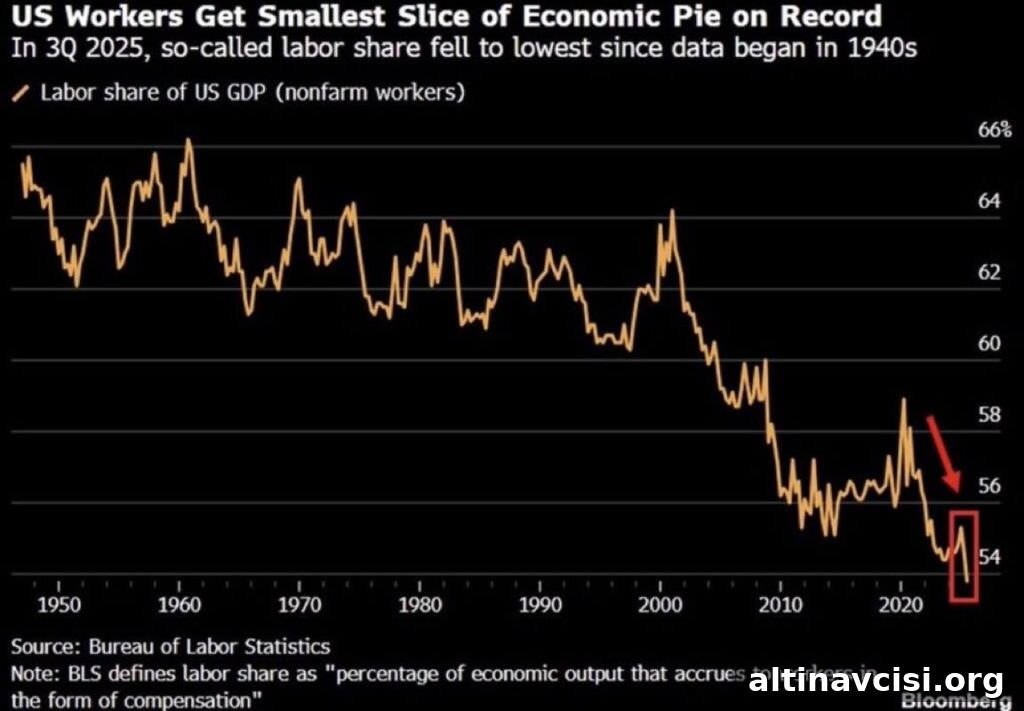
Labor share measures the portion of economic output that flows to wages and compensation rather than capital and profits. Over the past two decades this share has eroded significantly, with the financial crisis and subsequent structural shifts accelerating the trend.
Why this matters: when workers receive a smaller slice of national income, consumer spending — the engine of roughly 70% of U.S. GDP — risks weakening. Growing inequality and reduced purchasing power can dampen sustainable growth and increase macroeconomic fragility over time.
You May Also Like
- Silver Breaks $92; Analysts Note Potential for $100 by March
- Silver Jumps as Markets Reassess Risk Premiums
- Gold and Silver Soar Amid Concerns Over Central Bank Independence
- Gold Rises as Growth Signals Weaken and Job Momentum Slows
- Silver Experiences Volatility Ahead of Index Rebalancing and Jobs Data
Popular Topics
Picked from the archive
-
01
 Topics
Oil Prices Near $70 as Traders Warn of Looming Supply Glut
-
02
Topics
Gold-Backed Crypto Tokens Surge as Investor Demand Spikes
-
03
Topics
Gold Climbs as Dollar Weakens Ahead of US Producer Price Index
-
04
Topics
Dollar Surges as Trump Threatens Tariffs on Copper and Chips
-
05
Topics
Silver Price Surges 10% in June; July Outlook Positive
-
06
Topics
June Home Sales Drop 2.7% as Affordability Squeeze Worsens
-
07
Topics
Dollar Drops as Markets Price In Fed Cuts; Tariff Fears Rise
-
08
Topics
Powell to Announce Fed Policy Shift at Jackson Hole Summit