U.S. Debt Tops $38T; J.P. Morgan Forecasts Gold Above $5,000
Daily News Nuggets | Today’s top stories for gold and silver investors
October 23rd, 2025
Inflation Still Running Hot, But Fed Expected to Cut Anyway
Friday’s Consumer Price Index report is expected to show inflation remaining uncomfortably high. Core prices are forecast to rise 0.3% in September and sit around 3.1% year‑over‑year — well above the Federal Reserve’s 2% target. That continues a stretch of persistent price pressure that hasn’t cooled as quickly as policymakers anticipated.
Despite that, markets are pricing in a near‑certain rate cut next week. JPMorgan’s trading desk estimates roughly a 65% chance that stocks will rally after the data regardless of the print. The prevailing market view is that slowing growth, rather than elevated inflation, will drive the Fed’s decision.
That’s a risky assumption. Cutting interest rates while inflation remains elevated tends to weaken the currency and compress real yields — conditions that historically favor gold. For investors who view central-bank policy mistakes as a real possibility, precious metals often outperform because they act as an inflation hedge and portfolio insurance.
Americans Aren’t Buying the “Inflation Is Fixed” Narrative
Political messaging that inflation is under control is colliding with everyday reality. Costs that matter to households — groceries, insurance, rent and mortgage payments — remain high for many consumers, and an August CPI reading of 2.9% reversed months of cooling, underscoring that tariffs and lingering supply‑chain pressures are still working through the economy.
When public messaging diverges from lived experience, behavior changes. Savers and investors increasingly favor tangible stores of value — real estate, commodities and precious metals — that cannot be devalued by central-bank balance sheets or political spin. That demand for real assets often outlasts the headlines and can keep upward pressure on gold and silver even after policymakers pivot.
Nearly a Third of the U.S. Economy Now at Recession Risk
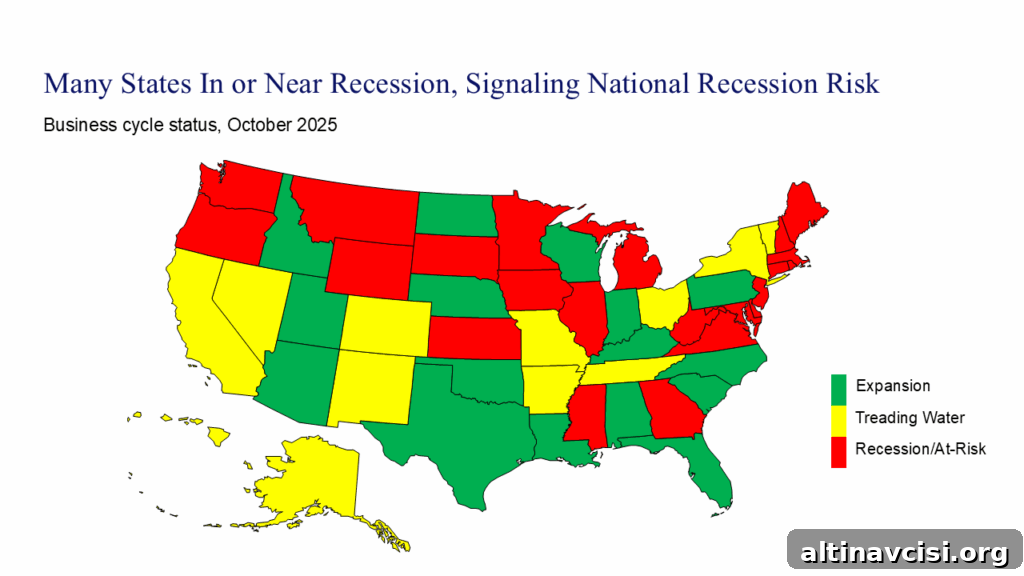
National GDP figures still show expansion, but regional data tells a different story. According to Moody’s Analytics and other regional measures, 22 states plus Washington, D.C. are currently in or near recession. This fragmentation highlights a widening gap between headline economic growth and underlying weakness spread across large parts of the country.
Chief economist Mark Zandi’s state‑by‑state breakdown shows that strain is not limited to rural or small states. While Texas continues to expand, economic powerhouses such as California and New York are barely growing, and states with industrial exposure like Michigan have shifted from stable to distressed in recent months.
Why this matters: when roughly a third of the economy is showing clear weakness while indexes like the S&P 500 sit near record highs, markets may be underpricing downside risk. Historically, such regional cracks tend to widen before broader deterioration appears in employment figures and corporate earnings. That scenario is precisely when defensive assets such as gold often reaffirm their role as portfolio protection.
U.S. National Debt Crosses $38 Trillion
The U.S. national debt recently surpassed $38 trillion, an increase of roughly $2 trillion since January. That latest trillion was added in about eight weeks — the fastest pace outside pandemic emergency spending — yet without the same crisis justification. The result: an interest bill that now tops $1.2 trillion annually, consuming a growing share of federal revenues.
Wall Street is increasingly focused on the long‑term implications. Large, sustained deficits can erode confidence in the dollar if foreign creditors become less willing to finance U.S. borrowing. When faith in fiat currency weakens, investors historically shift toward hard assets that are not a liability of any government. Gold, in particular, benefits in such environments because it cannot be printed away and remains a recognized store of value.
Taken together — persistent inflation, regional economic fragility and a rapidly rising debt burden — the macro backdrop increasingly supports treating precious metals not just as a hedge but as a core portfolio allocation for risk management.
J.P. Morgan Predicts Gold Above $5,000 by Late 2026
J.P. Morgan’s commodities desk has issued one of the most bullish gold forecasts in recent memory, projecting that prices will average $5,055 per ounce by the end of 2026 — roughly 20% above current levels. The bank points to three converging forces: slowing global growth, a weakening dollar, and significant central‑bank accumulation, notably by China and other emerging market buyers seeking to reduce dollar dependence.
Analysts compare the present mix of negative real rates, currency concerns and geopolitical tension with the early 2000s, when similar conditions triggered a long bull market for gold. If inflation remains elevated while central banks pivot toward rate cuts — further compressing real yields — gold could move from a tactical trade to a structural holding in many portfolios.
Investing in Physical Metals Made Easy
For investors concerned about inflation, currency risk and fiscal strain, physical precious metals can serve as a durable complement to traditional financial assets. Consider allocation, storage, and liquidity when evaluating metals for your portfolio.
Summary: Inflation remains stubborn even as markets expect policy easing, regional economic weakness is widening despite healthy national GDP figures, and the federal debt load is escalating. Those conditions, along with large central‑bank purchases and a potentially softer dollar, create a macro environment where gold and silver often play a defensive and diversifying role. Investors weighing portfolio risk would be well served to consider how precious metals fit into their long‑term strategy.
Popular Topics
Picked from the archive
-
01
 Topics
Dollar Steadies After Jobs Data Shock Sends 90% Odds of Fed Cut
-
02
Topics
Consumer Confidence Hits 4-Month High as Inflation Eases
-
03
Topics
Gold Price Falls Below $3,340 Ahead of Fed Comments
-
04
Topics
Global Oil Prices Steady as Travel Demand Rises, Sanctions Loom
-
05
Topics
Silver Prices Eye Record Highs as Fed Signals Rate Cuts
-
06
Topics
AI Bubble Fears Surge as Gold Price Falls Below 4,000 USD
-
07
Topics
Tariff-Driven Inflation Clouds Fed’s September Rate Decision
-
08
Topics
10-Year Treasury Yield Rises After Tariff News, Services Data