Gold Price 2025: Why Gold Will Outperform Models

Written by: The MacroButler
The markets have labeled 2025 not a jubilee but a dense fog of uncertainty. Investors feel the disorientation, sensing chaos without fully grasping its source. To understand this moment, it helps to return to Frank Knight’s 1921 distinction in Risk, Uncertainty, and Profit: risk is measurable; uncertainty is not. Risk can be quantified; uncertainty resists statistics and models. Knight argued that real profit often comes from navigating the incalculable rather than from taking known risks. Keynes and Davidson extended this thinking, but the core remains: when the future cannot be mapped, acting decisively creates opportunity. In 2025 the fog is thick, and that Knightian uncertainty is the defining feature.

While academics emphasize unmeasurable uncertainty, experienced market participants point to a very different view: long-run patterns, cycles, and historical precedent matter. Dismissing centuries of recurring financial patterns because they are inconvenient to model is risky. Some schools of thought treat the economy like a random beast that requires constant government intervention. But putting short-term, politically driven institutions in charge of “managing unpredictability” often creates more instability than it resolves.
In many classrooms economics is framed as unpredictable while natural science treats systems as law-bound. Practitioners who study cycles point to a consistent conclusion: cycles exist and influence outcomes. The business cycle repeatedly reasserts itself, regardless of theoretical optimism.
Many policymakers and politicians have not engaged seriously with the dynamics of the business cycle, assuming they could outmaneuver it. The consequences of that oversight are now visible in the market turmoil we see today.

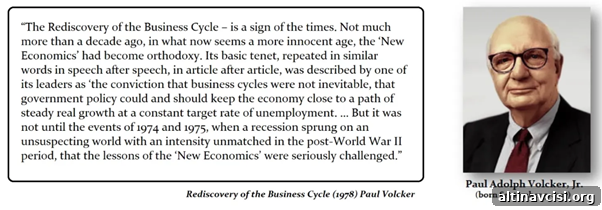
Market veterans tend to be skeptical of textbook economic theory crafted far from trading floors. Historical episodes—like the collapse of Bretton Woods and subsequent policy responses—remind us that the business cycle is real and persistent. Fed chairs such as Arthur Burns and Paul Volcker recognized the cycle’s power: it resurfaces and reshapes economic outcomes even in the face of aggressive policy efforts. Volcker often noted the roughly seven-year rhythm of cycles, a practical observation that contradicts the notion that recessions are merely avoidable anomalies.
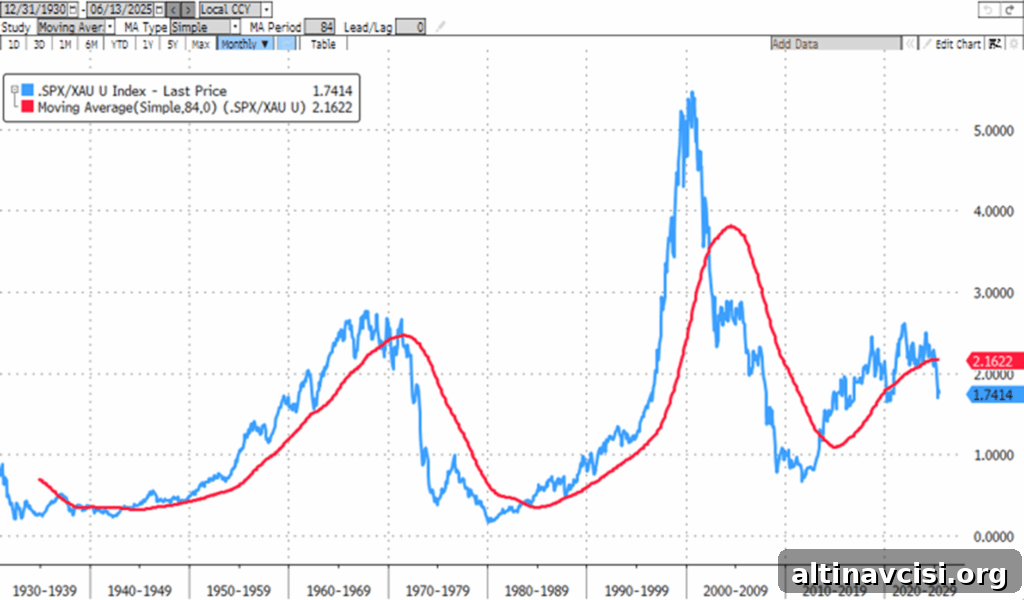
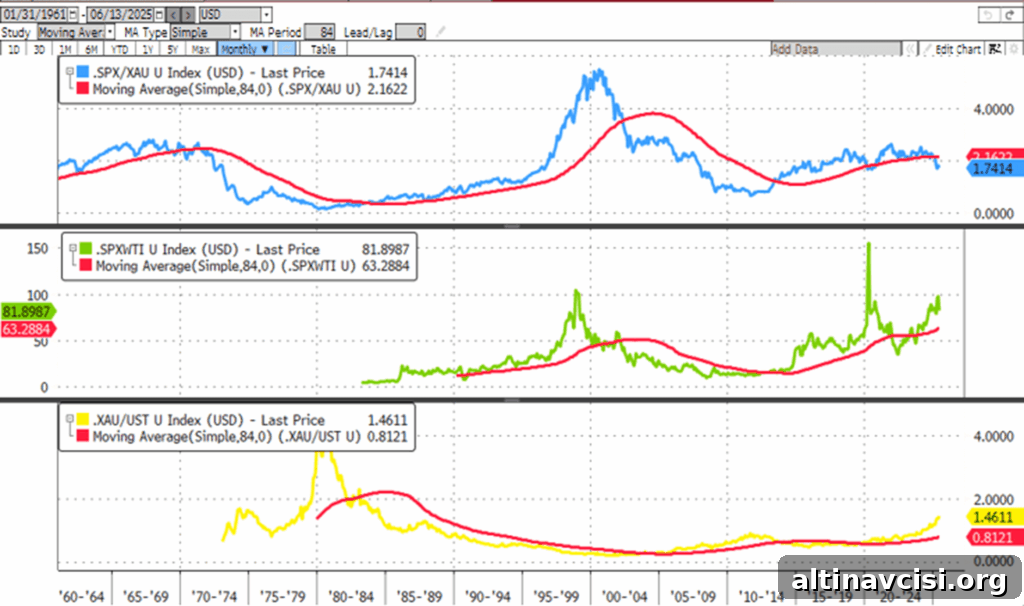
Since the new administration took office on January 20, 2025, a clear market signal emerged: the S&P-to-Gold ratio fell below its seven-year moving average. Historically, that indicator has signaled major shifts in investor sentiment and risk appetite.
Put simply: the data suggests the economy is not headed for a smooth soft landing but preparing for a more difficult phase. No amount of optimistic spin changes the underlying technical and cyclical signals.
S&P 500 to Gold ratio (blue line); S&P 500 to Gold Ratio 7-Year Moving Average (red line).
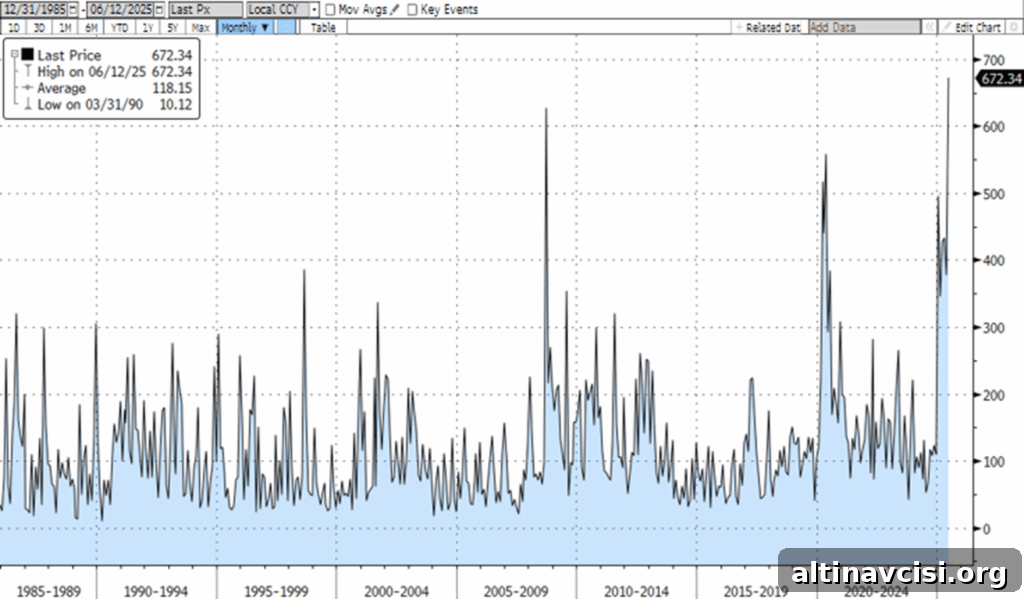
Policy uncertainty has risen sharply. A vaguely specified “reciprocal” tariff plan and ongoing tariff rhetoric have raised fears of retaliatory measures, higher costs, and disruptive trade shifts. The Economic Policy Uncertainty Index—tracking media references to policy-related uncertainty—has spiked, reflecting heightened market anxiety.
US Economic Policy Uncertainty Index since 1984.
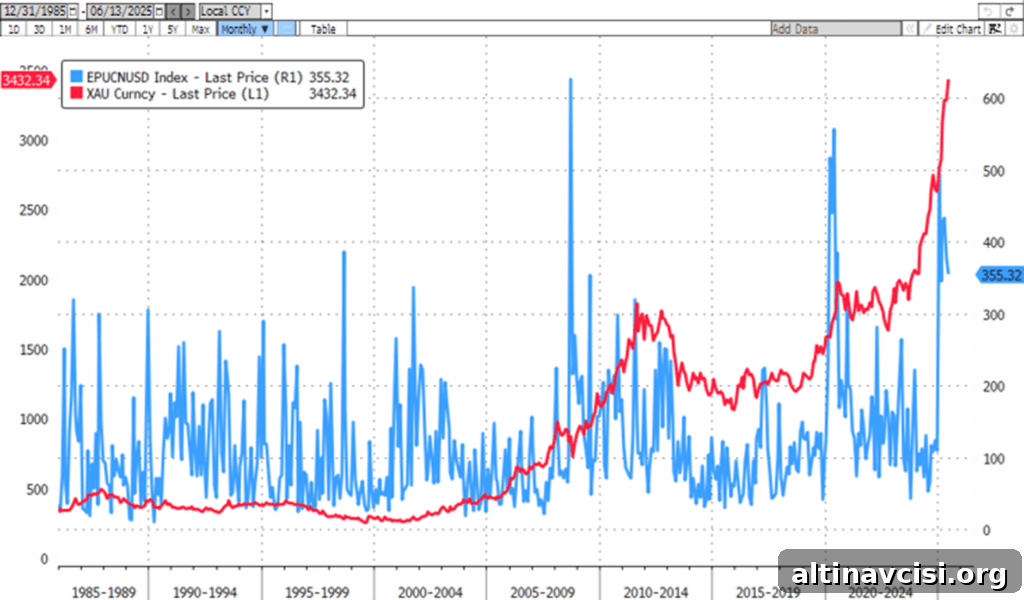
As confidence in U.S. institutions and policy consistency weakens, investors reassess counterparty risk. One asset that requires no counterparty or central bank backup is physical gold, and demand for it tends to rise when trust in governance and financial plumbing deteriorates.
US Economic Policy Uncertainty Index (blue line); Gold price in USD (red line).
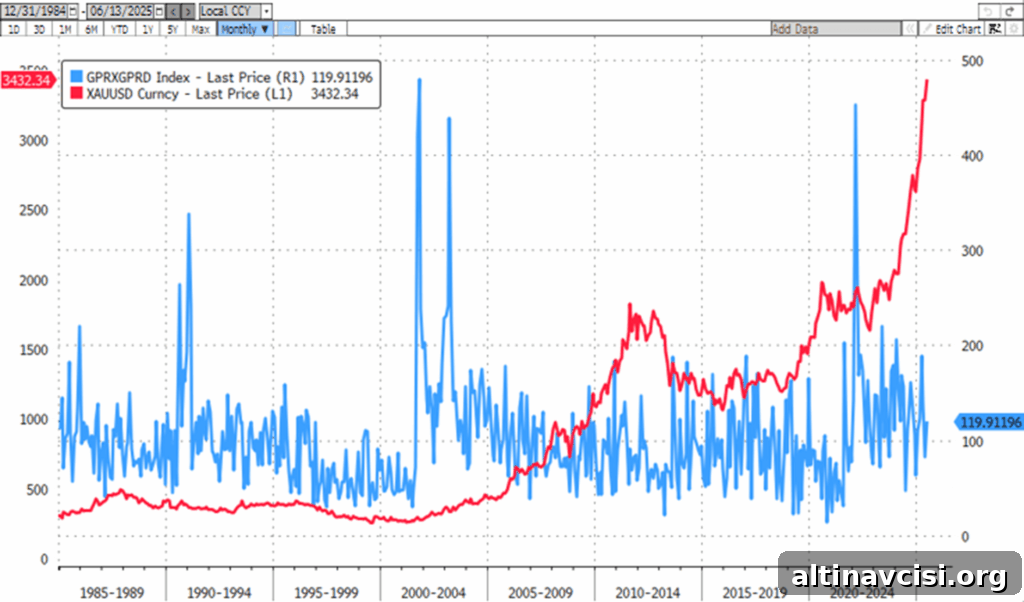
Gold traditionally benefits from geopolitical risk, and its price often correlates with spikes in geopolitical tension and policy uncertainty.
Geopolitical Risk Index (blue line); Gold price in USD (red line).
The relationship between gold and U.S. Treasuries has changed since early 2022. Geopolitical developments and sanctions dynamics altered perceptions of sovereign assets, introducing a new political dimension to what had previously been considered safe reserve holdings. This shift elevated concerns about political confiscation and access to reserve assets during international disputes.
Gold Price in USD terms (blue line); US 10-Year Yield (red line) & correlation since 1965.
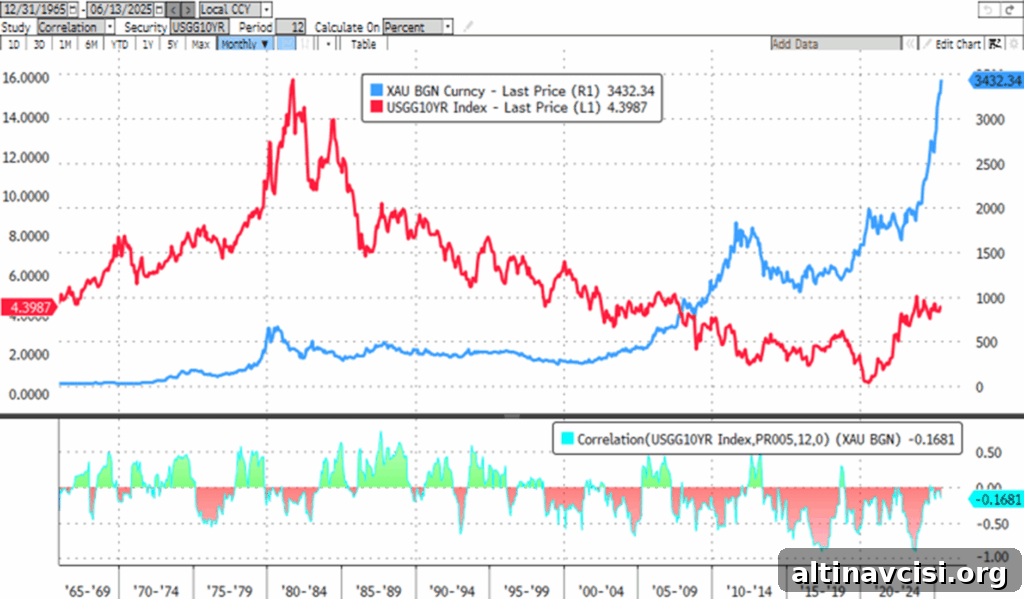
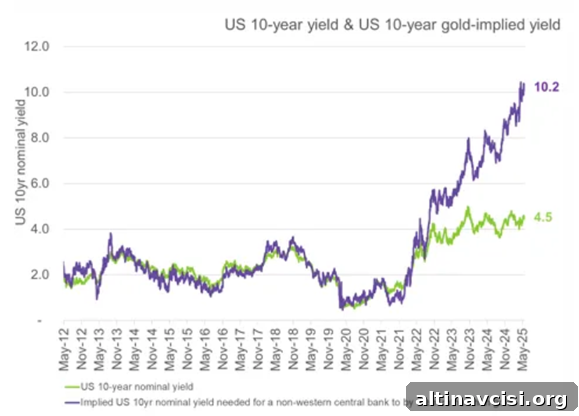
Wall Street’s conventional view is that gold’s opportunity cost is the real interest rate—when real rates rise, gold underperforms, and vice versa. But political actions that complicate access to reserve assets have weakened the perception of Treasuries as completely “risk-free.” For reserve managers outside the U.S., the risk of politically driven restrictions has added a premium to the cost of holding dollar-denominated assets.
Gold Price in USD terms (blue line); US 10-Year Yield (red line) & correlation since 1965.
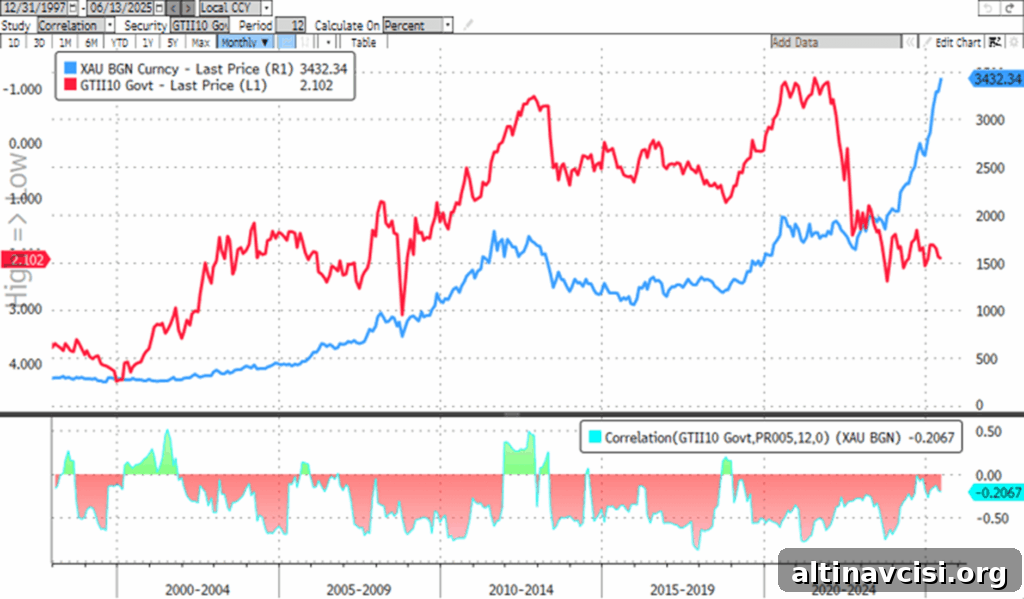
The freeze of foreign reserves in recent years served as a wake-up call for many central banks: access to U.S. dollar assets can become contingent on geopolitics. That creates a “confiscation tail risk” that must be priced by international reserve managers. For some global investors, the implied political risk premium makes physical gold comparatively more attractive.
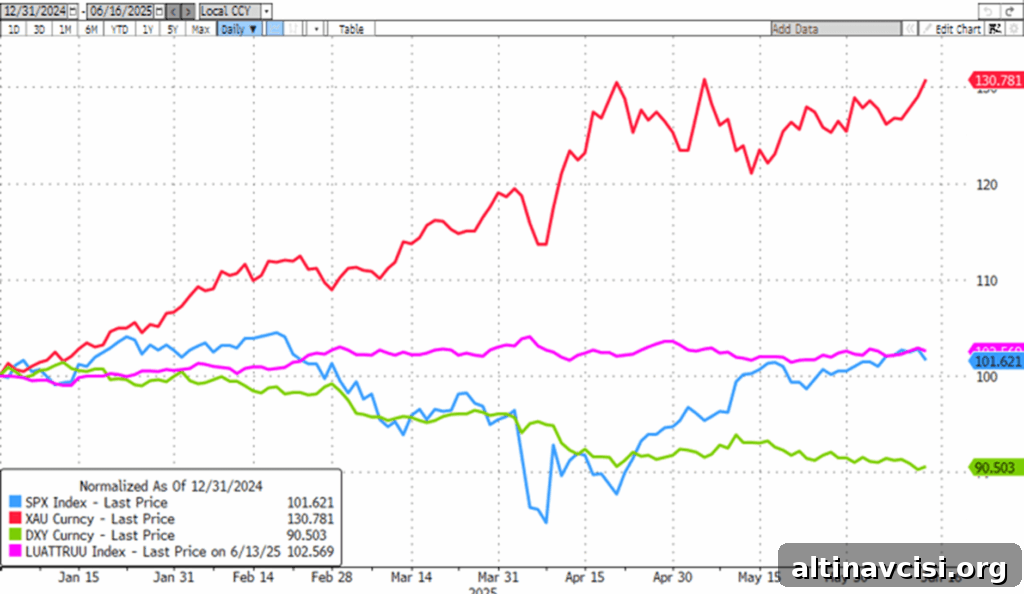
April 2025 illustrated how quickly markets can move: stocks, bonds, and the dollar weakened simultaneously while gold rallied to fresh highs. A surprise tariff announcement intensified fears of stagflation and recession, triggering broad market dislocations and pushing investors toward traditional safe havens.
Performance of $100 invested in S&P 500 index (blue line); Gold (red line); USD Index (DXY Index) (green line); Bloomberg US Treasury Total Return Index (purple line) since December 31st, 2024.
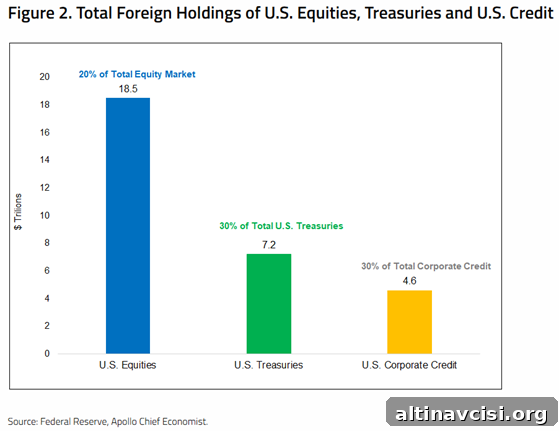
Foreign investors hold roughly $30 trillion in U.S. assets, many with substantial unrealized gains. Shifts in hedging behavior or confidence could trigger large currency flows, pressure yields, and affect the dollar. While the U.S. financial position remains strong overall, vulnerabilities are growing and could amplify market stress if policy missteps continue.
Gold peaked around $3,500 on April 22 and then experienced a rapid correction amplified by leveraged selling. Yet physical demand—notably from Chinese buyers and ETFs—remained robust, supporting prices through structural demand.
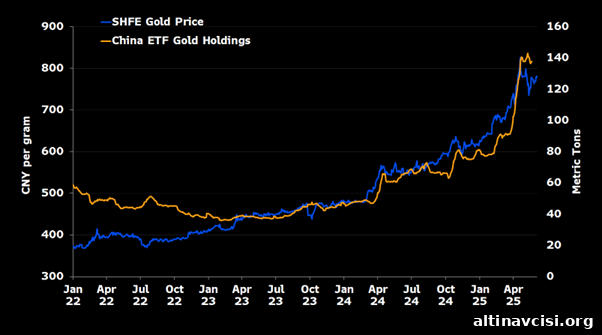
Managed-money positions in the U.S. have stabilized following earlier forced liquidations. Structural drivers—widening fiscal deficits, a softer dollar, rising long-term yields, and tariff-driven price pressures—argue for continued support for gold as a strategic holding.
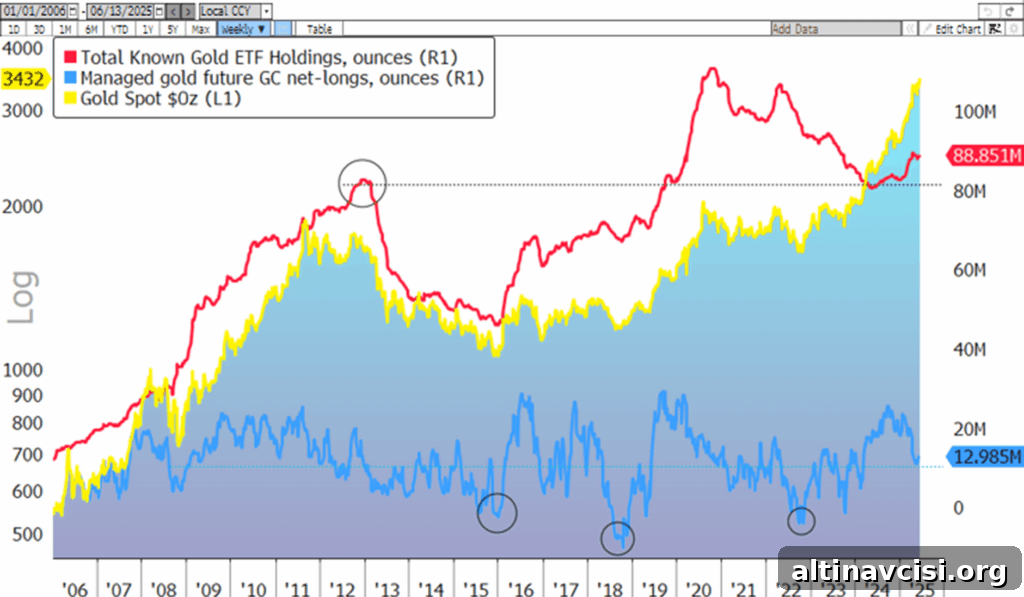
Central banks, particularly in emerging markets, have been active buyers of physical gold. They value its lack of counterparty exposure and its role as a reserve diversifier. In Q1, central bank purchases exceeded the five-year quarterly average, reflecting strategic accumulation rather than speculative momentum.
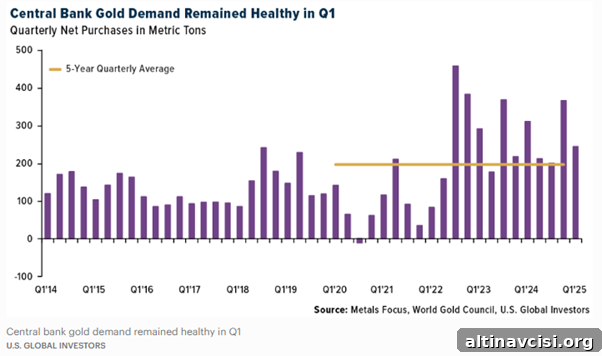
Global foreign exchange reserves exceed $12 trillion, still heavily weighted toward the U.S. dollar and other major currencies. Emerging market central banks have room to increase gold allocations: for example, China’s gold share of reserves remains below that of several advanced economies, offering potential for further diversification.
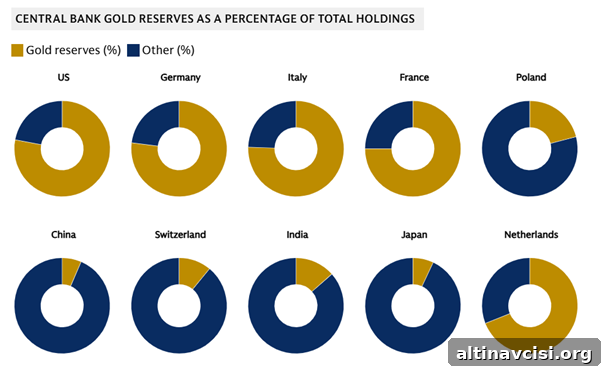
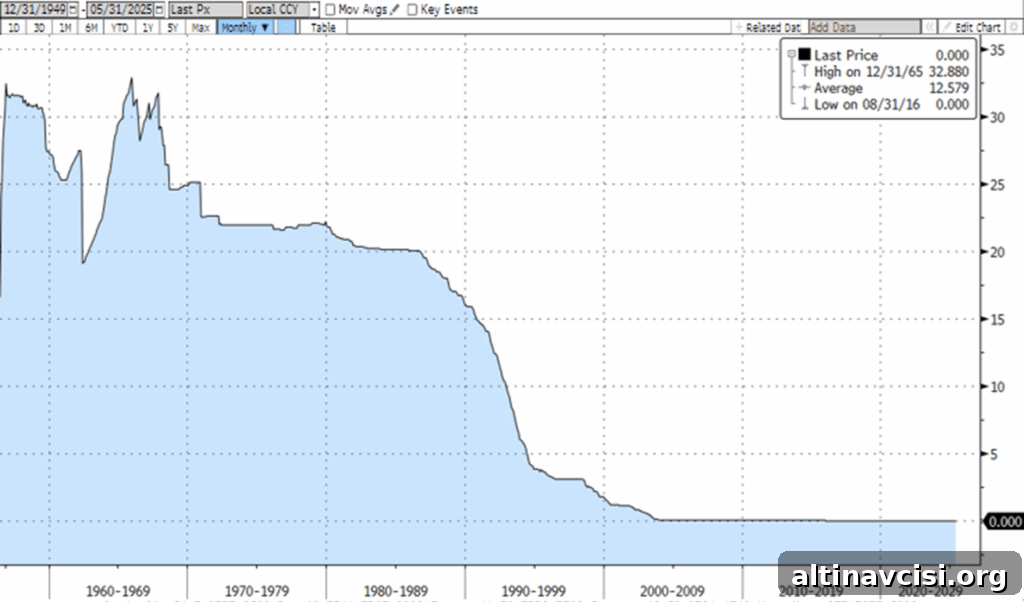
Some developed countries reduced gold holdings in prior decades. Canada, for instance, sold most of its reserves over time, preferring liquid government securities and foreign currencies. The UK’s late-1990s gold sales—executed near historic price lows—remain a widely cited example of timing costs associated with reserve management decisions.
Canada Gold Holding In Million Troy Ounces since 1949.
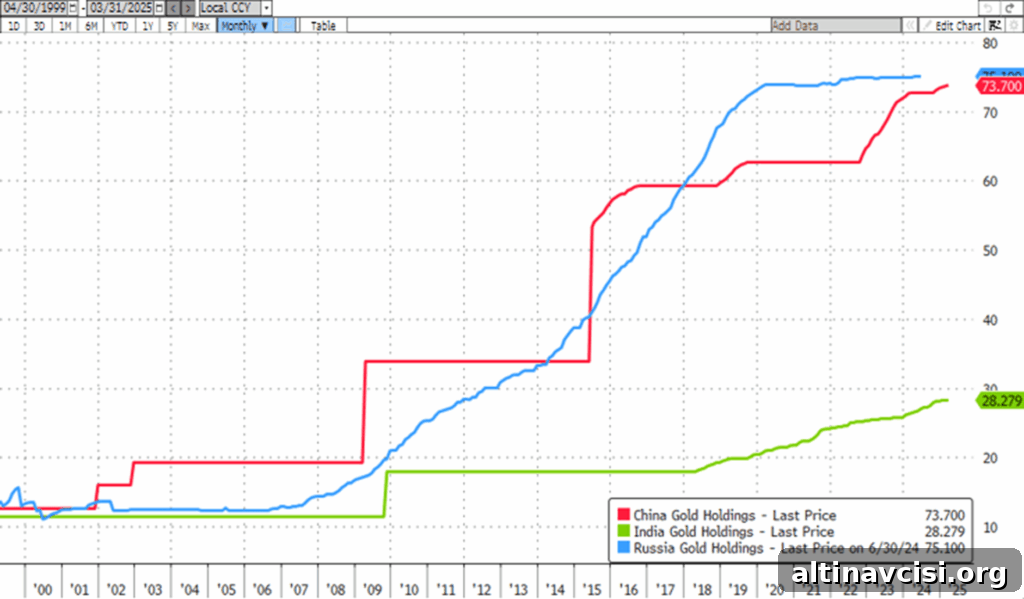
In contrast, several emerging market central banks have been increasing bullion purchases, part of a longer-term strategy to reduce reliance on a single dominant reserve currency and to diversify across tangible assets.
Russia (blue line); China (red line); India (green line) gold holdings in million Troy Ounces.
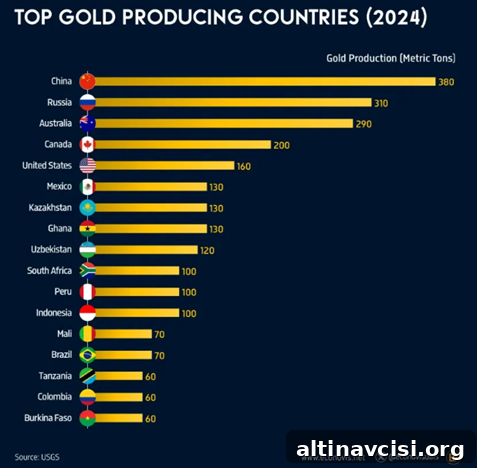
Producers and large consuming nations adding to official holdings create a structural backdrop for gold prices: production, central bank demand, and strategic accumulation together support a higher long-term floor for bullion.
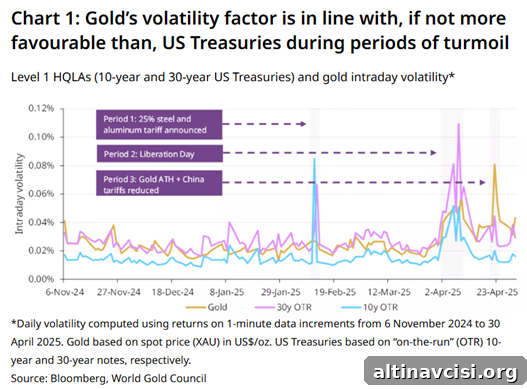
Regulatory shifts also matter. From mid-2025, Basel III reforms were scheduled to formalize gold’s treatment in bank capital frameworks. Under these rules gold receives a 0% risk weight for capital purposes, which elevates its status in regulatory terms. While liquidity treatment and specific haircut requirements remain nuanced—meaning not all forms of “paper gold” qualify—this represents a meaningful change in how regulators view unencumbered physical bullion.
That said, regulators emphasize strict conditions: only unallocated, fully allocated physical bars qualify for certain benefits, and haircuts or funding requirements still apply under liquidity metrics.
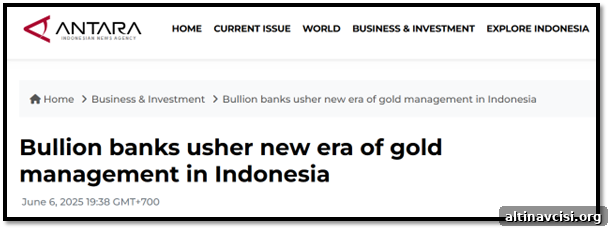
Bullion banks—specialized institutions that trade, store, and finance physical precious metals—are expanding beyond traditional centers like London and Zurich. New hubs are emerging in jurisdictions focused on secure custody and independence, reflecting demand for real assets and a desire to hold bullion outside conventional financial chains.
This trend is mirrored in some U.S. states that have moved to recognize gold and silver coins as legal tender or to exempt transactions in bullion from certain taxes. These measures are largely symbolic for now but signal growing political and public interest in non-fiat monetary options.
The broader political economy is changing as tech capital and private interests influence policy, governance, and regulatory outcomes. Market participants should note how private power, regulatory capture, and political cycles shape economic risk.

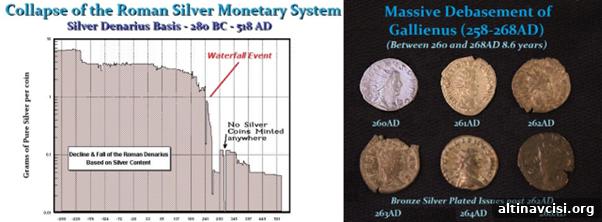
History offers cautionary examples: currency debasement, fiscal strain, and political fragmentation have long preceded major economic dislocations. Ancient coinage debasements and modern reserve mismanagement alike remind us that monetary stability depends on credible institutions and prudent fiscal policy.
As policy uncertainty rises and the business cycle turns, investors should reassess portfolio priorities: focusing on preserving capital rather than chasing returns. Real assets—particularly physical gold and silver—offer non‑counterparty, tangible stores of value. Diversified commodity exposure and short-duration investment-grade USD instruments can help manage liquidity and downside risk.
Active cash management—favoring short-dated investment-grade corporate bonds and Treasury bills with maturities under 12 and three months respectively—preserves flexibility. In equities, favor lean, low-leverage companies with resilient free cash flow, and prioritize energy and commodity producers that can benefit from supply-side dislocations.
In short: the “Goldilocks” era of steady growth and low volatility may be over. Prepare for a cycle where capital preservation, real assets, and disciplined liquidity management take precedence.
KEY TAKEAWAYS.
The main points of this analysis are:
- When uncertainty rules, historical cycles and practical signals often matter more than optimistic models.
- Since January 20, 2025, the S&P-to-Gold ratio has fallen below its seven-year average, signaling that a smooth soft landing is unlikely.
- Policy shifts and tariff risks have driven investors toward physical gold as a reliable safe haven.
- U.S. Treasuries’ perceived “risk-free” status has been challenged by geopolitical and sanction risks, elevating the case for non‑counterparty assets.
- Central banks are increasing gold reserves, while some developed economies regret past gold sell-offs—underscoring gold’s strategic value.
- Basel III changes raise gold’s regulatory standing, although liquidity and haircut rules constrain some uses.
- Bullion banks and diversified custody options are expanding globally as demand for physical metal grows.
- Investors should prioritize the Return OF Capital over the Return ON Capital amid rising stagflation risks and volatility.
- Physical gold and silver remain effective hedges against erosion of trust in public institutions and currency risk.
- Short-duration, high-quality USD instruments and selective, low-leverage equities complement a defensive allocation.
HOW TO TRADE IT?
As of mid‑June 2025, the U.S. appears to be in an inflationary upswing while key indicators—such as the S&P‑to‑Gold ratio—signal a likely transition to an inflationary bust sooner than many expect. Investors should remain disciplined, use market data to anticipate cycle changes, and avoid getting swept up by optimistic narratives.
Practical recommendations:
- Reduce exposure to long-duration government bonds; prefer short-dated, investment-grade USD corporate bonds (<12 months) and T‑bills (<3 months).
- Increase allocation to physical gold and silver held in secure, allocated custody outside risky counterparty arrangements.
- Favor equities with strong earnings, free cash flow, low leverage, and exposure to energy and commodity production rather than discretionary consumption.
- Maintain liquidity and be prepared for heightened volatility; active cash management is essential.
- Diversify across real assets and consider bullion-based custody solutions for a portion of reserves.
In short: preserve capital, favor tangible assets, and prepare for a cycle where uncertainty, not complacency, determines outcomes. In a world of rising policy and geopolitical risk, physical gold remains a core instrument for capital preservation.
This article originally appeared on The MacroButler Substack.
Popular Topics
Picked from the archive
-
01
 Topics
China May Cut Tariffs on Key US Medical and Industrial Imports
-
02
Topics
Weaponizing Supply Chains: Rare Earths to Semiconductors
-
03
Topics
76% of Central Banks to Increase Gold Reserves, WGC Survey Finds
-
04
Topics
Trump Demands Powell’s Removal as Fed Chair Warns on Tariffs
-
05
Topics
Gold Rises to No. 2 Global Reserve amid Sanctions Concerns
-
06
Topics
Daly Urges Fed to Temper Forecasts and Balance Dual Mandate
-
07
Topics
Strong Jobs Report Drives 10-Year Treasury Yield Above 4.34%
-
08
Topics
Report: Republican Tax Bill Masks Over 1 Trillion in Future Debt