

Last verified September 2026.
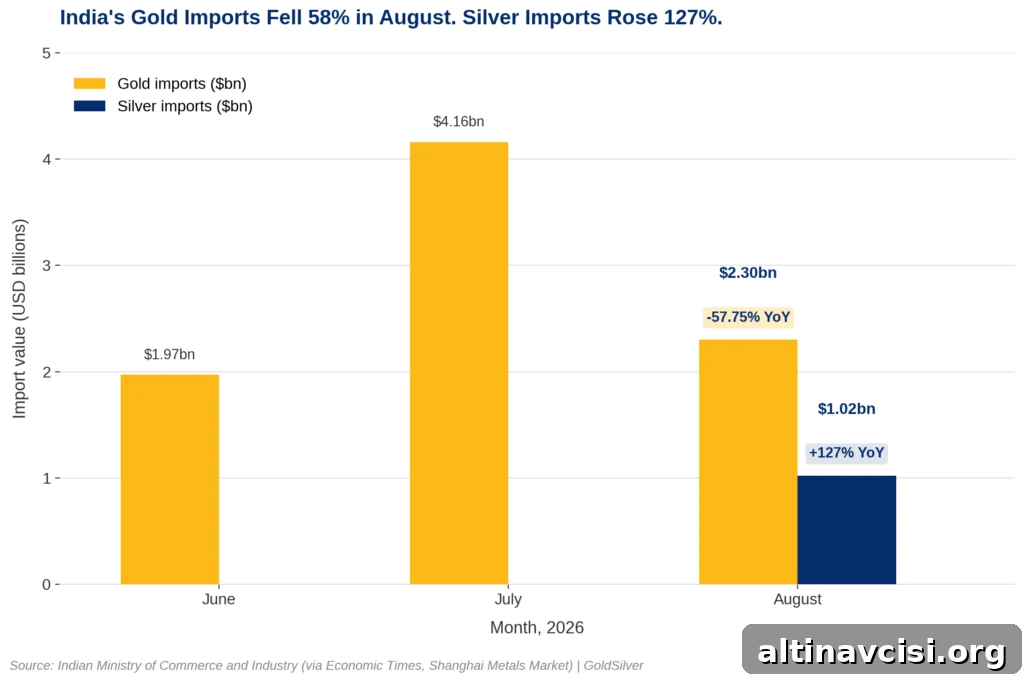
India’s gold imports didn’t just decline in August — they plunged. Commerce Ministry data reported that imports fell 57.75% year-over-year to $2.3 billion, while silver imports rose 127% to $1.02 billion. That sharp divergence between the two precious metals is the most pronounced the country has seen this year and offers a clear snapshot of how recent policy and price shifts are changing saver behavior in the world’s largest gold-consuming nation.
At the time of writing, gold is trading near $4,303 per ounce, up roughly 0.65% as markets cool after recent geopolitical tensions eased. Silver is trading around $64.81, up about 1.5%. Those daily price moves are secondary to the broader story: India’s August trade data provide a strong indicator of how a policy change — combined with high prices — can alter both official trade flows and actual household demand.
Key Takeaways:
- India’s gold imports fell 57.75% year-over-year in August to $2.3 billion, while silver imports rose 127% to $1.02 billion.
- Analysts propose three main explanations: lower household buying due to higher costs, postponed purchases ahead of the festival and wedding season, or a shift to unofficial, untaxed channels.
- April–August gold imports remain up about 3.38% year-over-year, indicating that the August collapse is a sharp one-month signal rather than definitive proof of a sustained trend.
Why Did India’s Gold Imports Collapse in August?
The primary driver is policy rather than a sudden change in sentiment. On May 13, 2026, India raised import duties on gold and silver from 6% to 15%. August represented the first full month when that higher duty fully affected landed costs, and it arrived alongside gold prices above $4,300 per ounce. After a rebound in July — when imports rose to $4.16 billion — August’s figures fell sharply, cutting that rebound by nearly half.
Kotak Institutional Equities described three plausible explanations. First, the straightforward view: households are buying less physical gold because the combined impact of the duty and elevated prices makes jewelry and bullion more expensive. That outcome would reduce import-driven pressure on India’s trade balance. Second, households may be postponing purchases until the Diwali and wedding season, when gold buying typically surges. Third, and more worrying for official statistics, demand may be migrating into informal or smuggled channels, meaning official import figures understate true consumption.
What Happens to Demand That a Duty Can’t Kill?
History and recent enforcement data point to the third mechanism as the most active. A 15% customs duty won’t eliminate demand for gold in a country where millions of households use the metal as a core store of value. Instead, it creates a price gap between taxed and untaxed channels, and that gap tends to be filled. India previously ran a large unofficial gold market under strict controls prior to 1990, and those informal channels re-emerge whenever official routes become costly or constrained.
Consistent with this, customs seizures of smuggled gold nearly doubled in the six weeks after the May duty increase, according to parliamentary data. That suggests official trade statistics measure tax-paid imports and therefore track compliance rather than total real demand. In short, an apparent collapse in duty-paid imports may reflect shifting routes and reporting rather than an equivalent fall in underlying household appetite for the metal.
Does China Show the Same Pattern?
Similar dynamics have been visible in other major markets. China recorded very large gold inflows over recent months, with official data showing more than 1,000 tonnes imported in eight months while the central bank accounted for only a fraction of that total. In both India and China, headline import figures capture only part of what savers and other buyers actually do; the remainder can show up in unofficial flows, private hoarding, or local premiums.
For investors and savers trying to interpret market signals, the key is to look beyond official import numbers. Consider price charts, domestic premiums, customs seizure reports, and festival-season buying patterns to build a fuller picture of demand.
Why Did Silver Imports Rise While Gold Imports Fell?
The divergence between gold and silver reflects price sensitivity more than a change in preference for stores of value. At roughly $4,300 per ounce, gold became unaffordable for many routine jewelry purchases once the duty is included. Silver, trading near $65 per ounce, remains within reach for everyday buyers even with a 15% import tax. The result: households shifted some of their near-term buying toward the metal that fits the budget.
August’s data therefore read as an affordability effect layered on top of policy-driven shifts in trade reporting. The crucial test will be September and October trade figures — the run-up to Diwali and the wedding season. If gold imports rebound, that supports the postponement hypothesis. If official imports stay depressed and reports of gray-market premiums increase, that would support the theory that significant demand has moved into underground channels.
Stay On Top of Gold & Silver Prices
Get important market alerts sent straight to your inbox.
SOURCES
1. Angel One – India’s Gold Imports Plunge 57.75% to $2.3 Billion in August 2026; Silver Imports Rise 127%
2. CNBC – India Hikes Bullion Import Duties as the World’s Second-Largest Gold Market Faces a Declining Rupee
3. Business Standard – India’s Gold Imports Fall Sharply: Kotak Sees ‘Good, Bad and Ugly’ Outcomes
4. IBTimes India – India’s Gold Imports Plunge 57.7% to $2.3 Billion in August as Overall Imports Rise 14.1%
5. GoldSilver – China Imported 1,000+ Tonnes of Gold in Eight Months. Its Central Bank Bought Only 80.
6. World Gold Council – Bullion Trade: India Gold Market Series
7. The Print – India Gold Duty Changed 8 Times in 14 Years. What This Did to Smuggling
Disclaimer: This article is for informational purposes only and does not constitute investment advice. Past performance is not indicative of future results. Always consult a qualified financial advisor before making investment decisions.
You May Also Like:
- Municipal Bonds Just Broke a 15-Year Record. Gold Doesn’t Have This Problem.
- Washington Sold $70 Billion in Debt. Wall Street Only Wanted Part of It.
- Gold’s Price Barely Moved. Five Institutions Repositioned Anyway.
- Iran Repeated Its Hormuz Demand at the UN. The Market Already Priced It In.
- Today’s PMI Beat Cuts Gold Two Ways. Only One Side Has Been Priced In.
- Gold Fell 1.7% Today. Silver Fell 3.6%. Five Signals Point at the Dollar, Not Demand.
- Xi Lands in Washington. Gold and Silver Both Retreat, and Silver Falls Harder.
- UBS Holds Its Silver Target. The Market Already Got There First.