
Nearly every major bank’s gold price prediction for 2025 had pointed higher, but few forecasters expected how dramatic the rally would become. By October 2025, gold surged past $4,000 per ounce, setting new records and reinforcing its role as a primary safe haven amid ongoing monetary and geopolitical uncertainty.
The performance over recent years highlights gold’s resilience and appeal as a defensive asset:
- 2020: +24.9%
- 2021: -3.6%
- 2022: -0.31%
- 2023: +13.09%
- 2024: +27.11%
(Source: StatMuse, CME, World Gold Council)
Gold Price 5 Year Chart
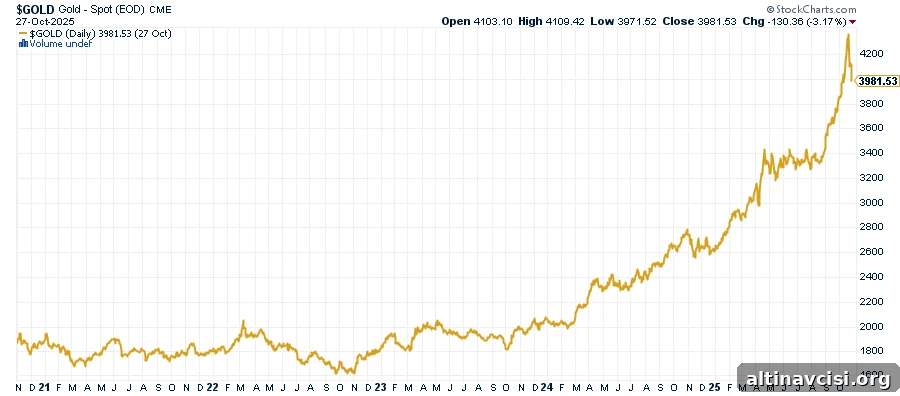
With prices consolidating just below all-time highs, investors are asking a central question: how much higher can gold go and how long might this bull market last?
What the Big Banks Are Saying: 2026–2030 Outlook
Consensus among major financial institutions has shifted notably upward. Forecasts that once seemed bullish are now the baseline. Several banks have published scenarios that project gold reaching $5,000 per ounce in 2026, with some desks outlining even larger moves later in the decade.
Key calls from the street include:
HSBC expects a “bull wave” pushing gold to $5,000/oz by the first half of 2026, and has lifted its annual average forecast to $4,600.
Bank of America raised its 2026 target to $5,000, citing policy uncertainty and rising investment demand, with an average forecast near $4,600.
J.P. Morgan updated its view in October 2025 to project gold averaging roughly $5,055 in Q4 2026, and suggested a longer-term target around $6,000 by 2028 if current trends continue.
The bottom line: Baseline forecasts have shifted higher. Late-2025 projections cluster in the high $3,000s, early-to-mid 2026 forecasts move through $4,000, and multiple reputable firms now publish $5,000 scenarios for 2026 with at least one desk mapping a path to $6,000 by 2028.
What’s Driving Gold Higher?
Three main forces support the bullish case:
1. Persistent central bank demand
Central banks continued to accumulate gold at a strong pace, averaging roughly 710 tonnes per quarter through 2025. Large-scale official buying creates a structural bid under prices and suggests institutions are diversifying reserves away from traditional assets.
2. Inflation and monetary policy dynamics
Inflation measures combined with broad money growth have indicated continued monetary expansion in many regions. Historically, gold performs well during inflationary regimes, making it an attractive hedge against currency erosion.
3. Geopolitical and macroeconomic uncertainty
Elevated global tensions and the prospect of stagflation or uneven growth keep safe-haven demand robust. If economic conditions worsen, safe-haven flows could push gold another 10%–15% higher from current levels.
How Much Gold Should You Own? Portfolio Allocation for the Next 5 Years
Appropriate allocation depends on objectives and risk tolerance:
Conservative (8–12%): Emphasize wealth preservation and downside protection, suitable for investors prioritizing stability amid uncertainty.
Moderate (5–10%): Balance defensive exposure with growth assets to capture steady appreciation while limiting concentration risk.
Aggressive (3–8%): Use a smaller core position in gold alongside higher-risk assets like silver or mining equities for potential amplified returns.
In September 2025, Morgan Stanley CIO Michael Wilson proposed a much higher allocation to gold—suggesting a “60/20/20” mix that replaces half of a traditional bond sleeve with gold. That recommendation highlights a broader reassessment of bonds’ role as a reliable portfolio hedge in the current environment.
Physical Gold, ETFs, or Mining Stocks? Choosing Your Investment Vehicle
For a five-year time horizon, common options include:
- Physical gold: Removes counterparty risk and gives direct control over the metal, appealing for long-term preservation.
- Gold IRAs: Provide retirement-oriented tax advantages while maintaining exposure to physical metal.
- Gold ETFs: Offer liquidity and easy trading, though they involve counterparty and custody considerations.
- Mining stocks: Deliver leveraged exposure to gold prices but carry company-specific operational and market risks.
Your choice should reflect storage capabilities, tax considerations, and desired liquidity over the investment horizon.
Risk Factors Every Gold Investor Should Monitor
Despite bullish forecasts, several risks could weigh on prices:
- US dollar strength: A prolonged dollar rally typically pressures gold.
- Resolution of major conflicts: Significant de-escalation could reduce safe-haven flows and trim recent gains.
- Federal Reserve or central bank policy shifts: Aggressive tightening cycles could temporarily dampen gold’s appeal.
- Supply dynamics: Higher prices can encourage recycling or limit consumer demand, moderating further gains.
What to Expect from Gold Over the Next 5 Years
Major institutions broadly expect continued appreciation through 2030, with price targets commonly cited between $4,000 and $5,000 per ounce and select forecasts that extend beyond that range. Current positioning suggests gold remains both a defensive asset and a potential growth opportunity over the coming five years.
As Gregory Shearer, head of Base and Precious Metals Strategy at J.P. Morgan, summarized: “We still think risks are skewed toward an earlier overshoot of our forecasts if demand continues to surprise. For investors, gold remains one of the most effective hedges against stagflation, recession, currency debasement and policy risks facing markets.”
For investors considering gold over a five-year horizon, the combination of strong institutional demand, supportive monetary dynamics, and persistent geopolitical uncertainty forms a persuasive investment thesis. Still, gold should be part of a diversified portfolio rather than a standalone solution.
People Also Ask
What will gold prices be in 2025 and 2026?
Most major institutions project gold averaging in the high $3,000s through late 2025, with several banks forecasting one-off or average levels near $5,000 per ounce in 2026. Some analyses extend higher into 2028 if the macro backdrop continues to favor the metal.
How much of my portfolio should be in gold?
Advisors commonly recommend a 5–12% allocation depending on risk tolerance, with conservative investors favoring 8–12% for preservation. A minority of strategists have proposed larger allocations in light of changing bond dynamics.
Is it too late to buy gold at $4,000?
Even after the move above $4,000, analysts see further upside supported by continued central bank demand, inflationary pressures, and geopolitical uncertainty. However, timing and allocation should reflect individual goals and risk tolerance.
What is driving gold prices higher in 2025?
The primary drivers are aggressive central bank buying, persistent inflation and money supply growth, and heightened geopolitical tensions that boost safe-haven demand. These factors together have established a firmer price floor for the metal.
Should I buy physical gold or gold ETFs?
Physical gold removes counterparty risk and suits long-term preservation, while ETFs provide liquidity and ease of trading but carry custody and counterparty considerations. The optimal choice depends on storage, tax treatment and liquidity needs.
This analysis is informational and not investment advice. Past performance does not guarantee future results. Consult a qualified financial professional before making investment decisions.
Investing in Physical Metals Made Easy
Get Gold & Silver Insights Direct to Your Inbox
Join thousands of investors who receive expert analysis, market updates, and exclusive insights every week.