

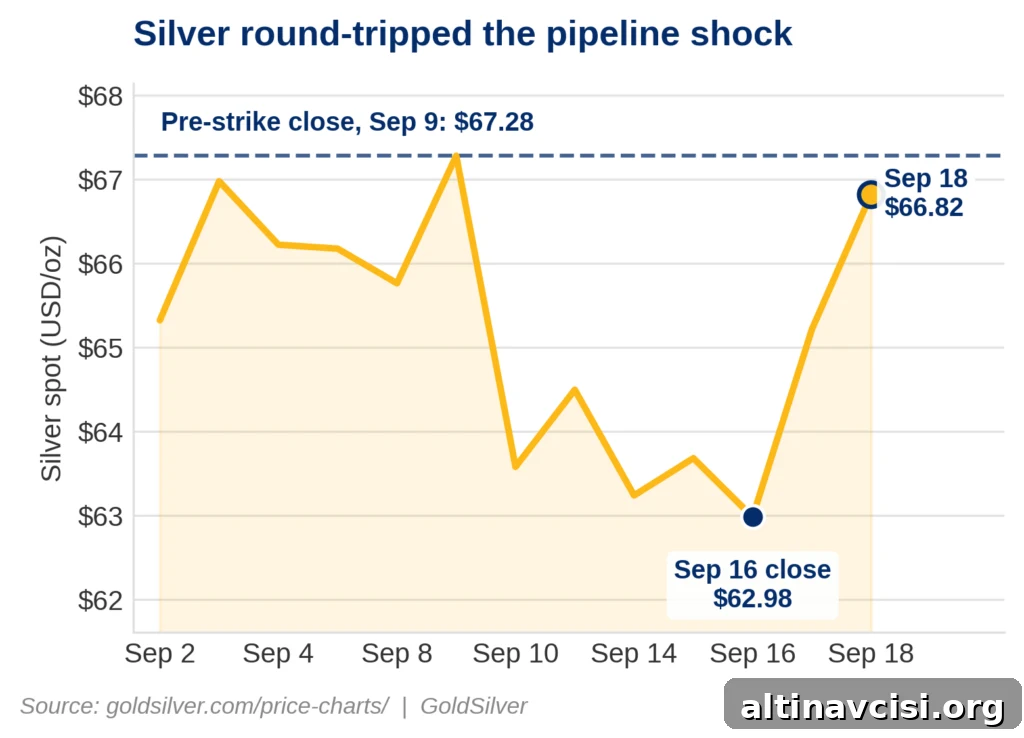
Silver closed at $67.28 per ounce on September 9. Since then, the market has absorbed a string of events: a drone strike that shut down Saudi Arabia’s largest oil pipeline, Treasury yields pushing to levels not seen since 2007, a Federal Reserve rate increase for the first time in more than three years, and a tanker hit in the Strait of Hormuz. After nine volatile days, silver trades only slightly below where it started—less than a dollar’s difference overall.
The rise in silver today is driven by a decline in real yields rather than by a sudden easing of inflation concerns. Falling oil prices helped pull nominal Treasury yields back from multi-year highs, which in turn reduced the real return on fixed income. Because silver pays no interest, its price competes with the real yield on bonds. As of 18:45 UTC on Friday, September 18, silver was at $66.54 per ounce, up roughly 2.0% on the session. Gold was trading near $4,381, up about 0.9%.
Key takeaways:
- Both gold and silver are now within about 1% of their September 9 closes, meaning the shock from the pipeline attack has essentially reversed.
- The sharp selloff following the attack was not driven by rising inflation expectations. Between September 9 and September 16, the 10-year real yield rose about 22 basis points while the breakeven inflation rate fell slightly.
- Silver has historically moved roughly twice as much as gold when real yields shift—a pattern visible during this episode. The moves here reflect real-rate dynamics rather than a metal-specific story.
Why did silver go up today?
Oil prices fell for a third consecutive session. Saudi officials announced they expected to restore about half of the damaged East-West pipeline within days and the entire 745-mile line within roughly six weeks. That timeline is the country’s internal estimate and should be treated cautiously. Brent crude retreated to about $102 per barrel after reaching roughly $108.59 on September 16.
The pipeline was struck by drones on September 10, damaging pumping stations. Riyadh shut the pipeline on the following day as a precaution; the route transports crude to Yanbu on the Red Sea and is a primary way Saudi oil avoids the Strait of Hormuz. The outage initially added a sizable supply premium to oil prices. As that premium has diminished, oil eased, which helped pull Treasury yields down and reduced the opportunity cost of holding precious metals. That chain of effects explains much of the rebound in gold and silver that began later in the week.
Stay On Top of Gold & Silver Prices
Get important market alerts sent straight to your inbox.
Did silver break out, or just recover?
It was a recovery. Headlines describing silver as escaping a $63–$64 range overlook that the drop into that band had occurred only a few sessions earlier and was itself a reaction to the pipeline attack and the surge in real yields. Silver’s low was $62.68 on September 16, about 6.8% below the September 9 close. It has since reclaimed most of that loss but remains slightly below the starting point. The gold-to-silver ratio tells a similar story: roughly 65.4 before the strike, 67.7 at the trough, and back near 66 today.
Why is the inflation explanation wrong?
The simple inflation narrative—higher oil prices spark higher inflation expectations, which then push metals higher or lower—does not fit the recent data. Between September 9 and September 16:
- The 10-year Treasury yield rose from about 4.83% to around 5.01%.
- The 10-year real yield, measured using inflation-protected Treasuries, rose from approximately 2.46% to 2.68%.
- The 10-year breakeven inflation rate, which represents the market’s inflation forecast, edged down slightly from around 2.37% to 2.33%.
If the market had been genuinely worried about higher inflation because of $108 oil, breakeven rates would have risen. Instead they fell. What increased was the real yield—meaning the return investors demand above inflation. Since silver and gold pay no interest, their prices are particularly sensitive to real yields. The metals fell when the real cost of holding them rose and recovered as that cost eased.
Why did silver move twice as much as gold?
Part of the explanation is positioning. In the week ending September 8, silver’s net speculative long was much smaller relative to open interest than gold’s, meaning silver had less crowded long interest. Silver is also a higher-beta metal by nature—when real yields surge, silver tends to move roughly twice as far as gold. Into the September 16 low, silver fell about 6.4% while gold fell around 3.1%; on the rebound, silver has roughly doubled gold’s gain. These dynamics reflect market structure and leverage more than a unique silver-specific catalyst.
Why do real yields matter more than headlines?
Real yields influence precious metals more consistently than any single headline. Gold and silver do not produce income, so their relative attractiveness depends on what investors can earn from cash and bonds after accounting for inflation. When real yields rise, the implied carrying cost of holding non-yielding assets rises and prices typically fall; when real yields decline, those assets become more attractive even in the absence of a geopolitical crisis.
For markets, the most reliable driver of gold has often been where real yields are expected to go rather than the Fed’s decision on the meeting day. This week the market repriced expected real yields twice, and both metals largely tracked that discounting. The oil headlines were loud and important for risk and supply sentiment, but the 22 basis point swing in real yields was the dominant financial story behind the metal price moves.
Looking ahead, two developments will matter most: whether pipeline repairs proceed on the timeline announced, and whether the 10-year real yield stays below the 2.68% peak observed on September 16. The path of real yields is the key variable to watch for future metal price action.
Spot prices referenced as of 18:45 UTC on September 18, 2026. Historical move comparisons use the September 9 and September 16 closes as anchors.
Sources
Price charts and market data referenced in this article come from industry price feeds, Treasury and inflation-protected securities market data, commitments-of-traders reporting, and contemporary news coverage of the Saudi pipeline outage and related events. Observations and dates referenced are those in market records for September 9 and September 16, 2026.
Disclaimer: This article is for informational purposes only and does not constitute investment advice. Past performance is not indicative of future results. Consult a qualified financial advisor before making investment decisions.
You may also like:
- Iran Hit a Tanker in Hormuz and Oil Isn’t Reacting
- Rates Just Went Up Twice. Five Reasons Gold Didn’t Care.
- The Bank of Japan Just Hiked to a 31-Year High. Gold Barely Noticed.
- The Fed Hiked. The Bank of England Held. They Landed on the Same Rate.
- Jobless Claims Just Beat Estimates. Gold Rallied Anyway.
- Gold and Silver Rip Higher as the Fed-Hike Selloff Reverses
- The Fed Just Hiked. 16 of 18 Officials Say It’s Not Done.