
Key Takeaways:
- The Cantillon effect explains that newly created money does not reach everyone at once. Those who receive it first—usually banks, large financial institutions, and government contractors—can spend and invest before prices adjust. Those who receive it last, typically wage earners and savers, face higher prices paid with devalued money.
- Richard Cantillon developed this idea around 1730 in his Essay on the Nature of Trade in General, drawing on first-hand experience in the era of John Law’s Mississippi Company.
- Post-2008 quantitative easing provides a clear, dated illustration: the Federal Reserve’s balance sheet expanded dramatically, and financial assets and property values rose much faster than wages.
- Distributional data from the Federal Reserve show the widening concentration of wealth: the top 0.1% accumulated far greater net worth in dollar terms than the entire bottom half of households.
- The way new money enters the economy matters. Bond purchases tend to inflate financial assets first, while direct fiscal transfers push consumer prices. The channel of entry affects which groups benefit in the short term.
- Physical gold and silver are outside the banking system’s transmission mechanism. Central bank balance sheet expansions cannot create more physical metal, which is why many investors regard bullion as protection against monetary dilution.
Gold trades near $4,296 an ounce and silver near $63 an ounce today. Those numbers are the market response to many forces, but the Cantillon effect helps explain why certain asset classes, including precious metals, react differently to monetary expansion.
What Is the Cantillon Effect?
The Cantillon effect describes how new money travels through an economy in stages rather than appearing uniformly. When a central bank or government injects new funds, those closest to the source—banks, large investors, and connected businesses—receive and spend the money first. They buy assets and services at existing prices. As the new money circulates outward, wages, pensions, and savings accounts adjust more slowly. By the time the broad public feels the effect, many prices have already risen. In practice, this means the timing and path of monetary injections determine which groups gain and which lose in real terms.
Richard Cantillon observed this sequence in the early 18th century after participating in speculative activity around John Law’s Mississippi Company. He saw who profited early and who was left holding devalued notes when the bubble burst. His insight turned a single episode into a general explanation of monetary transmission and distributional consequences.
How Does New Money Actually Move Through the Economy?
A textbook analogy treats monetary expansion like filling a bathtub: the whole surface rises uniformly. The Cantillon effect compares new money to a drop of ink in one corner. The region near the drop darkens first while the far side remains unchanged for some time. In modern economies the “drop point” is usually the banking and financial sector. When a central bank buys bonds or mortgage securities, it credits large institutions first. Those institutions, and the wealthy households that own most financial assets, are the initial beneficiaries. They can buy stocks, real estate, and other assets at pre-expansion prices. Wages and typical household incomes lag behind, reflecting earlier monetary conditions and adjusting only after prices have already moved.
What Did Post-2008 Quantitative Easing Actually Show?
The period after the 2008 financial crisis offers a clear historical test. Before 2008, the Federal Reserve’s balance sheet was under $1 trillion. Multiple rounds of quantitative easing (QE) expanded that sheet, reaching roughly $4.5 trillion after the first major waves and peaking near $8.95 trillion by April 2022 before subsequent runoff. Most of this expansion entered the economy through purchases of Treasury and mortgage securities from large financial firms. Those firms and their clients were the first to receive the newly created reserves and could deploy them into financial markets.
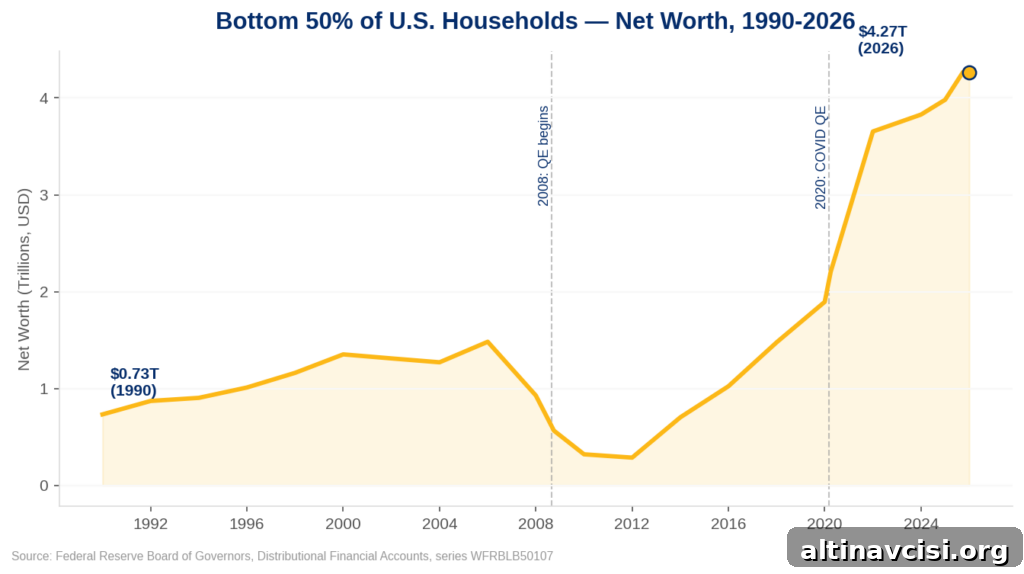
The Fed’s Distributional Financial Accounts illustrate the outcome: nominal net worth increased across the board, but far more so at the top. The combined net worth of the bottom half of households rose in dollar terms but remained small relative to gains at the top. The top 0.1% accumulated an outsized share of asset gains, widening the wealth gap. The timing of the injection—into bond and asset markets rather than directly into households—helps explain this distributional result.
Does It Matter How the Money Gets In?
Yes. The channel of entry strongly influences which prices rise first and which groups benefit. QE, which works by buying bonds and other securities, puts money into the financial system and inflates asset prices—stocks, bonds, and property—before consumer prices move much. Direct fiscal transfers, such as stimulus checks, send money straight into household accounts and tend to boost consumer demand and inflation in goods and services more quickly.
For example, direct payments in 2020 and 2021 temporarily narrowed measured wealth disparities because cash arrived with households that own fewer financial assets. Those transfers supported consumption and lifted prices for everyday goods. But when inflation accelerated in 2021–2022, households holding cash saw their purchasing power erode. The sequence and persistence of effects differ by channel: QE boosts asset holders early; fiscal transfers raise consumer prices faster but may be eroded by subsequent inflation.
The takeaway is structural: the injection point determines first recipients, not the moral judgment of a particular policy. Whoever is closest to the source of new money benefits first, and that structural effect has repeated across different policy episodes.
What Does the Cantillon Effect Mean for Gold and Silver?
Physical gold and silver differ from most financial assets because their global supply cannot be increased by a central bank balance sheet decision. No operation in a central bank’s ledger creates additional ounces. That scarcity is central to why many investors treat bullion differently: owning physical metal places you outside the path through which newly created bank reserves first reach financial markets.
Holding physical metal does not eliminate the broader consequences of monetary policy. It simply places a portion of wealth in instruments whose supply is constrained by geology and production rather than by policy. For investors concerned about the distributional effects of monetary expansion and the relative timing of price changes, physical gold and silver function as a hedge positioned outside the Cantillon transmission sequence.
The Knowledge That Changes Everything

Two essential guides — yours free. Understand why gold matters and why fiat currencies often face pressure over time.
Stay On Top of Gold & Silver Prices
Get important market alerts sent straight to your inbox.
People Also Ask
What is the Cantillon effect in simple terms?
Put simply: when new money is created, it does not reach everyone at the same time. Early recipients can spend before prices rise; late recipients pay the higher prices with money that has already lost purchasing power.
Does quantitative easing cause inequality?
QE tends to favor asset owners because it injects money into financial markets first. Evidence from the 2008–2022 period shows asset prices rising faster than wages and a widening gap in net worth between the very wealthy and the bottom half of households. That pattern is consistent with the Cantillon sequence, though other factors also influence inequality.
Who first described the Cantillon effect?
Richard Cantillon, an Irish-French banker and observer of early 18th-century monetary episodes, first articulated the concept in his Essay on the Nature of Trade in General.
How does gold protect against the Cantillon effect?
Because central banks cannot create more physical gold or silver on demand, bullion is not part of the banking transmission chain. Holding physical metal keeps a share of wealth in a scarce asset whose supply is governed by mining and geology rather than by policy decisions.
Sources
1. Econlib — Essai sur la Nature du Commerce en Général (Cantillon).
2. Oxford Academic — Richard Cantillon: Entrepreneur and Economist (Antoin E. Murphy).
3. Federal Reserve — H.4.1 Release: Factors Affecting Reserve Balances (Federal Reserve data).
4. Federal Reserve Board — Distributional Financial Accounts (DFA).
5. Mises Institute — Analysis of John Law and the Mississippi Bubble.
6. Liberty Street Economics — Historical notes on the Mississippi Bubble.
7. Britannica — Background on the Mississippi Bubble and related monetary history.
8. GoldSilver — Live gold and silver price data and charts.
Disclaimer: This article is for informational purposes only and does not constitute investment advice. Past performance is not indicative of future results. Consult a qualified financial advisor before making investment decisions.
You May Also Like:
- Silver Price Outlook September 2026: The Hike Is Priced In. The Positioning Isn’t.
- Gold Is About to Face Its First Rate Hike of the Cycle. Here’s Why It Isn’t Scared.
- How Much Gold Should You Own at 25, 45, or 65?
- Gold Price Outlook September 2026: What the Fed’s September Meeting Means for Your Metals
- Do You Have to Report Gold Stored in a Foreign Vault? FBAR and FATCA Rules Explained
- Tokenized Gold: What It Actually Is, and Where the “Just Like Owning Gold” Pitch Breaks Down
- IRA-Eligible Gold: The Coins and Bars That Actually Qualify
- The No-Home-Storage-IRA Myth: Why the IRS Requires a Depository