
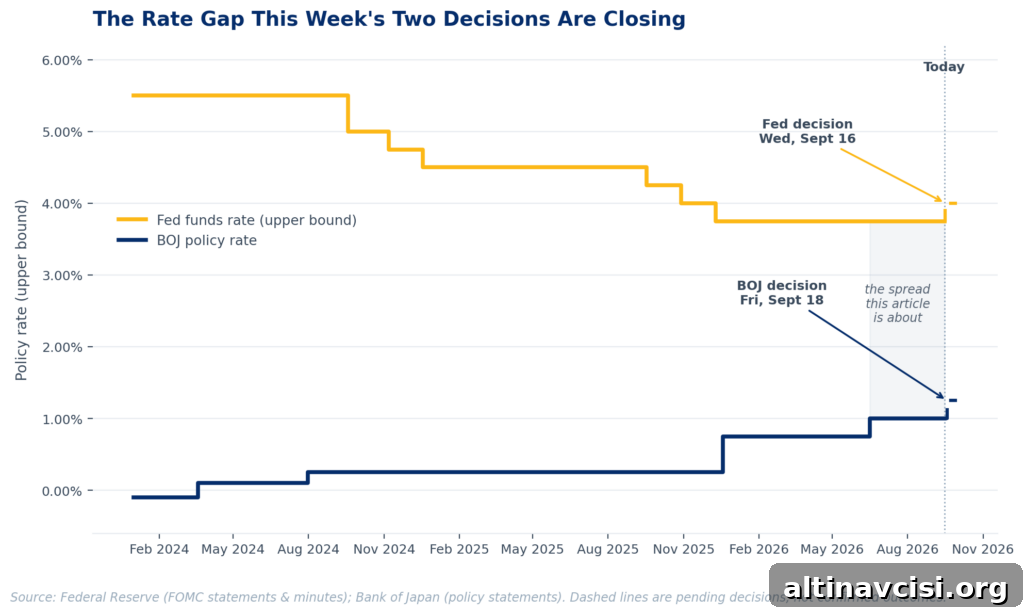
Gold is trading near $4,284 and silver around $63.18 on Tuesday, largely unchanged as markets wait for the Federal Reserve’s decision on Wednesday. The Bank of Japan will also vote on Friday, marking the first time in this tightening cycle that two major central banks are set to raise rates within the same eight-day span—an event with important implications for currency markets, liquidity and precious metals.
Why Is the Bank of Japan Rate Hike Decision Different This Time?
The Bank of Japan (BOJ) is expected to announce a rate increase on Friday, September 18. Economists widely forecast a move from the policy rate set at 1.00% in June to 1.25%. While economist surveys show near-unanimous expectations, market-implied pricing is less certain—reflecting differences between professional forecasts and how traders have actually positioned for the outcome. Consensus among economists and market-implied probabilities can diverge sharply because each reflects a different question: what will policymakers do versus how that outcome is priced into markets.
Importantly, every BOJ hike so far in this cycle occurred on its own schedule—March 2024, July 2024, December 2025 and June 2026. This upcoming decision is the first to fall in the same calendar week as a Fed rate decision, which raises the stakes and complexity for global markets.
The Fed’s own internal outlook has shown increasing dispersion. At the June Fed meeting, nine of eighteen officials projected at least one more rate increase before year-end, and the Fed chair refrained from publishing a personal dot for the first time since the dot-plot practice began. That division among policymakers, combined with an independent BOJ vote in the same week, creates a concentrated period of uncertainty for investors.
The Edge Every Investor Needs
Smarter precious metals investing starts here. The Nuggets Newsletter delivers timely market insights, Fed updates, global trends, and educational content to help investors stay informed.
What Happens When Two Central Banks Tighten in the Same Week?
One key transmission channel is the yen carry trade. For years, traders borrowed low-cost yen to fund higher-yielding U.S. dollar positions—investing in Treasuries, leveraged technology stocks, and growth-oriented assets. That strategy depends on a sufficiently wide interest-rate gap between the United States and Japan to cover borrowing costs. When the BOJ raises rates, it narrows that gap from the Japanese side; when the Fed tightens, it narrows from the U.S. side. Two rate increases in the same week signal that the era of near-free borrowing across multiple major currencies is coming to an end.
The more immediate market risk is not necessarily a slow, orderly adjustment but a sudden, reflexive unwind. A surprise hawkish move from either central bank could force highly leveraged positions to close quickly. We saw this dynamic in late July and early August 2024: a BOJ rate hike coupled with an unexpectedly weak U.S. jobs report triggered a rapid global unwind of yen-funded positions. Gold, being highly liquid and widely held, sold off sharply at the outset as investors scrambled for cash. That panic subsided within days once the BOJ signaled it would pause further hikes.
What Does This Mean for Gold and Silver Before Friday?
In the short term, a disorderly BOJ surprise could trigger a liquidity-driven selloff similar to the 2024 episode. Such moves typically reflect forced selling rather than a permanent change in the precious metals’ fundamentals, and they often reverse quickly once central banks clarify their intentions.
The usual relationship—where a stronger dollar pressures gold—may be muddied this week because the main shock could arrive via the yen rather than broad dollar strength. The yen’s moves influence the dollar index directly, but the market mechanics differ from a straightforward dollar appreciation driven by U.S.-specific factors.
Over the medium term, however, the broader picture supports the case for gold and silver. When more than one major central bank tightens monetary policy and raises the real cost of borrowing, the decade-long environment of ultra-cheap liquidity becomes harder to sustain. This week’s potential back-to-back rate rises would be evidence that global liquidity is tightening across multiple currencies, not just in the United States.
Gold and silver are attractive to many investors because their supply is limited and grows only modestly each year—roughly 1.5% to 2%—independent of policy decisions. Interest rates and currency values can change overnight, as two major central banks are poised to demonstrate. That dynamic reinforces the argument for holding assets whose supply cannot be expanded by policymakers: metals that remain a fixed, physical store of value even when central-bank policies shift.
Stay On Top of Gold & Silver Prices
Get important market alerts sent straight to your inbox.
SOURCES
1. Bloomberg — BOJ Watchers See Follow-Up Hike by January After September Move
2. BoJ Watch Tool — market-implied BOJ rate-hike probability (TONA futures)
3. Tech Times — Bank of Japan September Hike Arrives With Fed: Yen Carry Trade Alert
4. CNBC — Fed Interest Rate Decision, June 2026 (dot plot, Warsh abstention)
5. CNBC — Bank of Japan Hikes Rates to 1%, Highest Since 1995
6. HDFC Mutual Fund — Yen Carry Trade Unwind Explained (August 2024 timeline)
7. CME Group / LBMA — benchmark spot gold and silver pricing
Disclaimer: This article is for informational purposes only and does not constitute investment advice. Past performance is not indicative of future results. Always consult a qualified financial advisor before making investment decisions.
You May Also Like:
- The Fed Vote Is Already Priced In. These Five Things Aren’t.
- The 10-Year Yield Just Hit an 18-Year High. Gold Isn’t Falling For It.
- Gold Mining Stocks vs. Bullion: Leverage Math, September 2026.
- Gold Fell to $4,271 Today. Five Bigger Stories Are Moving Underneath It.
- Gold Just Ignored a War. Here’s What It’s Actually Watching.
- Five Forces Behind Today’s Gold and Silver Move.