
America’s checking account received a $33.6 billion inflow in a single day. Treasury Secretary Scott Bessent may choose to spend part of the roughly $967 billion that now sits in the Treasury General Account (TGA). Officials could use that balance to carry out a policy move the Federal Reserve cannot accomplish by a rate decision alone: buy back government bonds without issuing a single new Treasury security.
Gold is trading around $4,592 an ounce this morning, largely unchanged for the day, while silver sits near $70.42, up about 1.7% from the open. Those price moves are modest. The real story is the composition of Washington’s cash balance and why Treasury officials are publicly considering drawing it down to intervene in the bond market.

The Edge Every Investor Needs
Smarter precious metals investing starts here. The Nuggets Newsletter brings essential market insights, Fed updates, global trends, educational videos, and timely analysis.
What Is the Treasury General Account, and Why Does It Matter for Gold?
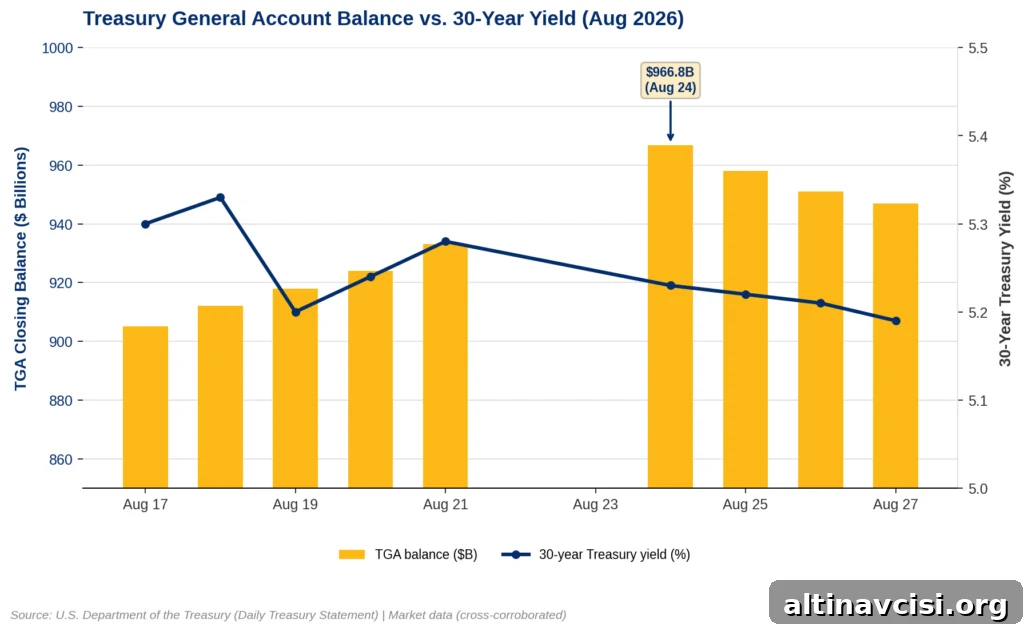
The Treasury General Account (TGA) is the federal government’s operational bank account held at the Federal Reserve. Tax receipts and other government cash inflows land there before being spent by agencies or transferred into financial markets. According to the Treasury’s Daily Treasury Statement, the TGA closed at $966.8 billion on August 24, reflecting a one-day increase of $33.6 billion. Much of that gain came from withheld individual and payroll taxes, which contributed $25.1 billion, and customs duties, contributing about $17.7 billion.
Two senior Treasury officials told reporters that the TGA is a potential funding source for the bond buyback program Treasury announced on August 19. That program doubled the maximum size of nominal long-end buyback operations, increasing the cap from $2 billion to at least $4 billion per operation, with the change scheduled to begin on September 9.
Why Does It Matter Where the Buyback Money Comes From?
There are two distinct ways Treasury can fund a buyback, and each has different market effects. The first method is to issue new short-term debt to raise cash, then use those proceeds to repurchase longer-term debt. Economically, that shifts outstanding obligations but does not reduce the total amount of Treasury debt outstanding. Many traders initially assumed this route when the August 19 announcement hit the market.
The other option is to draw down cash already sitting in the TGA. Because the TGA is held at the Federal Reserve, spending those balances returns reserves and cash into the broader banking system. That liquidity effect resembles an ease in financial conditions, similar in direction to a Fed liquidity injection, but it happens without issuing additional Treasury securities. In practical terms, using TGA balances to fund buybacks is like paying a bill directly from a checking account rather than transferring the debt to a new credit line. The outcome—reducing outstanding long-term Treasuries through buybacks—can look materially different in how it impacts money-market balances and funding rates.
What Have Analysts Said About the Treasury General Account Plan?
Market strategists offered differing takes. Michael Hsueh of Deutsche Bank told clients the Treasury move reinforces a constructive view on gold and could push prices toward his $4,800 target. UBS chief strategist Bhanu Baweja described the policy as an important signal for gold and argued that the dollar, rather than bullion, may absorb much of the adjustment as Washington manages its borrowing rate.
At the same time, some analysts remain skeptical. Blake Gwinn at RBC Capital Markets called the idea of tapping the TGA “very slapdash,” and believes there are low odds Treasury will drain the account at a scale large enough to matter. Treasury officials, when asked by reporters, declined to specify amounts or timelines, saying only that using the TGA remains an option.
That divide between “a powerful new lever” and “mostly talk” matters. The 30-year Treasury yield recently rose above 5.3%, the highest since 2007, before easing modestly after the August 19 announcement. Whether Treasury actually uses the TGA for sizable buybacks on or after September 9 will reveal whether policy makers are prepared to act or are primarily attempting to influence market sentiment by signaling intent.
What Does This Mean for the Sound Money Case?
The immediate question is not whether $967 billion will single-handedly move global markets — in a Treasury market with more than $31 trillion of securities outstanding, isolated effects may be limited. The broader implication is institutional: the government is increasingly managing borrowing costs by reallocating cash internally rather than reducing reliance on borrowing overall. Choosing to use tax cash to defend the bond market signals concern about how markets would respond to additional issuance on top of an already busy borrowing calendar.
For savers and investors observing from outside the Treasury market, this dynamic highlights a structural risk. Currency stability and public finance outcomes can hinge on discretionary decisions about which accounts to draw down at particular moments, rather than on a transparent, rules-based framework. That discretion is one reason some investors look to hard assets such as physical gold and silver, which sit outside the banking and sovereign debt systems.
What Should Investors Watch Next?
September 9 is a key date: the first expanded buyback operation under the new size limit should execute that week. Investors should watch whether Treasury announcements explicitly identify the TGA as the funding source for buybacks, or whether the department quietly relies on short-term bill issuance instead. The 30-year Treasury yield’s behavior in the days surrounding that operation will be the clearest market signal about whether using the TGA has meaningful influence over long-term yields. Observing yields, Treasury announcements, and any confirmed reductions in the TGA balance will be crucial for interpreting the policy’s practical impact.
Stay On Top of Gold & Silver Prices
Get important market alerts sent straight to your inbox.
SOURCES
1. U.S. Department of the Treasury — Daily Treasury Statement, Operating Cash Balance (Daily Treasury Statement dataset).
2. U.S. Department of the Treasury — Announcement on increased sizes of nominal long-end buybacks beginning September 9.
3. Press reporting on Treasury officials and commentary about the TGA and bond buybacks (reported by major financial news outlets).
4. Analysis and market commentary from major banks and brokerage research noted in press coverage (Deutsche Bank, UBS, RBC Capital Markets).
5. Public statistics on U.S. Treasury securities and market size, as cited by industry research providers.
Disclaimer: This article is for informational purposes only and does not constitute investment advice. Past performance is not indicative of future results. Always consult a qualified financial advisor before making investment decisions.
You May Also Like:
- Six Paper Claims, One Ounce of Silver: What First Notice Day Reveals
- Five Gold Signals Fired This Week. None of Them Are About Today’s Price.
- Gold Fell 9% the Last Time Warsh Spoke. He’s Back Tomorrow.
- Gold Ran Past Wall Street’s Own Price Targets. Four Banks Disagree on What Happens Next.
- Silver Beat Gold in August. Almost Nobody Said So.
- Americans Spent More in July. They Got Nothing Extra for It.
- The Fed Has Two Hike Numbers Right Now. Almost Everyone Quotes the Wrong One.