
America’s gold market still remembers the last time Kevin Warsh’s name reshaped expectations. When he was announced as Fed chair on January 30, 2026, spot gold plunged nearly 9% in a single session while silver futures suffered an extreme one-day decline. That episode was driven not by immediate comments but by a sudden re-evaluation of policy risk based on Warsh’s reputation. Traders priced that risk quickly — and the move left a lasting impression on metals markets.
That history frames the run-up to Warsh’s first Jackson Hole keynote as chair on Friday. Gold opened the day near $4,588 an ounce, a marginal decline after reaching a three-month high earlier this week. Silver, which also rallied during August, pulled back slightly from an intraday peak. The broader rally in both metals remains intact, but many investors are cautious: few want to take a firm position ahead of remarks from a Fed chair whose appointment has previously triggered sharp moves.
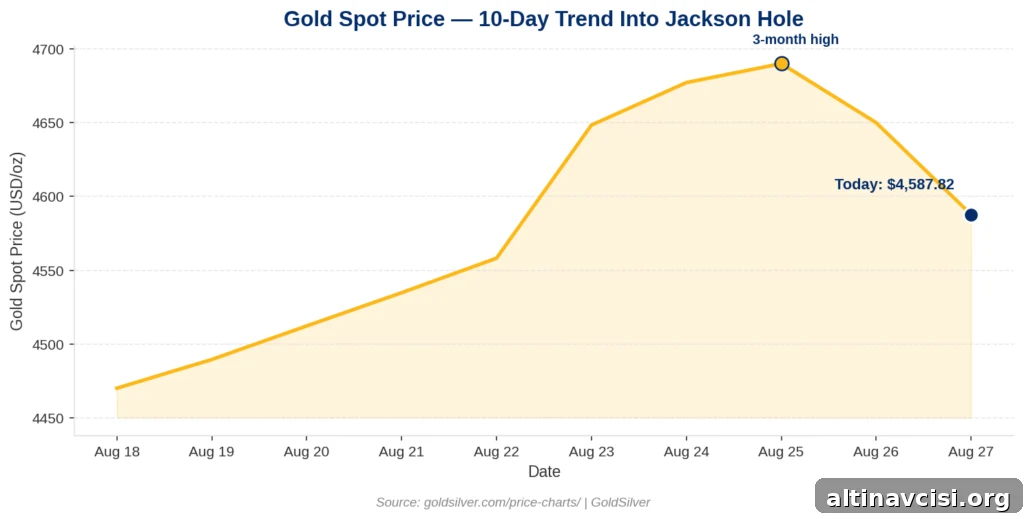
Why Did Gold Pull Back Today?
The immediate trigger for Wednesday’s pullback was fresh inflation data. The Commerce Department’s July PCE report showed headline prices rose 0.2% month-over-month, slightly above consensus, with annual inflation at 3.7%. Core PCE, which the Fed targets, also rose 0.2% for the month and 3.3% year-over-year — essentially matching forecasts. That in-line print is problematic because it sits well above the Fed’s 2% objective. When inflation is meaningfully above target, policymakers have less room to shift toward easing, and markets lose a clear signal. Gold, which had rallied into the release, saw traders trim positions rather than increase exposure ahead of the Jackson Hole address.
The Edge Every Investor Needs
Smarter precious metals investing starts with timely context. Clear analysis helps investors weigh policy signals, inflation trends, and fiscal developments that affect gold and silver.
What Is Kevin Warsh Expected to Say at Jackson Hole?
Warsh speaks at roughly 10:00 a.m. ET at the Kansas City Fed symposium. It is his first major address as chair and comes just nineteen days before the Fed’s September 16 rate decision. Without an established communication pattern, his words carry extra weight. Surveys of institutional managers show a divided expectation: many anticipate a neutral tone, a significant portion expect hawkish language, and a smaller group looks for dovish signals. That split makes the opening sentences especially important; markets can move sharply in either direction depending on his emphasis.
The transmission from Warsh’s tone to metals prices is straightforward. Gold yields nothing, so its relative appeal depends on real interest rates and the dollar. Hawkish comments that lift real yields and strengthen the dollar make zero-yield assets like gold less attractive. Conversely, a neutral or dovish stance would allow the current environment — a softer dollar, lower long-term yields, and ongoing fiscal concerns — to persist, supporting gold and silver. Unless Warsh actively shifts that outlook, the structural drivers behind August’s rally would remain intact.
Why Hasn’t One Speech Undone August’s Rally?
The rally reflects a broader positioning trade tied to concerns about real yields and fiscal policy — sometimes described as a debasement trade. Investors are pricing a weaker dollar and lower real yields as Treasury borrowing needs increase and policy choices try to keep financing costs manageable. Recently, the Treasury expanded buyback operations for longer-dated bonds, and officials have signaled potential further action. When a government’s debt manager intervenes to influence long-term rates, it creates a fiscal backdrop that can outlast any single Fed speech.
That dynamic helps explain why gold is still substantially higher for the month despite intraday pullbacks: the structural forces supporting precious metals remain in place. Even when an authoritative figure like a Fed chair can trigger sharp moves on reputation alone, those moves may not persist if the underlying fiscal and interest-rate picture remains unchanged. A single address can reshape short-term sentiment but cannot erase a sustained structural deficit or ongoing policy choices.
What Should Investors Watch Next?
Monitor market reactions closely during and immediately after the Jackson Hole speech, especially around 10:00 a.m. ET. In a market that is evenly divided on tone, the earliest sentences can trigger large moves. Beyond the speech, the September 16 FOMC decision remains the primary event to watch. Market-implied odds for a September rate change can shift rapidly, so treat any figure as a snapshot. More durable signals will come from fiscal operations — notably Treasury buybacks and other measures that affect long-term yields — because they establish a structural floor under gold and silver that is less sensitive to any one speech by a Fed chair.
SOURCES
1. CNBC — Coverage of market reaction to the Fed chair appointment and metals moves.
2. TradingEconomics — Commodity pricing and market commentary.
3. Reuters and other financial outlets — Reporting on Fed expectations and market positioning.
4. Market data providers — Real-time price charts for gold and silver.
Disclaimer: This article is for informational purposes only and does not constitute investment advice. Past performance is not indicative of future results. Consult a qualified financial advisor before making investment decisions.
You May Also Like:
- Gold Ran Past Wall Street’s Own Price Targets. Four Banks Disagree on What Happens Next.
- Silver Beat Gold in August. Almost Nobody Said So.
- Americans Spent More in July. They Got Nothing Extra for It.
- The Fed Has Two Hike Numbers Right Now. Almost Everyone Quotes the Wrong One.
- Gold and Silver Pulled Back Today. The Treasury’s Plumbing Explains Why.
- A Stablecoin Issuer Bought More Gold Last Year Than Any Central Bank.
- Two Investors Ran the Debt Math Separately. Both Landed on 15% Gold.