Everyone was reporting on the same month, but most named the wrong winner.
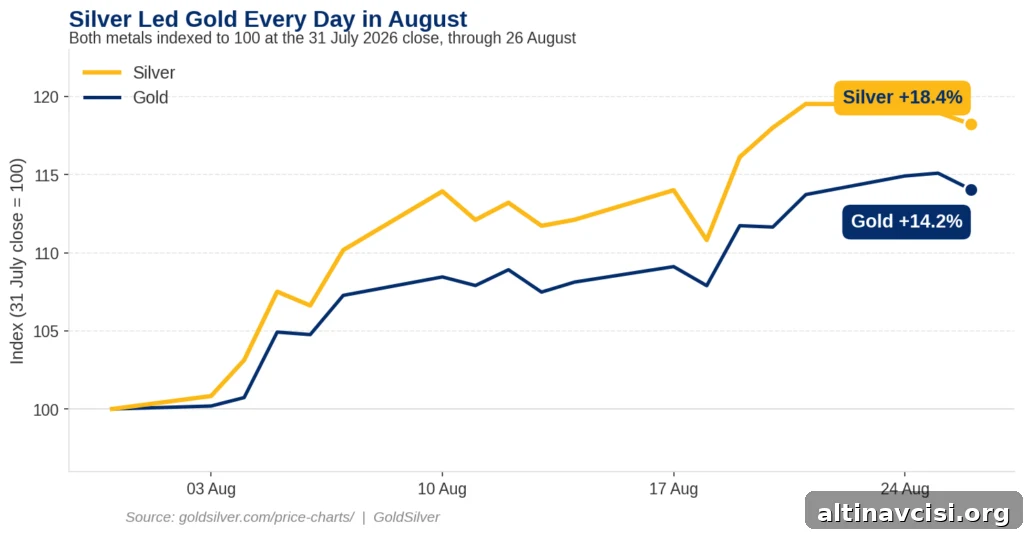
From the July 31 close through the August 25 close, silver climbed 19.0% while gold rose 15.1%. If you owned both metals, silver did the heavier lifting this month.
Key takeaways
- Silver gained 19.0% from the July 31 close through the August 25 close; gold gained 15.1% over the same period.
- The gold‑silver ratio declined from about 70.1 to just under 68 during that window, indicating silver outpaced gold.
- The 10‑year real yield was 2.38% on August 24, per Federal Reserve data — a condition under which gold is typically expected to struggle.
Both metals eased on the following Wednesday. Gold was trading just under $4,600 and silver in the high $60s at the referenced close. The monthly percentages above are fixed because they measure two completed closes.
So which metal had the better August?
Silver, by nearly four percentage points. For several days the media narrative focused on gold, with some outlets calling it gold’s best month since September 1999. That story is true only if you look at gold in isolation. When you compare both metals side by side, silver clearly outperformed.
The gold‑silver ratio — the number of ounces of silver required to buy one ounce of gold — tells the same story from a different angle. Over the month the ratio fell, meaning silver gained relatively more value. Yet public conversation remained skewed: mentions of gold outnumbered those of silver by roughly eight to one in the sound‑money discourse during the same week. A 19% monthly rise in silver attracted far less attention than it warranted.
Why is gold rising when real yields are this high?
This is where simple explanations fail. The market yield on inflation‑indexed Treasuries — the 10‑year real yield — was about 2.38% on August 24. That represents a positive, near risk‑free return above inflation. Conventional wisdom says gold should struggle in that environment because investors can earn a real return from government bonds instead of holding non‑yielding bullion.
Yet both metals rose. Looking at the yield curve helps explain why the usual narrative does not fully fit. The 10‑year nominal Treasury yield was about 4.70% while the 2‑year sat near 4.24%. The long end therefore paid roughly 46 basis points more than the short end, a term premium rather than a signal of imminent rate cuts. Investors were being compensated to hold longer‑dated government debt, not rewarded to wait for lower rates — and precious metals were bid higher anyway.
Why did silver move more than gold?
Silver’s market is smaller and less liquid than gold’s, so comparable flows have a larger price impact. This is a recurring theme: earlier in the year silver fell harder than gold, and in August it rose harder. In May, for example, silver dropped about 12% while gold fell around 3%, showing how the two metals often move in the same direction but with different amplitudes.
Institutional flows also played a role. Data for July showed Asian funds leading global gold ETF inflows for the year while North America registered net outflows. That suggests Western institutional investors were not the primary drivers early in the rally; they tended to join the move later, amplifying momentum rather than initiating it.
What happened in September 1999?
The comparison to September 1999 is useful because it highlights how policy can alter metal markets. On September 26, 1999, a group of European central banks signed an agreement capping combined annual gold sales, which removed a major source of selling pressure. At the time, gold was trading near multi‑decade lows, and prices rallied sharply in the days after the agreement. That month’s move was sparked by a deliberate policy change among official holders. This August’s rally, by contrast, came while a government was taking actions to support its own debt market — not by central banks agreeing to restrain gold sales. The similarity is the size of the move; the difference is the direction of official influence.
More broadly, the pairing of gold and silver offers insight into monetary sentiment. Gold tends to react first to shifts in the monetary picture; silver often follows and moves more dramatically. Watching both metals gives a fuller view than watching one alone.
What should you watch now?
Upcoming speeches and calendar timing matter. A prominent monetary speech at the Jackson Hole symposium is scheduled for Friday at 10:00 ET, and only a couple of market sessions remain in the month after that. Historically, September has been a relatively weak month for gold: over the past two decades it has averaged a small decline and finished lower in a majority of years. When gold entered September already up by double digits, it often saw some retracement.
A record or strong month is noteworthy, but it is not a guaranteed forecast of continued gains. Market conditions, policy actions, and investor positioning can change quickly, so ongoing vigilance is prudent for anyone exposed to precious metals.
SOURCES
1. Federal Reserve Bank of St. Louis (FRED) — Market Yield on U.S. Treasury Securities at 10‑Year Constant Maturity, Inflation‑Indexed (DFII10), August 24, 2026.
2. Federal Reserve Bank of St. Louis (FRED) — Market Yield on U.S. Treasury Securities at 10‑Year and 2‑Year Constant Maturity (DGS10, DGS2), August 24, 2026.
3. News reports summarizing market moves and Treasury buyback plans, August 25, 2026.
4. World Gold Council — Gold ETF flows and holdings data for mid‑2026.
5. Historical records of the First Central Bank Gold Agreement (Washington Agreement), September 1999.
6. U.S. Commodity Futures Trading Commission reports on gold options and futures from the 1999‑2000 period.
7. Gold and silver price charts and historical closes referenced for August 2026.
Disclaimer: This article is for informational purposes only and does not constitute investment advice. Past performance is not indicative of future results. Consult a qualified financial advisor before making investment decisions.
You May Also Like:
- Americans Spent More in July. They Got Nothing Extra for It.
- The Fed Has Two Hike Numbers Right Now. Almost Everyone Quotes the Wrong One.
- Gold and Silver Pulled Back Today. The Treasury’s Plumbing Explains Why.
- A Stablecoin Issuer Bought More Gold Last Year Than Any Central Bank.
- Two Investors Ran the Debt Math Separately. Both Landed on 15% Gold.
- Gold Nears $4,700, Silver Holds Above $69. Why Is Everyone Waiting on One Friday Speech?
- Gold Hits 3‑Month High as Oil Falls Ahead of Sanctions Announcement.