
Key Takeaways
- Sound money is a form of currency whose supply cannot be expanded by government decree, so it preserves purchasing power over time instead of steadily losing it.
- The idea guided 19th-century monetary policy and typically meant a metallic standard: coins defined by weight and paper money redeemable on demand in that metal.
- Since 1971, broad measures show the U.S. dollar has lost a large share of its purchasing power; the decline is evident across several official inflation series.
- Over the same multi-decade period, gold’s price rose dramatically, reflecting how a fixed-supply asset holds value while the measuring unit (the dollar) depreciated.
- Central banks continued to add gold to their reserves, with notable purchases in recent years even as patterns of demand fluctuate across quarters.
You earn, spend and try to save. But have you considered whether the money you keep actually holds its value over time?
That question is central to the idea of sound money. Understanding it changes how you interpret paychecks, savings balances and long-term plans. It also helps explain why gold has recorded a large price rise since the early 1970s while the dollar has weakened in purchasing power.
Where Did the Term “Sound Money” Come From?
The expression grew common in the 19th century as nations moved to metallic standards, most often gold. In that context, sound money meant coins of defined weight and purity and paper claims that could be exchanged for the metal on demand. This system limited arbitrary expansion of the money supply and anchored prices.
The idea carried political weight as well as economic. Some economists and historians argue the demand for sound money arose in response to rulers debasing coinage. In that view, rules that constrain currency manipulation serve a similar role to constitutions or bills of rights: they set limits on government power.
A widely told anecdote links the phrase to merchants tapping coins to see if they rang true, but the documented use of the term stems from monetary debates of the 19th century. Regardless of its origin story, the distinction remains important: sound money rewards patience and saving, while systems that allow unlimited issuance erode savings over time.
The Knowledge That Changes Everything
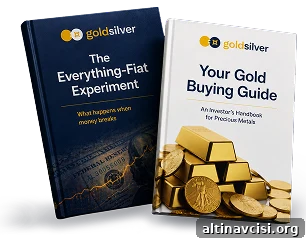
Two concise guides at no cost: one explaining why gold matters and the other exploring the long history of fiat currency and why it tends to lose value.
How Does Sound Money Differ from Fiat Currency?
Sound money meets three practical conditions: it reliably stores value, it resists arbitrary inflation, and no single authority can create unlimited amounts by decree. These traits ensure that saving is worth the effort over time.
By contrast, fiat money is valuable because a government declares it so. The Latin root fiat—“let it be done”—captures that origin. Because fiat value rests on authority rather than a natural scarcity, there is no intrinsic limit to how much can be issued.
The difference appears in the data. Measures of the U.S. money supply have expanded many times over the last several decades while real economic output grew far more slowly. When the quantity of money rises much faster than the goods and services it purchases, each unit of currency buys less.
Official inflation statistics show decades of cumulative price increases that reduce the purchasing power of cash savings. Over long periods, this erosion becomes severe: money that preserves little real value forces savers to look for alternative stores of wealth.
Why Did the Dollar Leave the Gold Standard?
For much of modern history, the dollar was tied to gold. Under the classical gold standard, currency units represented specific amounts of metal, which constrained how much money could be created and tended to stabilize prices over long stretches.
That arrangement changed over the 20th century. The Federal Reserve was created in 1913, and policies during the Great Depression and after World War II altered the relationship between dollars and gold. The Bretton Woods system fixed the dollar to gold while other currencies pegged to the dollar.
In August 1971, the U.S. government ended dollar convertibility into gold. Facing heavy demands for redemption and a domestic treasury issuing more currency than gold reserves could cover, policymakers cut the final legal link. Since then, the global reserve currency has operated without a metallic anchor.
What Has Happened to the Dollar Since 1971?
The consequences are clear in price histories: a dollar saved for decades buys far less than it once did. Shorter-term stretches also show marked declines in purchasing power during periods of monetary expansion.
At the same time, public debt has risen dramatically over many decades, and interest payments on that debt have grown into a major budget item. Removing the gold constraint made it easier for governments to expand spending and money supply, shifting the cost onto anyone holding nominal currency balances.
Put simply, widespread ability to create money without a hard anchor means inflation becomes a predictable risk to holders of cash and cash-like assets. That reality is the practical reason many investors diversify into assets that do not expand by decree.
Why Do Central Banks Still Buy Gold If the Gold Standard Ended?
An important point: institutions that manage fiat currencies continue to hold and, in many cases, add to their gold reserves. Central banks buy gold for several reasons, including portfolio diversification, a hedge against currency risk and a liquid asset with global acceptance.
Purchase patterns vary by region and quarter, and some countries occasionally sell, but surveys of official reserve managers consistently show expectations that official gold reserves will rise over time. When conservative institutions increase holdings despite price fluctuations, their actions signal a preference for holding a scarce, long-established store of value.
How Does Sound Money Protect Your Savings?
Gold and silver have maintained value through repeated monetary regimes because their supply is constrained by physical scarcity rather than policy decisions. Over the long run, assets with limited supply tend to preserve purchasing power far better than currencies that can be expanded at will.
For individual savers, the implication is straightforward: keeping all wealth in a currency predisposed to lose value is a slow path to diminished purchasing power. Allocating a portion of savings to physical precious metals or other non-fiat stores of value can protect against the chronic risk of monetary debasement without requiring precise predictions about the future.
That strategy is not a guarantee against every risk, but it reflects a long historical pattern: when the unit of account weakens, fixed-supply assets record the change in value. Recognizing that pattern helps form practical, diversified plans for preserving wealth.
Stay On Top of Gold & Silver Prices
Get important market alerts sent straight to your inbox.
People Also Ask
Gold and silver are the most widely recognized examples because both are durable, scarce and cannot be created by decree. Other commodities have served as money in different societies, but these two have the longest and most consistent history as reliable stores of value.
A formal return would require major changes to the global monetary system. For most individuals, the more practical question is whether they can adopt sound-money principles personally by holding assets outside the fiat system.
Appropriate allocation depends on each person’s circumstances and goals. The key principle is diversification: a modest allocation to physical metal can provide a long-standing store of value that behaves differently from fiat-denominated assets.
SOURCES
1. Bureau of Labor Statistics — Consumer Price Index (CPI-U) Historical Data
2. Federal Reserve — H.6 Money Stock Measures
3. U.S. Treasury — Debt to the Penny dataset
4. Congressional Budget Office — Budget and economic projections
5. World Gold Council — Gold demand and central bank reserve reports
6. Mises Institute — Writings on the classical idea of sound money
7. Gold and silver price histories from public market data providers
Disclaimer: This article is informational only and does not constitute investment advice. Past performance is not indicative of future results. Consult a qualified financial advisor before making investment decisions.
You May Also Like:
- Vault Storage vs. Gold ETFs: Who Owns the Gold You Paid For?
- Silver Price Outlook: Market dynamics and ownership trends
- What an inverted yield curve can mean for gold prices and investment decisions
- Gold Price Outlook: Interpreting key economic data for precious metals
- Why investors keep choosing a popular gold bullion coin after decades without design changes
- Core versus headline inflation: which number matters for monetary policy?
- How commodity ETF weightings affect exposure to gold