
Data note: Market prices and intraday figures in this article reflect conditions as of approximately 9:30 AM ET on August 20, 2026. Prices may have changed. Last verified: August 20, 2026.
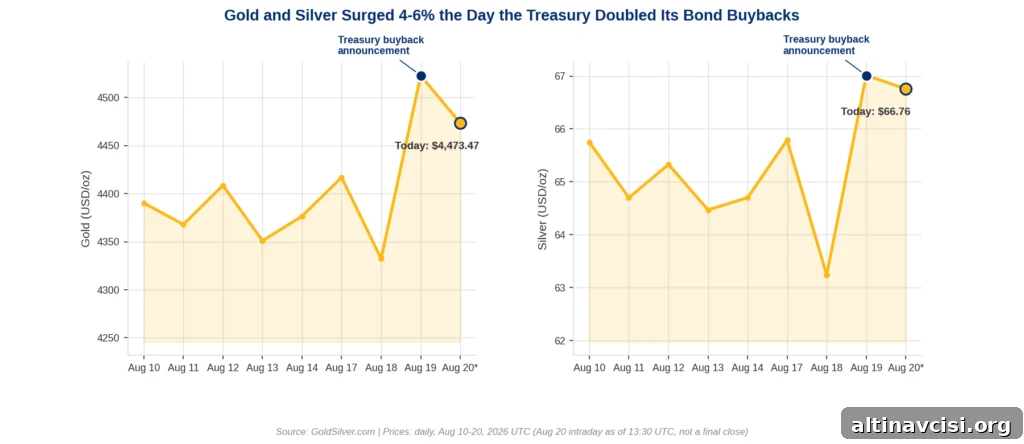
Gold is trading around $4,473 today, down roughly 1.1% from this morning’s open. Silver is near $66.76, off about 0.4%. Both metals eased after a sharp 4–6% surge earlier in the week.
Key Takeaways
- The 4–6% move in gold and silver this week was driven primarily by the U.S. Treasury’s decision to double its long-bond buyback capacity (from $2B to at least $4B per operation) after a weak $16B 20-year auction, not solely by ETF flows.
- The Treasury’s debt-management actions and the Federal Reserve’s monetary-policy decisions are separate. This week’s market catalyst came from the Treasury, not a Fed policy change.
- Real 10-year yields remain positive near 2.44%, which historically pressures gold. This week’s rally represents a notable divergence from the usual relationship between real yields and precious metals.
What Actually Happened to Gold and Silver This Week?
If you followed the financial feeds this week, you likely saw a single, simple explanation repeated: ETFs drove the rally. That is part of the story, but it misses the proximate market shock that set things off. An ETF share and a vaulted bar represent different forms of exposure, and conflating the two overlooks why prices moved so quickly.
The decisive event began with a weak $16 billion 20-year Treasury auction that drew unusually poor demand. On Tuesday, the 30-year Treasury yield jumped to about 5.33%—the highest reading since June 2007—reflecting what traders described as a “buyers’ strike” in long-dated government debt that had developed since late June.
On Wednesday, the Treasury responded. It announced an upscaling of its buyback program, moving the size of operations from $2 billion to at least $4 billion per transaction for 10–20 and 20–30 year securities. That program was scheduled to start September 9 and run through November 4. Within hours, long-end yields fell: the 30-year slipped roughly 9–10 basis points and the 10-year down about 5–6 basis points.
As yields dropped, gold and silver reacted as they typically do when interest-bearing alternatives become less attractive. Gold rose more than 4% and silver climbed about 6% in a single session. The move reflected a rapid re-pricing of long-duration risk after the Treasury’s intervention, amplified by market positioning and ETF purchases.

The Edge Every Investor Needs
Smarter precious metals investing starts with clear market insight: yield drivers, fiscal moves, and what to watch next.
So Why Did the Treasury Have to Step In?
A buyback in itself would not be remarkable. What made this instance notable was that it followed a poorly received auction and it came just two weeks after the Treasury released its planned quarterly schedule. Treasury officials chose to act rather than wait—an indication they were concerned by the market’s reaction. As one market strategist put it, the Treasury did not like what was happening in long-term yields and moved to stabilize conditions.
Market estimates suggest the expanded program could amount to roughly $128 billion on an annualized basis—about 30% of the projected issuance in the affected maturities—meaning the Treasury’s actions are large enough to meaningfully influence long-end liquidity and pricing.
$128 billion a year: a rough estimate of the expanded buyback’s annual pace—about 30% of projected Treasury issuance in the targeted maturities.
How Does a Bond Buyback Push Yields Down and Gold Up?
When the Treasury buys long-dated securities, it increases demand for existing issues. That higher demand raises prices and lowers yields, since price and yield move inversely. The funding for these purchases is primarily through shorter-term bill issuance rather than new long-term borrowing, so the buybacks alter the supply-demand balance in long-dated maturities without expanding long-term issuance.
Lower long-term yields reduce the opportunity cost of holding non-yielding assets like gold and silver, making them relatively more attractive. That mechanism explains the immediate connection from the Treasury announcement to the sharp precious-metals rally.
Why Does This Matter If You Hold Gold or Silver Long-Term?
For long-term holders, the Treasury’s intervention is an on-the-ground signal that fiscal dynamics are actively shaping bond-market outcomes. Real 10-year yields are positive—around 2.44% based on TIPS data—levels that typically act as a headwind for gold. Yet both metals rallied strongly, suggesting investors are pricing in an added factor: the government’s direct influence on the long-end market may reduce the normal link between real yields and precious-metals performance.
In other words, this is less about an inflation headline and more about the plumbing of debt markets—when the issuer steps in to buy its own paper, it changes the risk calculus for holders of duration-sensitive assets, including gold and silver.
What Should You Watch Next?
The expanded buybacks are scheduled to run from September 9 through November 4, when the Treasury will reassess. Key questions for markets: will the program keep long-end yields suppressed through the fall, or will upward pressure resume once buybacks pause? Watch Treasury announcements and auction coverage for signs of renewed demand weakness or stability.
Also relevant are Federal Reserve signals: the Fed’s July meeting produced a 9–3 vote to hold rates, with three regional presidents dissenting in favor of a hike. That internal Fed division sits alongside Treasury easing—two different institutions pushing in contrasting directions—so tracking FOMC communications and economic data remains essential.
Stay On Top of Gold & Silver Prices
Get concise market alerts and updates delivered to your inbox.
Frequently Asked Questions
Both metals eased after a sharp weekly rally. The spike earlier in the week followed the Treasury’s announcement to double long-bond buyback capacity after a weak 20-year auction pushed the 30-year yield higher. Today’s pullback is market digestion of that event, not necessarily a reversal of the structural drivers for precious metals.
A Treasury buyback is when the U.S. government repurchases older Treasury securities from the market, typically funded by issuing shorter-term bills. The effect is to reduce the supply of longer-dated paper, which tends to raise prices and lower yields for those maturities.
The decision followed a poorly received $16B 20-year auction and a sharp rise in long-term yields. The Treasury chose to increase buyback capacity to stabilize long-end liquidity and help contain borrowing costs.
By pushing long-term yields down, buybacks reduce the opportunity cost of holding non-yielding assets like gold and silver. Lower yields often make precious metals more attractive, which can boost their prices.
No. The Treasury manages government debt issuance and buybacks; the Federal Reserve sets short-term interest rates and conducts its own balance-sheet operations. The Treasury’s buybacks are funded mainly through bill issuance, whereas Fed actions involve monetary policy tools and separate balance-sheet adjustments.
The minutes from the Fed’s July meeting showed a 9–3 vote to hold the policy rate steady, with three regional presidents voting for a quarter-point hike. That split was the most divided vote since 2016 and indicates continued debate within the Fed about near-term policy direction.
SOURCES
1. GoldSilver.com — Price Charts (August 20, 2026)
2. CNBC — Coverage of Treasury yields and auctions (August 19, 2026)
3. Business Standard — Coverage of Treasury buybacks (August 19, 2026)
4. FRED, Federal Reserve Bank of St. Louis — 10-Year Real Yield (DFII10) (data as of August 17, 2026)
5. CNBC — Fed minutes and related commentary (August 19, 2026)
Disclaimer: This article is for informational purposes only and does not constitute investment advice. Past performance is not indicative of future results. Always consult a qualified financial advisor before making investment decisions.
You May Also Like:
- The Fed Just Confirmed a 9-3 Split. Then It Said Something Bigger.
- Gold and Silver Are Climbing Today. The Textbook Says They Shouldn’t Be.
- Gold Jumped 1.9%. Silver Jumped 2.7%. The Fed Hasn’t Said a Word Yet.
- The Long Bond Hit a 19-Year High. Inflation Expectations Didn’t Move.
- FOMC Minutes Tomorrow. Jackson Hole in Nine Days. Here Is What Gold Needs From Both.
- Three Fed Officials Voted to Hike. What It Means for Gold.