
Most coverage of the Trump administration’s proposed polysilicon tariff focuses on solar panels and semiconductor chips. That narrow lens misses a key connection: polysilicon sits at the start of a supply chain that ends in silver paste — the conductive material applied to virtually every solar cell. When trade policy reshapes that chain, silver investors should pay attention.
As of August 6, 2026, silver traded near $61.39, slipping slightly on the day. The metal has lagged gold’s recent multi-session rally, and the new tariff developments help explain part of the divergence.
What Is the Polysilicon Tariff and Why Does It Matter for Silver?
The administration is preparing a package that would impose a 15% tariff and establish minimum import price floors on polysilicon and related downstream products — wafers, solar cells, and complete modules. The move follows a Section 232 national security review by the Commerce Department. Reports indicate an announcement could arrive imminently.
Polysilicon is the ultra-pure silicon used to make both solar panels and semiconductor chips. Solar manufacturing consumes the majority of global polysilicon output, while chips account for a much smaller but strategically sensitive share. The proposed measures would cover both end uses.
The silver link comes through solar manufacturing. Every photovoltaic cell requires silver paste on its front and back contacts to collect and conduct the electricity generated. Because the solar industry is the single largest industrial user of silver, changes to solar economics feed directly into silver demand.
How Much of Silver’s Demand Does Solar Actually Drive?
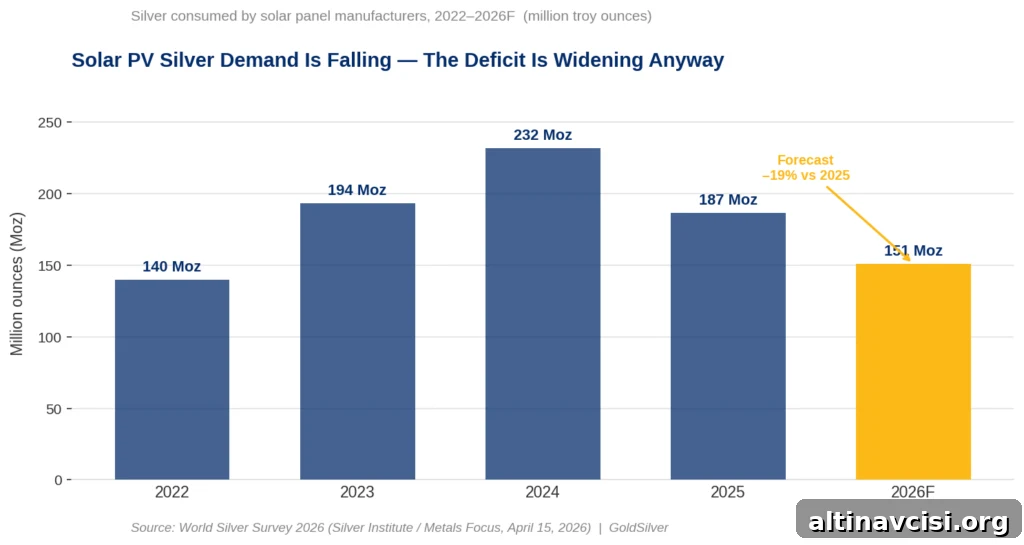
In 2025 the solar sector consumed roughly 186.6 million ounces of silver, down about 6% from 2024’s record of roughly 232 million ounces, according to the World Silver Survey 2026. Solar has represented roughly 29% of industrial silver demand in recent years, making it larger than electronics, automotive, and brazing combined.
Forecasts for 2026 show further decline: solar photovoltaic silver demand is expected to drop to about 151 million ounces, a near 19% fall from 2025. The main driver is “thrifting” — manufacturers reducing the silver paste per cell. Rising silver prices earlier in 2026 made thrifting more attractive economically. Thrifting lowers per-panel silver content but is not equivalent to outright substitution, a distinction the World Silver Survey emphasizes for understanding long-term structural supply and demand.
Crucially, solar demand was already cooling before the polysilicon tariff surfaced. The tariff introduces an added layer of uncertainty to a market that was already adapting to higher metal prices and manufacturing efficiencies.
What Does the Tariff Actually Do to Silver Demand?
The tariff influences silver demand in two opposing ways.
In the near term, it raises costs for U.S. solar developers. China supplies the lion’s share of global polysilicon capacity and dominates downstream wafer, cell, and module manufacturing. Existing tariffs already increased costs on Chinese-made solar components, and an additional Section 232 measure with price floors would further raise import expenses. Higher input costs typically slow the pace of U.S. solar installations, which would reduce near-term silver demand tied to new panels.
Over the longer term, the policy aims to spur reshoring of polysilicon and solar manufacturing to the United States. If domestic production expands meaningfully, the U.S. could develop a steadier, locally sourced market for silver used in panel manufacturing. That outcome would support a more stable and potentially growing domestic industrial demand base for silver over several years.
Thus, the immediate effect is likely to be downward pressure on demand; the potential long-term effect could be increased, more resilient domestic demand. Investors need to weigh both horizons.
Is There a China Retaliation Risk for Silver?
China has already responded to recent U.S. trade actions with targeted measures such as export controls on certain drones and restrictions on selected U.S. entities. Those steps were framed as a calibrated response to prior restrictions and not directly tied to the polysilicon tariff.
Still, the risk of escalation matters. If the new tariff prompts additional Chinese countermeasures, the silver market could see further uncertainty. China is a major user of silver across electronics and electric vehicle components as well as solar manufacturing; coordinated trade frictions that disrupt manufacturing would affect demand beyond U.S. installations alone.
What Does This Mean for the Structural Case for Silver?
The tariff itself does not change silver’s fundamental supply situation. The World Silver Survey 2026 documented a sixth consecutive annual supply deficit of 46.3 million ounces, and the market has drawn down roughly 762 million ounces from above-ground stocks since 2021. Those figures reflect long-running structural conditions in which demand has outpaced mine supply.
Industrial demand accounts for a majority of total silver consumption. That industrial weight makes silver uniquely sensitive to manufacturing policy shifts — tariffs, trade restrictions, and reshoring incentives have material effects on silver’s supply-demand balance in ways they do not for gold.
Another nuance often missed is the United States’ dual objective: it seeks both to restrict Chinese imports and to rebuild domestic solar manufacturing. Those aims can work against each other unless an explicit industrial strategy addresses inputs and the supply of key materials, including silver. For investors holding physical silver as part of a monetary allocation, neither short-term outcome destroys the structural case. Nevertheless, successful reshoring of solar manufacturing would be meaningfully bullish for U.S.-based silver demand over a multi-year horizon, making that scenario particularly important to monitor.
What Should Silver Investors Watch Next?
Three near-term developments will clarify the outlook:
- Official tariff details: The precise product scope, any exemptions, and the presence or absence of price floors will determine whether the near-term impact is narrow or broad.
- Industry reaction: Announcements from major U.S. solar developers about project delays or cancellations in response to higher polysilicon costs would be a concrete signal of weakening near-term silver demand.
- China’s response: Any additional countermeasures that affect materials or components used in U.S. manufacturing would add a supply-side risk to what is otherwise primarily a demand story.
Stay On Top of Gold & Silver Prices
Receive timely market alerts and analysis straight to your inbox.
SOURCES
1. Reuters — “US weighs polysilicon price floor, tariffs to counter China in solar and chips,” August 4, 2026. (reported by Reuters)
2. Silver Institute / Metals Focus — World Silver Survey 2026, April 15, 2026.
3. NBC News / Associated Press — “China announces countermeasures against Washington,” August 5, 2026. (reported by NBC News)
4. US Trade Representative — Section 301 tariff increase on Chinese polysilicon and solar wafers to 50%, effective January 1, 2025. (official USTR announcements)
Disclaimer: This article is for informational purposes only and does not constitute investment advice. Past performance is not indicative of future results. Consult a qualified financial advisor before making investment decisions.
You May Also Like:
- Gold Rallied 6% This Week. Tomorrow One Number Decides Whether It Holds.
- Why Is Silver Outperforming Gold? A 6-Year Deficit
- Hormuz. ISM. Hecla. Barrick. Five Things Moved Gold and Silver Today.
- Jobs Missed. Gold Hit $4,200. Silver Hit $62.
- South Korea’s Central Bank Hasn’t Bought Gold in 13 Years. That Just Changed.
- Gold and Silver Hold As Bessent Promises a Hormuz Deal, a Vessel Gets Hit, and JOLTS Drops
- Why Gold Is Holding Near $4,067 Ahead of a Jobs Week That Could Trigger a Rate Hike