
Key Takeaways:
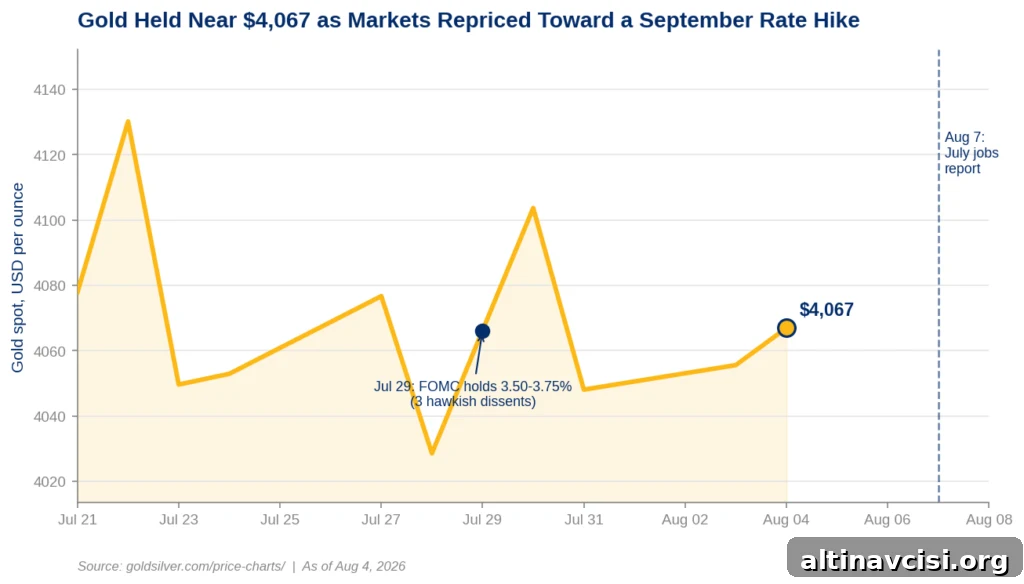
- On August 4, 2026, gold traded near $4,067 an ounce, supported by a softer U.S. dollar and steady central-bank purchases, despite lower oil and 10‑year Treasury yields close to an 18‑month high.
- As of August 4, 2026, CME FedWatch implied roughly a 68% chance of a 25 basis‑point Federal Reserve rate increase in September rather than a cut.
- The Federal Reserve left the target federal funds rate at 3.50%–3.75% on July 29, 2026, with three officials dissenting in favor of a hike.
- June nonfarm payrolls rose by just 57,000, well below expectations, and prior months were revised down by 74,000 in total.
- In a stagflation scenario—sticky inflation with slowing growth—gold can remain attractive because it sits outside the traditional policy trade‑off.
Gold is holding firm near $4,067 an ounce as of August 4, 2026. The metal has found support from a softer U.S. dollar and persistent official sector buying, which together have offset two important headwinds: a diminished geopolitical risk premium and relatively high real yields. With markets focused on upcoming labor releases, the jobs data this week will be a key driver of Fed expectations and short‑term market volatility. Whatever the print, gold appears resilient.
Many expect weak economic data to tilt the Fed toward eventual rate cuts, a scenario that usually helps gold. This cycle looks different: weak data can still create conditions that push the Fed to pause or even tighten if officials fear inflation remains too high. Gold is moving higher into the jobs report, reflecting both cyclical and structural demand.
Why is gold so high, holding above $4,000 before the jobs report?
Two conventional negatives for precious metals arrived at once this week. The geopolitical premium that had supported commodity prices faded after signs of resumed diplomacy, weighing on oil and risk premia. At the same time, U.S. 10‑year Treasury yields climbed toward 4.7%, near an 18‑month peak, which typically pressures an asset that pays no yield. Yet gold has stayed elevated. The offsetting forces are a weaker dollar and continued central‑bank purchases. The dollar slipped to roughly 99.9, its weakest since mid‑June, and official buyers have been steadily adding reserves. Central‑bank demand tends to be long‑term and less reactive to short‑term headlines, providing a durable floor for prices.
The Edge Every Investor Needs
Smarter precious metals investing starts with clear market updates, central‑bank activity, and concise analysis you can act on.
Will the Fed raise interest rates in September?
Market pricing on August 4 showed about a 68% chance of a 25 basis‑point hike at the Federal Open Market Committee’s September meeting. That pricing followed the Fed’s July 29 decision to hold the policy range at 3.50%–3.75%, a meeting that included three dissenting votes in favor of a hike. The tone from policy makers remains focused on bringing inflation back toward the 2% objective, and that focus keeps the possibility of further tightening on the table. Markets are watching labor and inflation data closely for any clues on the Fed’s next move.
What would a weak jobs report mean for gold?
Recent hiring has slowed: June nonfarm payrolls rose just 57,000, well below consensus and accompanied by downward revisions totaling 74,000. If that softness persists, the Fed would face a difficult choice—raise rates into a cooling labor market or risk letting inflation remain elevated. A weak report would strengthen the case that growth is decelerating and raise concerns about a policy mistake, which often boosts demand for safe‑haven and inflation‑resistant assets like gold. Conversely, a strong payrolls print, especially if paired with robust services activity, could validate hawkish Fed members, lift yields and create short‑term headwinds for gold. Even so, both scenarios have elements that can support the metal: protection from inflation risk on one hand and safe‑haven demand on the other.
Is this stagflation, and why does gold care?
The U.S. economy is showing signs of a difficult balance. Inflation remains above target while growth and hiring cool—a combination that fits the description of stagflation. Policymakers face no easy path: raising rates risks deepening a slowdown, while holding rates risks letting inflation erode purchasing power. Gold sits largely outside that policy trade‑off. It has no counterparty risk and pays no coupon that can be repriced by central‑bank action. Historically, when inflation proves sticky amid slowing activity, investors turn to precious metals to preserve purchasing power. In that environment, physical gold can be especially attractive.
What should gold owners watch this week?
Key data arrive across the week and culminate with the July nonfarm payrolls report. Tuesday brought the JOLTS openings, Wednesday will include ADP private payrolls and the ISM Services index (a key gauge for services activity and prices), Thursday features initial jobless claims and unit labor costs, and Friday delivers the headline payrolls and unemployment figures. Services inflation and wages are the variables the Fed watches most closely. Owners of physical gold should focus on the broader macro picture: the interplay of inflation, growth, and central‑bank buying that explains why the metal can remain supported whether the labor print surprises to the upside or downside.
Sources
– Live gold and silver price charts (as of Aug 4, 2026).
– CME FedWatch Tool (market‑implied probabilities as of Aug 4, 2026).
– Federal Reserve FOMC statement (July 29, 2026).
– U.S. Bureau of Labor Statistics Employment Situation Summary (June 2026).
– Daily Treasury yield data and U.S. dollar index readings (early August 2026).
– Institute for Supply Management services PMI (early August 2026).
Disclaimer: This article is for informational purposes only and does not constitute investment advice. Past performance is not indicative of future results. Consult a qualified financial advisor before making investment decisions.
You May Also Like:
- Manufacturing Hit a Four‑Year High Today. Gold Didn’t Move. Here’s Why.
- Gold Is Caught Between a Structural Bull Case and a Policy Ceiling. Something Has to Give.
- The Same Force That Crushed Gold All Year Just Flipped.
- Gold ETFs Lost 45 Tonnes Last Quarter. Central Banks Bought 289. Here’s What That Split Means.
- Gold Had Every Reason to Rally Today. It Didn’t. Five Reasons Why.
- Central Banks Bought 289 Tonnes of Gold Last Quarter. Prices Were Falling the Whole Time.
- Why a Small PCE Drop Didn’t Change the Fed’s Focus—and What That Means for Gold.