Gold and silver market update — May 6, 2026
Key Takeaways:
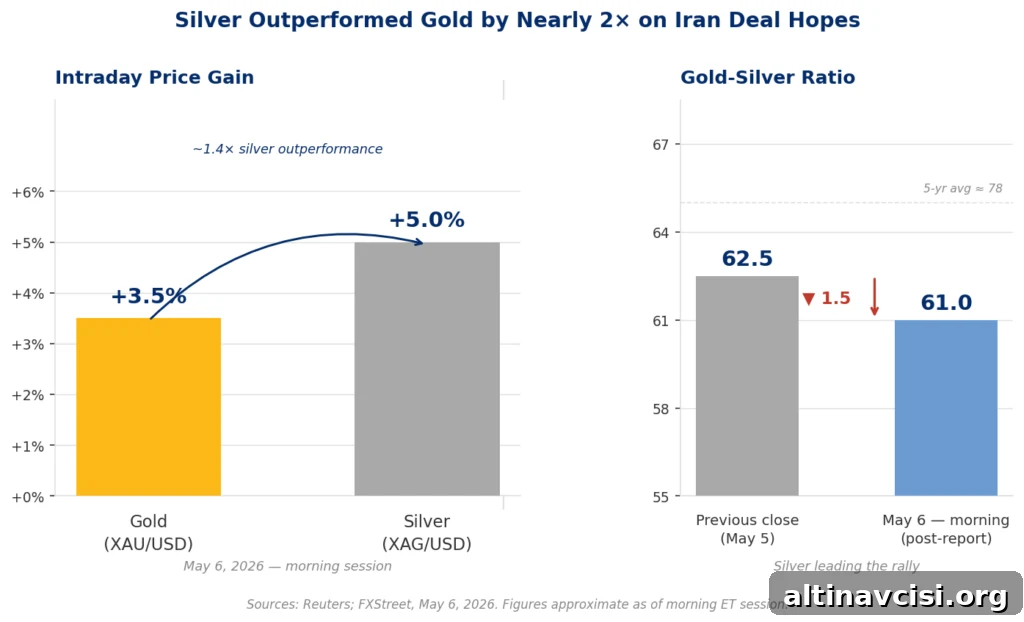
- Gold rose roughly 3.5% to near $4,700 and silver jumped about 5% to roughly $76–$77 on Wednesday, May 6, 2026, after Axios — citing two U.S. officials — reported the White House is close to a one-page peace memorandum with Iran.
- This move reflects the market repricing the inflation channel that kept the Fed on hold — not a classic safe-haven bid. A reopening of the Strait of Hormuz would ease oil prices → lower PCE inflation → increase the likelihood of Fed rate cuts. Silver outperformed because a deal helps both its monetary and industrial demand drivers at once.
- The memorandum is not signed and prior peace signals have reversed. Major bank year-end targets for gold (Goldman Sachs $5,400; JPMorgan $6,300) depend on the inflation relief actually arriving. Watch Iran’s 48-hour response window and Friday’s jobs report.
Silver jumped about 5% Wednesday morning, May 6, 2026, to roughly $77 an ounce. Gold moved toward $4,700, trading near $4,690 by mid-morning ET. The immediate catalyst was a report that the White House believes it is close to a one-page memorandum with Iran, with an Iranian response expected within 48 hours. The market reaction was rapid and pronounced.
Calling this a “peace trade” is accurate but incomplete. Gold and silver are rising not because investors suddenly seek safety, but because the inflation mechanism that suppressed precious metals for weeks appears to be receding.
Why Is Gold Rising When Peace Should Hurt It?
De-escalation normally removes a safe-haven premium, which would push gold lower. This time the dynamic is different: the conflict had trapped gold through its inflation effects rather than through fear alone.
When Iran disrupted traffic through the Strait of Hormuz earlier in the year, oil spiked above $100 a barrel. That shock fed into PCE inflation, which rose from 2.8% in February to 3.5% in March — the largest jump in nearly three years. Manufacturing input prices surged as well. The result: the Federal Reserve could not credibly cut rates while inflation metrics were elevated. Markets priced out early rate cuts, keeping real yields elevated and weighing on gold, which yields nothing.
The core issue was the inflation channel created by the Strait closure, not the geopolitical event itself.
A Hormuz deal reverses that chain. The Axios report pushed oil prices lower almost immediately. Falling oil eases headline and core inflation pressures, which could give the Fed scope to cut rates over time. Rate cuts compress real yields, and lower real yields are the primary driver of major gold rallies. In effect, peace restores the conditions that support higher gold prices rather than removing the market’s impetus.
The Edge Every Investor Needs
Smarter precious metals investing starts here. The Nuggets Newsletter brings essential market insights, Fed updates, global trends, educational videos, and more.
Why Is Silver Outperforming Gold Today?
Silver’s roughly 5% gain — nearly twice gold’s move — matters because silver benefits from two demand engines: monetary and industrial. On Wednesday, both channels picked up momentum.
The monetary channel mirrors gold’s reaction: cooling oil lowers inflation, which increases the prospects for Fed easing and compresses real yields. Silver typically tracks gold along this path.
Silver’s industrial demand is a differentiator. The two-month disruption of the Strait of Hormuz strained global manufacturing: energy costs rose, supply chains were rerouted, and production declined. That reduced industrial demand for silver. The Silver Institute projects another annual silver deficit in 2026, and a reopening that restores manufacturing activity would directly lift industrial silver demand.
The market reflected that shift: the gold-silver ratio fell from about 62.5 to roughly 61 in a single session, signaling silver is leading rather than following this rally.
If a Deal Is Signed, What Happens to Gold’s Ceiling?
Major banks maintained elevated year-end targets for gold through the conflict because their forecasts assumed the Fed’s inflation constraint was temporary. Goldman Sachs’ $5,400 and JPMorgan’s $6,300 targets both rested on inflation receding and rate cuts occurring later in the year. The war delayed that path but did not invalidate it.
A Hormuz normalization would remove the oil shock from the inflation pipeline. PCE could cool toward a 2.5–3% range over several quarters, allowing the Fed to act. Rate cuts would compress real yields and could open the $5,400–$6,300 range for gold within 2026.
Analysts have suggested that with Hormuz normalizing, gold reaching $5,000–$5,500 by year-end is a plausible base-case outcome rather than an outlier.
What Should You Watch in the Next 48 Hours?
Axios’ reported 48-hour window extends through Thursday night, one day before Friday’s U.S. nonfarm payrolls report. Consensus for payrolls sits around 53,000 new jobs, well below March’s pace. Key signals to watch: whether Iran publicly acknowledges reviewing specific terms, whether oil holds below roughly $105, and whether Friday’s jobs data shows further labor market cooling. A weaker jobs print, confirmed deal progress, and falling oil together would present a very favorable setup for precious metals.
The memorandum is not finalized and previous signals have reversed, so the move could unwind. Nonetheless, the market’s question has shifted from “when will the inflation trap lift?” to “is this the moment?” — a materially different focus for investors and traders.
SOURCES
1. Axios — Exclusive: U.S. and Iran closing in on one-page memo to end war
2. Reuters via CNBC — Gold climbs over 3% as Middle East peace hopes drag down dollar, oil
3. FXStreet — Silver price today: rises on May 6
4. UPI — Project Freedom pause coverage
5. Jerusalem Post — Reporting on regional operations
6. Silver Institute — World Silver Survey 2026
7. IEA — Analysis of Middle East and global energy markets
8. U.S. Bureau of Economic Analysis — Personal Income and Outlays, March 2026
9. Institute for Supply Management — April 2026 manufacturing data
Disclaimer: This article is for informational purposes only and does not constitute financial or investment advice. Consult a qualified financial adviser before making investment decisions.
You May Also Like:
- What the IMF’s Inflation Forecast Shift Means for Gold
- What’s Really Driving Gold Prices Today — 5 Key Signals
- Gold Price and the Jobs Report: A Pre-Market Guide
- The Gold-Silver Ratio Is Expanding — and Being Misread
- Gold, Silver, and Stagflation: 5 Signals That Matter Now
- Why Gold Fell on the Hormuz Tanker Strike
- WGC Q1 2026: What Asia Knows That Wall Street Doesn’t
- BEA Stripped Silver From GDP. Here’s What It Means