
If you are considering buying precious metals in 2026, you are in good company. Increasing numbers of analysts, wealth managers, and institutional investors are reassessing the role of gold and silver in modern portfolios. Many now conclude that precious metals warrant larger allocations than seen in recent decades.
Momentum for this shift picked up in September 2025, when Morgan Stanley’s Chief Investment Officer publicly recommended a 60/20/20 portfolio — 60% stocks, 20% bonds, and 20% gold — framing gold as a central inflation hedge rather than a peripheral diversifier.
For an industry long rooted in the 60/40 stock-bond framework, this represents a meaningful change.
Why Institutions Are Increasing Precious Metals Allocation
Institutional interest in gold has risen steadily, and the last 18–24 months have accelerated that trend. Research teams at major banks and financial institutions point to several consistent drivers:
- Persistent inflation and uncertainty about longer-term price stability
- Declining real yields, which historically correlate with higher gold prices
- Elevated geopolitical risk, increasing the value of non-correlated assets
- Concerns over high debt levels and expanding money supply
Each institution frames these factors differently, but the overall message is the same: precious metals provide a combination of liquidity, independence, and diversification benefits that many traditional financial assets cannot match.
For investors evaluating whether to buy precious metals in 2026, this growing institutional support adds credibility and signals a broader shift in portfolio construction for the coming decade.
What Happens If Gold Becomes a Standard 20% Allocation?
Consider a simple thought experiment.
Scenario 1: U.S. retirees allocate 20% of their portfolios to gold
Although ambitious, the scenario is not implausible and its implications would be substantial. U.S. retirement accounts hold roughly $45.8 trillion across IRAs, 401(k)s, and pension funds. A 20% allocation to gold would represent about $9.16 trillion in demand.
To acquire $9.16 trillion worth of gold would require approximately 142,454 metric tonnes — more than 44 times annual global mine production.
Scenario 2: Global investors adopt similar allocations
The U.S. is only part of the picture. If global pension funds across the top 22 markets also adopted a 20% allocation to gold, the potential demand increases dramatically:
- $11.7 trillion in additional potential demand
- Equivalent to roughly 181,956 metric tonnes of gold
- Nearly 57 times annual new mine supply
Actual vs. Theoretical Gold Market Cap Under Higher Allocation Chart
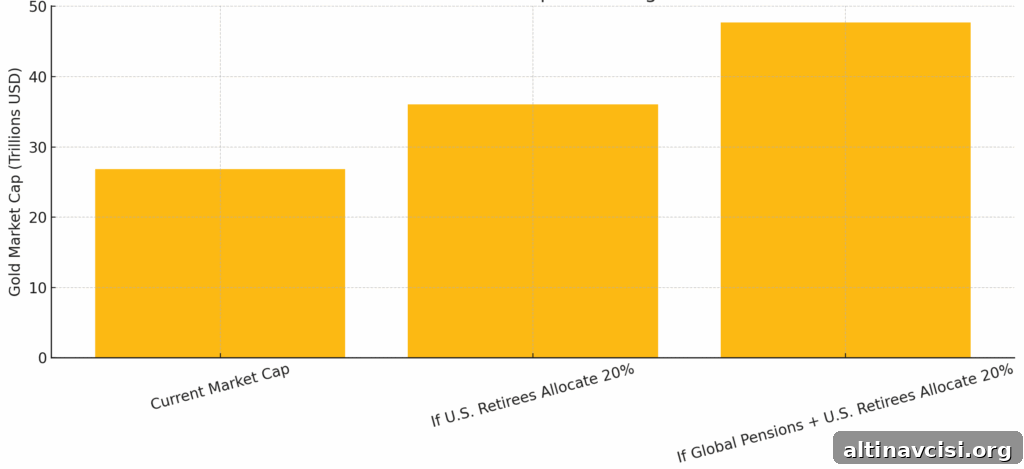
- Current market cap (at $4,000 gold): $26.86T
- If U.S. retirees allocate 20%: +$9.16T → $36.02T
- If global pension funds also allocate 20%: +$11.7T → $47.72T
Demand of this magnitude would overwhelm new supply and could reshape gold’s pricing, liquidity, and market structure. The point is not that universal adoption is required; even a subset of investors moving in this direction would create structural upward pressure on demand.
Even a modest 5% shift into gold across retirement accounts would exceed current annual production. A widespread 20% allocation would place immense upward pressure on the metal, far beyond what the physical market is structured to absorb today.
The Academic Case for Higher Precious Metals Allocation
Academic research predates this recent industry reassessment and consistently finds that modest allocations to gold and silver improve portfolio outcomes. Multiple studies show that portfolios keeping a 5–15% allocation to gold and silver tend to deliver superior risk-adjusted returns over time, experience smaller drawdowns during market stress, and maintain steadier performance through economic uncertainty.
Gold typically performs well when equities falter, inflation accelerates, or volatility spikes, while silver provides additional industrial exposure and diversification. These effects are observable across many market cycles, which is why more investors treat precious metals as a strategic allocation rather than a short-term trade.
Why 2026 May Be a Strategic Entry Point
A number of macro forces are converging:
- Central banks are accumulating gold at multi-decade highs
- Real yields are fluctuating but show a long-term downward bias
- Inflation remains elevated relative to pre-2020 norms in many regions
- Market cycles display late-stage characteristics while geopolitical risks remain heightened
- Structural demand from technology, solar, and energy infrastructure is increasing, particularly for silver
None of these factors alone guarantee price moves for gold or silver, but together they suggest long-term resilience for precious metals and strengthen the case for strategic accumulation in 2026.
The Bottom Line
Whether you are a retiree protecting savings, a long-term investor seeking balance, or simply exploring how to buy precious metals in 2026, the landscape is changing. Institutional allocations are trending higher, academic studies demonstrate diversification benefits from metals, and global uncertainties underscore why gold and silver remain reliable stores of value.
This is less about fear and more about strategy. If you are weighing your next move, understanding these trends before wider adoption takes hold can help you make more informed decisions.
For investors seeking education, data, and guidance on these transitions, numerous resources exist to help evaluate allocation choices and implement a plan that aligns with individual goals.
Investing in Physical Metals Made Easy
People Also Ask
Is 2026 a good time to buy precious metals like gold and silver?
2026 could be a strategic time to consider precious metals. Ongoing inflation, lower real yields, and elevated global debt all support long-term demand. Many institutions are revisiting higher gold allocations as a hedge, which may influence markets over time.
Why are more investors increasing their allocation to gold?
Investors are allocating more to gold because of persistent inflation, geopolitical uncertainty, and the limited real returns of bonds. Historically, gold has performed well when real yields fall and risk aversion rises, offering portfolio protection during turbulent periods.
How big is the current gold market cap at $4,000 per ounce?
At $4,000 per ounce, the global above-ground gold supply is valued around $26–27 trillion. That figure serves as a reference point for evaluating how large institutional allocations could expand the market.
What percentage of a portfolio do experts recommend for gold?
Many academic and quantitative studies recommend a 5–15% allocation to gold or silver to improve diversification and reduce drawdowns. Some newer portfolio models explore larger allocations depending on investor risk tolerance and objectives.
What would happen if U.S. retirees allocated 20% of their portfolios to gold?
A 20% allocation across U.S. retirement accounts would translate to roughly $9.16 trillion in new gold demand — more than 44 times annual global mine production. Such a shift would materially change supply-demand dynamics and the structure of the gold market.
Get Gold & Silver Insights Direct to Your Inbox
Join thousands of investors who receive expert analysis, market updates, and exclusive offers each week.