
Daily News Nuggets | Today’s top stories for gold and silver investors
November 7th, 2025
Gold at $4,000, Silver Near $49 — Momentum Holds
Gold climbed back above $4,000 per ounce this morning as investors weighed political gridlock, inflation concerns, and a weakening dollar. Silver traded near $48.58, recovering from recent losses but still short of last month’s peak near $54. Despite ongoing volatility, both metals have posted strong gains: over the past three months gold is up roughly 17% and silver has risen more than 25%.
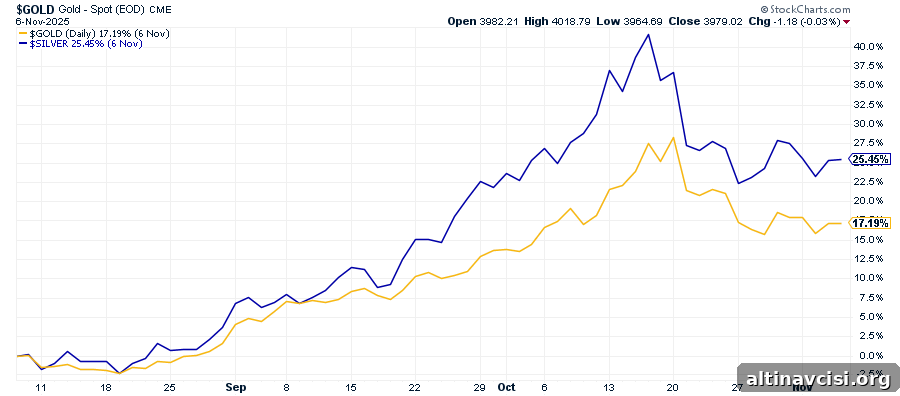
These are outsized moves in a compressed time frame — returns investors normally expect from a full year are appearing in a single quarter. The drivers are familiar: steady central bank buying, concerns about U.S. fiscal stability, and a rotation into hard assets. For silver, industrial demand from solar panels, electric vehicles and data centers is tightening supply and amplifying price gains.
This rally is no longer just an inflation hedge. With policy and fiscal uncertainty elevated, many investors are choosing assets that carry no counterparty risk. A prolonged government shutdown that has curtailed key economic releases is one of the main sources of that uncertainty.
No Jobs Report, Big Speculation
The October jobs report was not released because of the government shutdown, but economists’ estimates suggested a cooling labor market. Forecasts pointed to around 125,000 new jobs and an unemployment rate rising to roughly 4.2%, the weakest job growth since mid-2023. Markets reacted in advance: fewer jobs implies less wage pressure and greater scope for the Fed to consider rate cuts, which supports expectations for easier policy even as the Fed publicly remains cautious.
Gold’s move above $4,000 reflects a market pricing in a softer economic trajectory and heightened downside risk. When economic indicators weaken — or when data are missing and uncertainty increases — safe-haven assets typically benefit. The job data gap is only one example; other official indicators are also delayed.
Fed’s Data Blind Spot Adds Risk to Inflation Outlook
Chicago Fed President Austan Goolsbee warned that the pause in official inflation reports caused by the shutdown is forcing policymakers to “drive in the fog.” With no fresh CPI or PCE releases, the Fed is relying more on private-sector indicators and internal surveys. Before data publication halted, some measures were already signaling a potential uptick in inflation, which raises the risk that headline inflation could be underestimated.
Absent the normal inflow of inflation data, the Fed may move more cautiously, potentially slowing or delaying expected rate cuts. For precious metals investors, that increased politcal and data-driven uncertainty can be supportive of gold and silver since the clarity around future monetary policy is reduced.
Airlines Cut Flights as Shutdown Drags On
The government shutdown is beginning to affect travel: airlines are trimming schedules in anticipation of staffing shortfalls and delayed FAA inspections. Reductions are expected at major hubs just as the holiday travel season approaches, creating further disruption for millions of passengers.
Prolonged shutdowns impose measurable costs on the economy. Current estimates suggest this one could shave an estimated 0.3% off GDP growth this quarter, adding to an already slowing expansion. Markets are responding with lower Treasury yields and higher gold prices as investors seek stability amid rising uncertainty. This pattern — safe-haven inflows when fiscal standoffs intensify — has repeated through prior episodes of U.S. political gridlock.
Silver Lands on U.S. Critical Minerals List
The administration recently expanded the U.S. critical minerals list, adding ten items including silver and copper. The designation acknowledges their essential roles in electric vehicles, data centers, and renewable energy infrastructure. This recognition could unlock federal support for domestic production, permitting assistance and supply-chain development to reduce reliance on imports.
For silver, the listing formalizes what market participants have long noted: it is both a precious metal and a key industrial input. The designation may accelerate conversations about reshoring mining and refining capacity and could bolster long-term demand fundamentals for the metal.