Morning News Nuggets | Today’s top stories for gold and silver investors
March 18th, 2026 | Brandon Sauerwein, Editor
The U.S. economic outlook heading into spring looks resilient on the surface. But with oil near $100, the Fed announcing its decision today, and the Strait of Hormuz effectively closed, underlying strains are becoming harder to ignore. Here’s what’s moving markets.
Is Gold’s $5,000 Floor About to Be Tested?
Gold briefly slipped under $5,000 on Wednesday morning ahead of the Fed meeting. The short breach unsettled some traders, but the recovery will tell the larger story. After reaching highs above $5,500 in late February, the metal has pulled back materially. Even so, it remains far above where it started the year — and the $5,000 mark has become a key technical and psychological level.
Two forces are tugging on gold right now. Safe-haven demand tied to the Iran conflict and the Hormuz crisis supports prices. At the same time, caution ahead of today’s Fed decision limits further upside.
If Chair Powell signals a hawkish stance, the dollar could strengthen and pressure bullion. Conversely, a dovish or uncertain tone — especially around growth — could trigger a rapid rally in gold.
Technically, the market looks like it is consolidating rather than breaking down. Gold remains substantially higher than at the start of the year, and the $5,000 level is now a critical line to watch for both momentum and investor sentiment.
Gold Prices: Three Month Chart
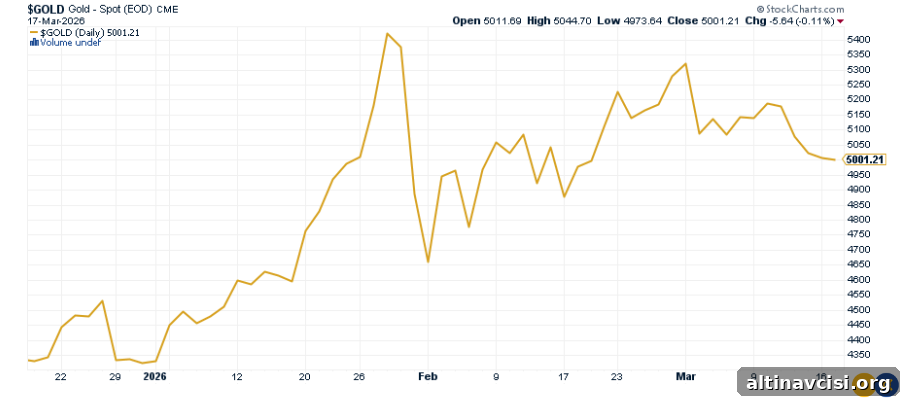
Gold has risen nearly 15% since January and is currently probing the $5,000 area.
Source: StockCharts.com, data through March 17, 2026
Why Won’t U.S. Allies Help Reopen the Strait of Hormuz?
President Trump asked international partners to join a mission to secure the Strait of Hormuz. Most declined or stepped back.
China, France, Germany, Japan, Australia, and the UK have all signaled reluctance to participate in a naval coalition. Their refusals are not just diplomatic hedging: many allies point to the lack of prior consultation and concerns about escalation. Japan’s pacifist constitution constrains its options, Germany has been explicit about political reservations, and the UK supports reopening the strait without committing warships to the center of a confrontation.
The upshot is a United States more isolated in a conflict it initiated, without a clear exit plan. Energy markets are responding accordingly: oil trading near $100 is as much a reflection of low confidence in a resolution as it is a supply issue. With fewer actors willing to step in, the price of uncertainty is rising.
The Edge Every Investor Needs
Smarter precious metals investing starts here. The Nuggets Newsletter delivers market insights, Fed updates, global trends, educational videos, and timely alerts.
If Oil Stays at $100, What Does That Mean for Interest Rates?
The Iran conflict pushed oil prices toward $100 a barrel and has complicated the Fed’s outlook for the year. Higher crude undermines the central bank’s plan by introducing new inflationary pressure and growth risk simultaneously.
With crude near $96, $100 is the psychological threshold markets are watching. If oil stays elevated for an extended period, it would deepen the Fed’s policy dilemma. Just weeks ago, internal debate focused on when to begin easing. That consensus has fragmented: some policymakers still favor cuts if inflation cools, while others are openly considering the need for higher rates to counter new price pressures.
Supply-driven oil shocks historically slow growth more than they push core inflation higher, but there are too many moving pieces to make a confident call. Forecasts suggest sustained oil near $100 for several months could nudge the economy toward recession; lowering rates risks renewed inflation, while keeping policy tight risks tipping growth into contraction.
Gold sits squarely between these competing forces — buoyed by inflation worries yet vulnerable to a stronger dollar. For now, uncertainty is the dominant theme.
What Will the Fed Signal at 2PM Today — and Why Does It Matter?
The rate decision is widely expected to be a hold at 3.5%–3.75%. The focus will be on Chair Powell’s language and the updated economic projections included in the meeting materials.
A hawkish tone could boost the dollar and weigh on gold even without a rate change. A more cautious tone about growth would likely have the opposite effect, supporting bullion. Investors will parse the dot plot and any changes to growth, inflation, and rate expectations closely.
The Fed faces a classic policy trade-off: cut too early and inflation could reaccelerate; keep policy too restrictive and the expansion may weaken. When Fed messaging is unclear, markets typically become more volatile — and periods of volatility have historically favored gold.
The U.S. Economy Outlook Looks Strong. So Why Are Economists Nervous?
On the surface, the U.S. economy entering spring 2026 appears solid: growth is ongoing and unemployment remains low. Yet many economists describe the expansion as “delicate,” and several underlying indicators are flashing caution.
Consumer spending is showing signs of strain as households draw down savings and rely more on credit. Higher borrowing costs are filtering through consumer and business sectors. Housing activity remains subdued, business investment is cautious, and credit demand is softening — all signs that momentum could fade if conditions deteriorate further.
The Fed is acutely aware of these trade-offs, which is why the timing and scale of any rate cuts are so contested. The gap between strong headline data and weaker underlying trends creates uncertainty — and uncertainty tends to increase demand for safe-haven assets like gold.
Stay On Top of Gold & Silver Prices
Get important market alerts sent straight to your inbox.
You May Also Like
- Gold Price Today Holds at $5,000 — What’s Driving It
- Gold and Silver Prices Today: Stagflation, the Fed, and What Comes Next
- Gold Supply Outlook: As Prices Rise, Producing Nations Want a Bigger Share
- Why Oil Is Surging and Gold Isn’t (Yet)
- Gold Price Rises as Iran War Escalates