This morning the U.S. Bureau of Labor Statistics released the Producer Price Index (PPI) for March 2026 — the first broad wholesale inflation report since the U.S. naval blockade of Iranian oil through the Strait of Hormuz. The headline: final demand PPI rose 4.0% year-over-year, the strongest annual producer inflation reading since the conflict began. The inflation pipeline is still filling up.
Gold is trading around $4,761. Headlines saying “gold is falling” miss the nuance behind the price action. Understanding the drivers explains why the metal can decline in the short term even as inflationary pressures intensify.
Why is gold falling when inflation is rising?
Rising inflation tends to support a stronger dollar and push expected rate cuts further into the future. Both are headwinds for gold, which pays no interest. That dynamic can trigger short-term price pullbacks. But higher inflation also erodes the purchasing power of cash over time, which is the fundamental reason many investors hold gold. The short-term price pressure and the long-term rationale for gold are not contradictory — they simply operate on different timeframes.
What Does the PPI Actually Tell Us?
The Producer Price Index measures what businesses pay before those costs reach consumers. When producer costs spike, companies may absorb some of the increase temporarily but typically pass higher costs on to consumers. The gasoline-driven jump that helped push consumer inflation higher already moved through the producer level first. Today’s PPI is effectively a snapshot of that pipeline.
In March, final demand PPI rose 0.5% month-over-month and 4.0% year-over-year, up from 3.4% in February. Goods prices jumped 1.6%, confirming energy pass-through into producer prices. The one bright spot: services were flat for the month, suggesting that, for now, inflation remains concentrated in energy and goods rather than broadly embedded in the service sector.
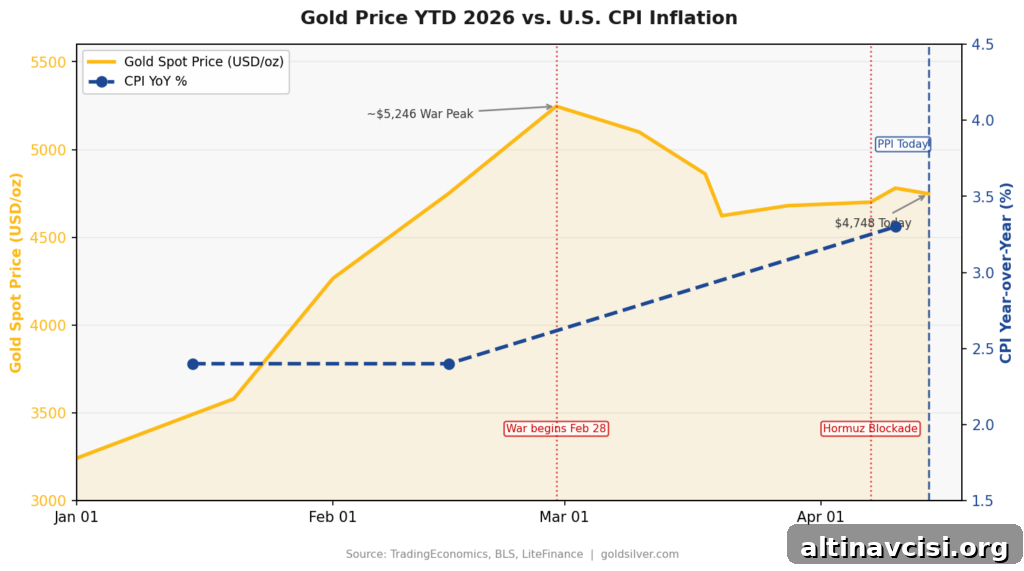
Gold rallied roughly 60% from January to its conflict-related peak before retracing about 10% as hopes for ceasefire talks and a stronger dollar weighed on price. Meanwhile, consumer inflation (CPI) rose from 2.4% to 3.3% in March.
Economists expect more hot inflation prints as energy costs flow through supply chains. Transportation services and durable goods typically register increases later in the cycle. Short-term forecasts project CPI peaking in the coming months before easing — assuming geopolitical conditions stabilize.
Is the Gold Correction a Bear Signal or a Buy Signal?
Gold at $4,761 is lower than its $5,300 war-era high. That drop looks dramatic in headlines, but the context matters: much of the money exiting gold recently was speculative and opportunistic. During the 2025 surge many momentum traders and generalist funds piled in. When price action turns choppy, those participants leave quickly. Their flows amplify volatility but do not reflect structural demand.
Long-term, the buyer base remains intact. Several years of above-target inflation have eroded the purchasing power of dollar savings — a dollar saved several years ago buys noticeably less today. That reality has shifted central banks’ and institutions’ calculus toward holding real assets like gold. While short-term speculative flows can cause corrections, the structural drivers for gold remain in place.
The Edge Every Investor Needs
Smarter precious metals investing starts here. The Nuggets Newsletter delivers market insights, policy updates, global trends and educational content to help informed decisions.
Are Central Banks Still Buying?
Yes. In January 2026, global central banks added gold to reserves, albeit at a lower monthly pace than in 2025. The list of buyers is broadening: several countries resumed purchases and China continued accumulation. Uzbekistan and other nations were notable buyers during the latest reporting period.
Sovereign buyers act for strategic and long-term reasons rather than chasing momentum. The post-2022 geopolitical landscape — including the freezing of certain dollar reserves — changed perceptions about the conditional nature of dollar-denominated assets. Physical gold held domestically is seen as a sovereign insurance asset, a rationale that remains unchanged.
What Happens at the April 29 Fed Meeting?
Markets assign a very high probability to the Fed leaving policy unchanged. With producer inflation running at an elevated 4.0% annually, the Fed faces limited credibility to cut rates. At the same time, hiking further risks pushing an already stressed, war-affected economy into recession. The likely outcome is policy inertia: rates held in a range that satisfies neither growth advocates nor inflation hawks. That creates a prolonged tension that markets — and gold — price over months rather than days.
The Bottom Line
Gold trading near $4,761 does not invalidate the long-term case for sound money. The recent decline looks like a shakeout that removes speculative positioning ahead of the next structural move. Today’s 4.0% annual PPI print underscores ongoing inflationary pressure and reinforces the rationale for holding real assets that preserve purchasing power.
Short-term traders are departing. Patient, structural buyers remain on the sidelines watching and waiting.
Stay On Top of Gold & Silver Prices
Get important market alerts sent straight to your inbox.
SOURCES
1. TradingEconomics — Gold Price, April 14, 2026
2. APMEX — Gold Price Today
3. U.S. Bureau of Labor Statistics — Consumer Price Index, March 2026
4. CNBC — CPI Inflation Report March 2026: Consumer Prices Rose 3.3%
5. CNBC — Inflation Breakdown for March 2026
6. U.S. Bureau of Labor Statistics — Producer Price Index, March 2026
7. U.S. Bureau of Labor Statistics — Producer Price Indexes, February 2026
8. CNBC — Fed Interest Rate Decision March 2026: Holds Rates Steady
9. Morningstar — March CPI Forecast Reflecting Energy Price Impacts
10. Fox Business — March 2026 CPI Coverage
11. Briefs.co — Recent Gold Weekly Performance
12. World Gold Council — Central Bank Gold Statistics, January 2026
13. Wikipedia — Economic Impact of the 2026 Iran War
This article is for informational purposes only and does not constitute financial or investment advice. Consult a qualified financial advisor before making investment decisions.
You May Also Like
- Gold Outranks the Dollar at Central Banks — What It Means for Your Savings
- Hormuz Blockade Sent Gold Down 2%. Here’s Why That’s Bullish
- Gold Jumps 2% as Political Developments Unfold
- $88 Billion a Month: Why U.S. Debt Is Driving Gold Prices
- CPI Hits 3.3%, GDP Stalls — Is Stagflation 2026 Here?
- War Risk, Stagflation Signals, and a $6,300 Gold Target
- Gold and Oil Brace for Strait of Hormuz Developments