Key Takeaways
- A gold IRA rollover transfers retirement assets into a self-directed IRA that holds physical precious metals without immediate tax consequences when IRS rules are followed.
- A direct trustee-to-trustee transfer is usually the best option: funds never go to you, no withholding applies, there is no 60-day deadline, and the once-per-year rollover limit does not apply.
- An indirect rollover places funds in your hands first. Employer plans (401(k), 403(b), TSP) must withhold 20% for federal taxes. For distributions from an IRA the default withholding is 10%, which you can elect to reduce to zero using IRS Form W-4R. In all indirect rollovers you have 60 calendar days to redeposit the full original amount or the IRS will treat the distribution as taxable income.
- Gold intended for IRAs must meet minimum purity rules: generally 99.5% (0.995) fineness for gold, with the American Gold Eagle as a statutory exception.
- IRA metals cannot be stored at home. Physical metals in an IRA must be held at an approved depository managed by a qualified custodian.
- Rollover amounts do not count toward annual IRA contribution limits; they are separate from the yearly contribution caps.
A gold IRA rollover moves retirement savings—such as funds from a 401(k), traditional IRA, 403(b), or similar account—into a self-directed IRA that holds physical precious metals like gold, silver, platinum, and palladium. The Taxpayer Relief Act of 1997 and subsequent IRS guidance permit these metals inside IRAs when specific rules are met. You can complete a rollover either by a direct trustee-to-trustee transfer or by an indirect 60-day rollover, though the direct method is typically safer and more reliable. Below is a clear explanation of both options, what to watch for, and how the process works in practice.
What Is a Gold IRA Rollover?
A gold IRA is simply a self-directed individual retirement account that holds physical precious metals instead of or in addition to traditional paper investments. Unlike a typical brokerage IRA, a gold IRA requires a custodian authorized to administer alternative assets and mandates that all precious metals be stored at an approved depository. While the metals remain inside the IRA, you cannot take personal possession of them.
A rollover is the transfer mechanism used to fund the new account. You can move assets from many types of retirement plans into a self-directed gold IRA without creating a taxable distribution, provided you follow IRS rules for the type of transfer you choose. Importantly, a rollover preserves the tax status of the original account: a traditional IRA rolled into a gold IRA remains tax-deferred, and a Roth IRA retains Roth treatment.
What Is the Difference Between a Direct and Indirect Gold IRA Rollover?
Choosing between a direct and indirect rollover is the most important decision when moving retirement funds into a gold IRA. Both methods end with precious metals inside a tax-advantaged account, but they differ sharply in risk and administrative requirements.
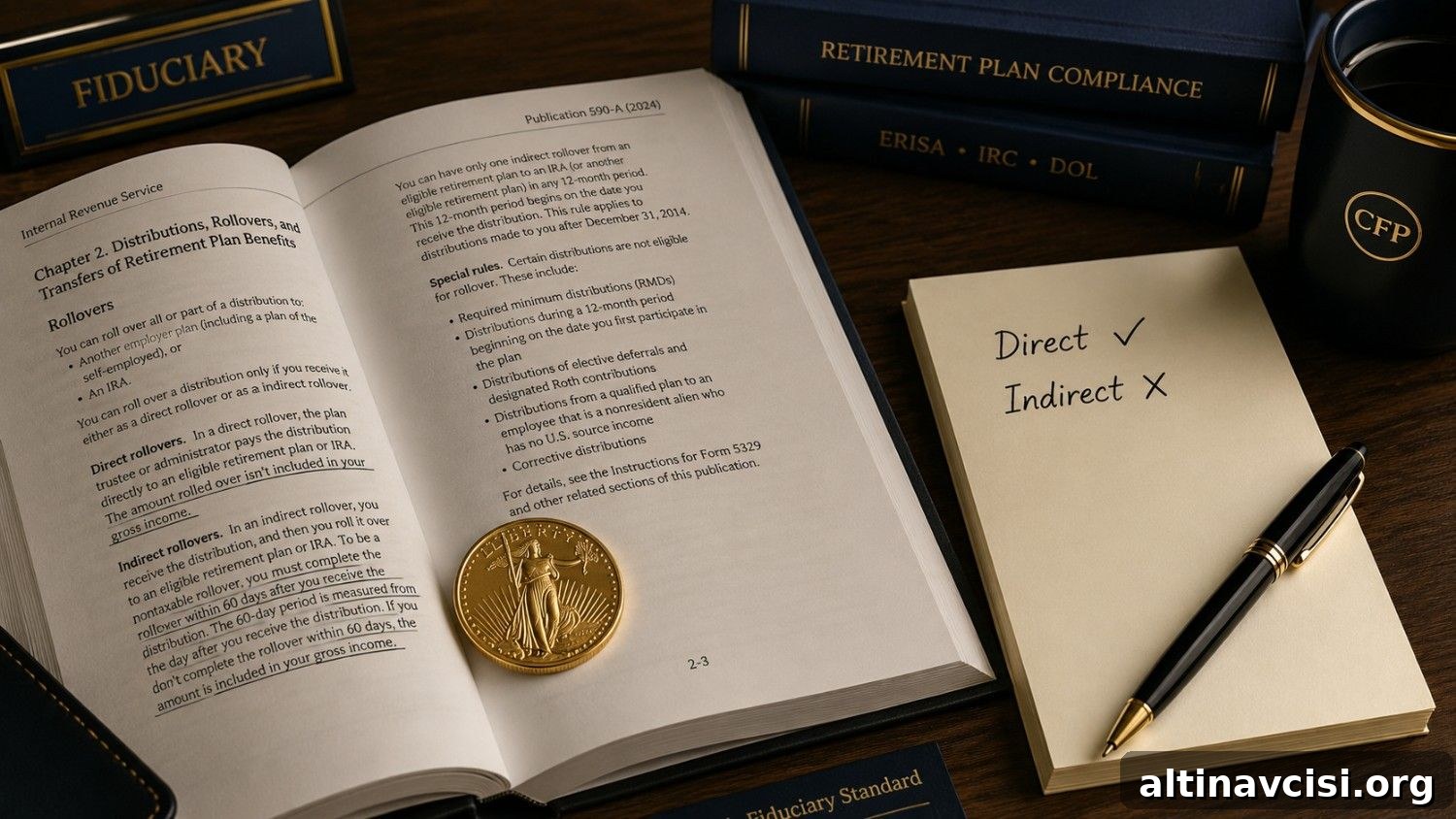
Direct rollover (trustee-to-trustee transfer): The current custodian or plan administrator sends funds straight to the new gold IRA custodian. You never handle the money. Because the transfer is direct, no federal withholding is required, the 60-day countdown never starts, and the once-per-year indirect rollover restriction does not apply. This path eliminates most of the practical pitfalls of moving retirement assets.
Indirect rollover (60-day rollover): The account holder receives a distribution and must redeposit the full original amount into a new IRA within 60 calendar days. Withholding rules vary by source: employer plans generally withhold 20% for federal taxes and cannot waive that withholding; IRA custodians typically withhold 10% by default, and you can elect zero withholding. Regardless of withholding, you must restore the entire distribution amount to the new IRA within 60 days to avoid a taxable event. The indirect route carries more risk because of the deadline, mandatory withholding from employer plans, and the IRS rule limiting one indirect rollover among all IRAs per 12-month period.
Direct vs. indirect gold IRA rollover
A single choice can avoid mandatory withholding and the 60-day risk
| Direct rolloverTrustee-to-trustee | Indirect rollover60-day | |
|---|---|---|
| Funds touch your hands? | No | Yes |
| Withholding | None | 20% mandatory from employer plans; 10% default from IRAs (waivable) |
| 60-day deadline? | No | Yes — miss it and the amount becomes taxable |
| Once-per-year limit? | None | Limited to one indirect IRA-to-IRA rollover in 12 months across all IRAs |
| Risk of taxable event? | Minimal | High if the rules are not followed |
| IRS authority | IRS guidance and tax code provisions supporting trustee transfers | Tax code provisions governing distributions, withholding, and rollovers |
| Verdict | Preferred for nearly all investors | Only use if advised by a tax professional |
Sources: IRS guidance, tax code provisions, and court interpretations related to rollover rules
What Is the 20% Withholding Trap, and How Do You Avoid It?
The withholding trap is most dangerous when an employer-sponsored account is distributed to you in an indirect rollover. For example, a $200,000 401(k) rolled indirectly could result in $40,000 withheld immediately, leaving you with $160,000. To complete a tax-free rollover you must redeposit the full $200,000 within 60 days, meaning you would need to make up the withheld $40,000 from other funds and later claim a refund when you file taxes. If you cannot replace the withheld amount within 60 days, the IRS considers the withheld portion a taxable distribution.
If the distribution originates from an IRA rather than an employer plan, withholding is typically lower and can be waived by filing the appropriate IRS form. Even with no withholding, the 60-day deadline still applies. Missing the deadline triggers ordinary income taxation on the distribution and, if you are under age 59½, a potential 10% early distribution penalty in addition to regular income taxes.
Because of these risks—mandatory withholding from employer plans, tight timelines, and the once-per-year rollover restriction—the direct trustee-to-trustee transfer is generally the safer and more efficient choice for moving retirement assets into a gold IRA.
What Are the IRS Purity Requirements for Gold IRA Metals?
Not all coins and bars qualify for an IRA. Generally, gold used in an IRA must meet a minimum fineness of 0.995 (99.5% pure). Accredited refiners and approved government mints are required sources for bars and rounds. Silver, platinum, and palladium have similarly strict purity standards. One notable exception allows the American Gold Eagle—minted at a lower fineness—to be IRA-eligible under a specific statutory provision. Other 22-karat coins without a statutory exemption, such as the South African Krugerrand, typically do not qualify.
Collectible and numismatic coins are prohibited regardless of metal content. The IRS distinguishes bullion coins and bars valued for their metal content from coins valued primarily for rarity or collectibility.
Typical IRA-eligible gold products include popular bullion coins and approved gold bars and rounds from reputable refiners and mints. Confirm eligibility with your custodian before purchase to ensure compliance with custody and purity rules.
Why Does a Gold IRA Require a Special Custodian?
Because IRAs that hold physical metals are treated differently from traditional brokerage IRAs, the IRS requires a qualified custodian or trustee that can handle alternative assets. The custodian purchases metals on your behalf, arranges delivery, and ensures storage at an approved depository. You cannot personally buy metals and deposit them into the IRA yourself, and personal possession of IRA metals before distribution triggers prohibited transaction rules and taxable consequences.
What Does the Gold IRA Rollover Process Look Like in Practice?
From start to finish, a typical rollover takes about two to six weeks, depending on custodian responsiveness and paperwork. Common steps are: open a self-directed IRA with a qualified precious-metals custodian; request a direct transfer from your current plan administrator or IRA custodian; once funds arrive, instruct the custodian which IRS-eligible metals to purchase; and have the custodian coordinate delivery to an approved depository for storage in your IRA’s name.
Rollover transactions are separate from annual contribution limits. Moving a large balance into a gold IRA does not reduce your ability to make that year’s regular IRA contribution.
What Are the Tax Rules When You Eventually Withdraw?
Distributions from a traditional gold IRA are taxed as ordinary income in the year received. Qualified distributions from a Roth gold IRA—taken after age 59½ and after the required holding period—are tax-free. Required minimum distributions apply to traditional IRAs beginning at the age set by current law and can be taken in cash or in-kind as physical metals; either option is taxed as ordinary income.
If you withdraw before age 59½, an early withdrawal penalty may apply in addition to income tax, subject to customary exceptions. If physical metals are distributed and later sold, any gain may be treated under rules that apply to collectibles, which can affect the applicable tax rates on those gains.
Stay On Top of Gold & Silver Prices
Get important market alerts sent straight to your inbox.
People Also Ask
A transfer is a direct, trustee-to-trustee movement between IRA custodians and is not treated as a distribution, so it has no 60-day deadline or once-per-year restriction. A rollover is a distribution paid to you that you must redeposit within 60 days. Most investors should use direct transfers rather than indirect rollovers when moving IRA funds.
Yes, if you use a direct rollover where the 401(k) plan sends funds directly to the gold IRA custodian. No taxes are withheld and the movement is not treated as a taxable distribution. An indirect distribution triggers mandatory 20% withholding from most employer plans and creates risk unless you redeposit the full pre-withholding amount within 60 days.
Typically two to six weeks from initiation to completed metal purchase. The timeline depends on paperwork, custodian coordination, and delivery to the depository.
The IRS treats the distributed amount as ordinary taxable income for the year, and if you are under age 59½ an early withdrawal penalty may also apply. The IRS may grant rare hardship relief in exceptional circumstances, but relying on that relief is risky; direct transfers avoid the deadline altogether.
Eligible gold must generally meet prescribed purity standards and come from approved refiners or government mints. The American Gold Eagle is a specific exception that qualifies despite lower fineness. Collectible and numismatic coins are disallowed.
There is no dollar limit on rollover amounts. Rollover transfers do not count against annual IRA contribution limits, which are separate and unchanged by rollover activity.
SOURCES
Authoritative IRS publications, Internal Revenue Code provisions governing rollovers and eligible metals, and related tax guidance inform the details in this article.
Disclaimer: This article is informational and not financial or tax advice. Consult a qualified adviser or tax professional for guidance specific to your situation.
You May Also Like:
- The Canadian Gold Maple Leaf: details about purity and typical IRA eligibility.
- How central banking and monetary policy affect currency value over time.
- Gold storage standards and why secure vaulting matters.
- A practical investor guide to the American Gold Eagle coin.
- An overview of the petrodollar system and its historical role.
- A complete guide to self-directed IRAs for precious metals investors.