
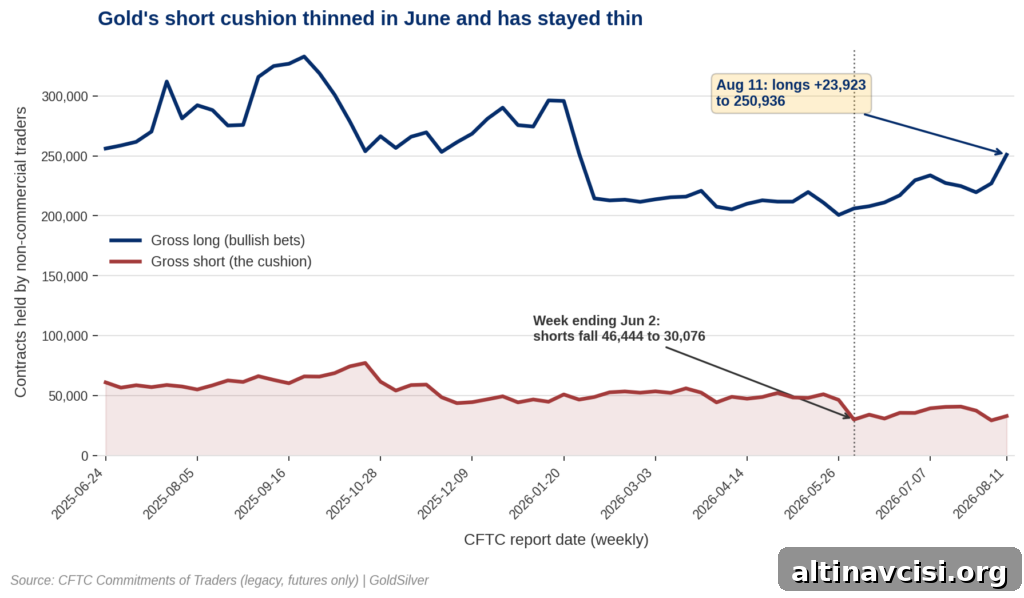
Speculative short positions in COMEX gold collapsed by about 35% in the week ending June 2 and have remained thin since. Then, on August 11, buyers added 23,923 long contracts on top of that short squeeze, changing what any price dip now implies.
Why hasn’t gold rallied more? It rose just 0.64% on Monday to $4,405 an ounce and still struggles to clear $4,500. The explanation isn’t primarily the Federal Reserve or the dollar. Rather, the futures market lost one of its two balancing sides in early June. This week’s surge in long positions piled fresh money into a market that already had very few sellers left to absorb a decline.
To recap the important facts: gross short positions in COMEX gold dropped from 46,444 contracts to 30,076 in the week ending June 2—a decline of roughly 35% in a single reporting period, according to the CFTC’s Commitments of Traders report for that week. Short interest has remained unusually low since then. Nine of the past 60 weeks with gross shorts under 40,000 contracts occurred after that June 2 reading. As of the most recent report the gross short base sits near 32,996 contracts, about 64% of the 60-week median of 51,716.
What does a short position do in the gold market?
The CFTC publishes the Commitments of Traders report each Friday, covering positions held the previous Tuesday. The non-commercial category in that report represents speculators—traders seeking profit from price moves, not commercial hedgers like mines or refiners. Net length in that category equals speculative longs minus speculative shorts.
Short positions are more important than they often appear. When short sellers close positions they buy futures contracts, so shorts act as a buyer of last resort during price declines. That buying provides a cushioning effect under the market. Each COMEX gold contract represents 100 troy ounces, so a gross short base of roughly 33,000 contracts corresponds to about 3.3 million ounces of standing demand. By comparison, before June that cushion averaged closer to 5.49 million ounces (about 54,900 contracts), highlighting how much the market’s shock-absorbing capacity has thinned.

The Edge Every Investor Needs
Smarter precious metals investing starts here. The Nuggets Newsletter delivers concise market insight, Fed developments, global trends, and educational material tailored for metals investors.
What changed in gold positioning this week?
In the week ending August 11, gross long positions jumped by 23,923 contracts to 250,936, the highest level in the recent ten-week stretch. Total open interest rose by 28,758 contracts to 400,309. That combination indicates fresh buying capital entered the market rather than a wave of shorts simply covering positions.
Net speculative length reached 217,940 contracts, or 54.4% of open interest—the largest share in the 60-week period tracked here. June 2 registered a similar concentration at 53.99%, so the precise percentage is close, but the important point is that buyers have committed heavily into a market that already had almost no one on the other side. That creates a crowded trade on the long side and a fragile market structure.
Why is gold not going up past $4,500?
Because the trade is heavily crowded on one side. When speculative net length reaches more than half of all open interest, as it did in the week ending August 11, there are few marginal buyers left to respond to positive news. Supportive developments therefore have limited ability to push the price higher.
This month gold received favorable news: the market’s perceived odds of a September Fed rate hike fell, and the dollar softened—factors that typically help bullion. Last week was gold’s best since January. But the traders who would buy on that news had largely already positioned themselves, so the move up was muted. That situation is arithmetic rather than sentiment: with a high share of open interest already net long, the market lacks the incremental demand needed to lift prices substantially.
That does not mean gold’s long-term outlook is weak. Large research teams continue to forecast higher average levels over longer horizons. Still, in the short term the market sits in a technical no-man’s-land: bullish longer-term expectations can coexist with a crowded short-term positioning that prevents a decisive breakout.
Is silver positioned the same way as gold?
No. Silver has been behaving differently. On the same reporting snapshot, silver climbed 1.60% on Monday to $65.74, more than double gold’s daily gain. Silver’s speculative net long amounts to about 23,646 contracts, roughly 20.5% of its open interest—well below the crowding seen in gold and only around the middle of its 60-week range. Against silver’s 60-week peak in gross longs, current positioning sits at roughly 37% of full strength. In short, silver has room to attract more speculative buying, while gold’s market is already heavily committed to the long side. This is a story about positioning differences between the two metals, not about a blanket weakness or strength across precious metals.
Stay On Top of Gold & Silver Prices
Get timely market alerts delivered to your inbox.
What does crowded positioning mean if you own physical metal?
Futures positioning does not change the physical supply of metal. Open interest of 400,309 contracts corresponds roughly to 40 million ounces of paper claims; those claims are priced on electronic markets and can move rapidly as positioning changes. Physical ounces held in vaults are not subject to margin calls and cannot be liquidated by other market participants’ leverage.
That distinction matters. Futures positioning sets the quoted daily price, but it does not alter the fundamental reasons investors may own physical gold or silver, such as concerns about monetary expansion, fiscal deficits, or long-term purchasing power. When a crowded paper trade unwinds, the quoted price can fall quickly while the physical metal and the long-term case for holding it remain unchanged. For an investor with a multi-year horizon, a temporary dip driven by futures positioning can represent a buying opportunity rather than a reason for alarm.
Two near-term dates merit attention: minutes from the July FOMC meeting are scheduled for release on Wednesday, August 19 at 2:00 p.m. Eastern, and the next Commitments of Traders report will be published on Friday, August 21, covering positions as of August 18. That update will reveal whether the crowded long position in gold expanded further or began to ease.
Frequently asked questions
The Commitments of Traders (COT) report is published weekly by the CFTC and shows futures positions held the previous Tuesday. It breaks open interest down by trader category, so readers can see whether speculators or commercial hedgers dominate a market.
Positioning appears stretched rather than the price being objectively extreme. Speculative net length is a 60-week high as a share of open interest, driven chiefly by an unusually small short side. That makes the futures market fragile to a forced unwind, but it does not provide a definitive directional forecast.
No. Futures positions are financial claims that can be forced closed by margin events and therefore move the quoted price. Physical metal cannot be liquidated by other traders’ leverage. A positioning-driven price move affects the paper price but not the existence or intrinsic attributes of physical metal.
SOURCES
1. CFTC — Commitments of Traders (Legacy, Futures Only), data as of August 11, 2026, released August 14, 2026.
2. CME Group — COMEX Rulebook Chapter 113: Gold Futures, accessed August 17, 2026.
3. CME Group — CME FedWatch Tool, August 14, 2026.
4. Federal Reserve — August 2026 Release Calendar, accessed August 17, 2026.
5. J.P. Morgan Global Research — Gold price commentary and longer-term outlook, June 2026.
6. Live gold and silver price charts, data as of August 17, 2026, 19:11 UTC.
7. CFTC speculative position summaries, mid-August 2026.
Disclaimer: This article is for informational purposes only and does not constitute investment advice. Past performance is not indicative of future results. Consult a qualified financial advisor before making investment decisions.
You May Also Like:
- JP Morgan Just Flagged a Silver Demand Warning. Silver Rose Anyway. Here Is Why
- Gold Needed One Thing to Break $4,400. It Just Got Five of Them.
- Zero Tankers Crossed Hormuz on Sunday. Oil Hit $89. Gold Barely Moved.
- Gold Rebounds to $4,392 as Sentiment Crashes to 51 and Inflation Expectations Rise
- Gold Price and the September Fed Pivot: Five Data Prints Rewrote the Odds This Week
- The Fed’s September Math Just Changed. Here’s What It Means for Gold.