Gold has shifted from a crisis hedge to a core portfolio asset—and the evidence supports keeping it as a permanent allocation. In 2025, global gold demand exceeded 5,000 tonnes for the first time, while central banks added 863 tonnes even as prices hit record levels. The structural drivers of gold’s long-term value—monetary debasement, persistent fiscal deficits, and the fading of stock-bond diversification—remain intact. Historically, a 5–15% allocation to gold has improved risk-adjusted returns across many portfolio types without requiring investors to time short-term price moves.
As of early May 2026, gold was trading near $4,700 per ounce, roughly 16% below its January 28, 2026 all-time high of $5,589.38. Short-term traders may see a pullback; long-term investors may view it as an entry opportunity. The crucial question is not whether gold will reach new highs, but whether you have exposure when it does.
What Makes Gold a Core Asset Rather Than Just a Hedge?
A hedge is reactive—bought in fear and sold when the crisis passes. A core asset is held for what it consistently delivers across full market cycles: lower portfolio volatility, protection of purchasing power, and preservation of value when other assets falter. It’s a structural allocation, not a timing decision.
For the past four decades many treated gold as a crisis instrument. That perspective is fading. The conditions that made bonds reliable ballast—low inflation, stable growth, and negative stock-bond correlations—have changed. Bonds no longer reliably diversify the way investors once expected; gold increasingly fills that role.
Your Gold Buying Guide Most investors overpay when they buy gold, then overpay again when they sell. This guide explains what to own—and why.
Why the 60/40 Portfolio Can’t Do the Job Alone
The classic 60/40 allocation depended on stocks and bonds moving in opposite directions—equity declines were offset by bond gains. That relationship persisted for decades but has broken down in recent years.
With structural fiscal deficits, elevated sovereign debt, and a higher-for-longer interest-rate environment, bonds and equities increasingly move together during market stress. The ballast investors trusted has become less reliable.
Gold helps fill this gap. Its correlation with U.S. equities over the past 20 years is about 0.14—essentially zero—so it tends to hold value or rise when other portfolio components are under pressure. European institutional investors have recognized this: WisdomTree’s 2025 survey found average gold allocations of 5.7%, equal to developed-market sovereign debt holdings. Gold is moving from a fringe position to a mainstream portfolio anchor.
What Are Central Banks Telling Us About Gold?
Central banks are patient, strategic investors. When they buy gold consistently—even at record prices—it signals a deliberate, long-term reserve strategy rather than a reaction to headlines.
In 2025 central banks purchased 863 tonnes, the fourth-largest annual increase in official reserves and nearly double the 2010–2021 annual average of 473 tonnes. In surveys, 95% of central banks expected reserves to rise over the next 12 months—the highest optimism in eight years, with none expecting reductions. By late 2025, gold surpassed U.S. Treasuries to become the world’s largest reserve asset by value—a milestone not seen since 1996.
Poland was the largest single buyer, adding 102 tonnes and raising gold’s share of its reserves to 28.2% by year-end 2025, up from 16.9% a year earlier. Kazakhstan recorded its largest annual purchase since 1993, and Brazil resumed buying after a four-year pause.
Gold provides liquidity without counterparty risk: it has no issuer that can default and cannot be frozen by another government. When nation-states increase gold holdings, it constitutes a strong institutional endorsement of the metal’s role in reserves.
How Does Gold Actually Perform When Markets Turn?
Gold isn’t intended to outpace equities in sustained bull markets—stocks typically deliver higher long-term returns. Gold’s role is to hold value when other assets struggle.
Historically, gold has shown resilience during market stress. In 2008, while the S&P 500 dropped significantly, gold ended the year slightly positive. In 2020 gold rose around 25% for the year. In 2025, with 53 new all-time highs across markets, total gold demand exceeded 5,000 tonnes and generated $555 billion in value—a 45% increase year-over-year.
Notably, bar and coin investment reached a 12-year high of 1,374 tonnes in 2025, up 16% year-over-year, while jewelry fabrication fell 19% as record prices reduced consumer volumes. Rising investment demand amid contracting consumer fabrication points to patient, long-term buyers rather than speculative momentum.
Gold’s durability stems from properties that matter in an era of geopolitical fragmentation and sovereign debt growth: it carries no credit risk, has no issuer, and cannot be frozen by foreign authorities. Those attributes gain value when structural economic risks persist.
What Is the Right Gold Portfolio Allocation?
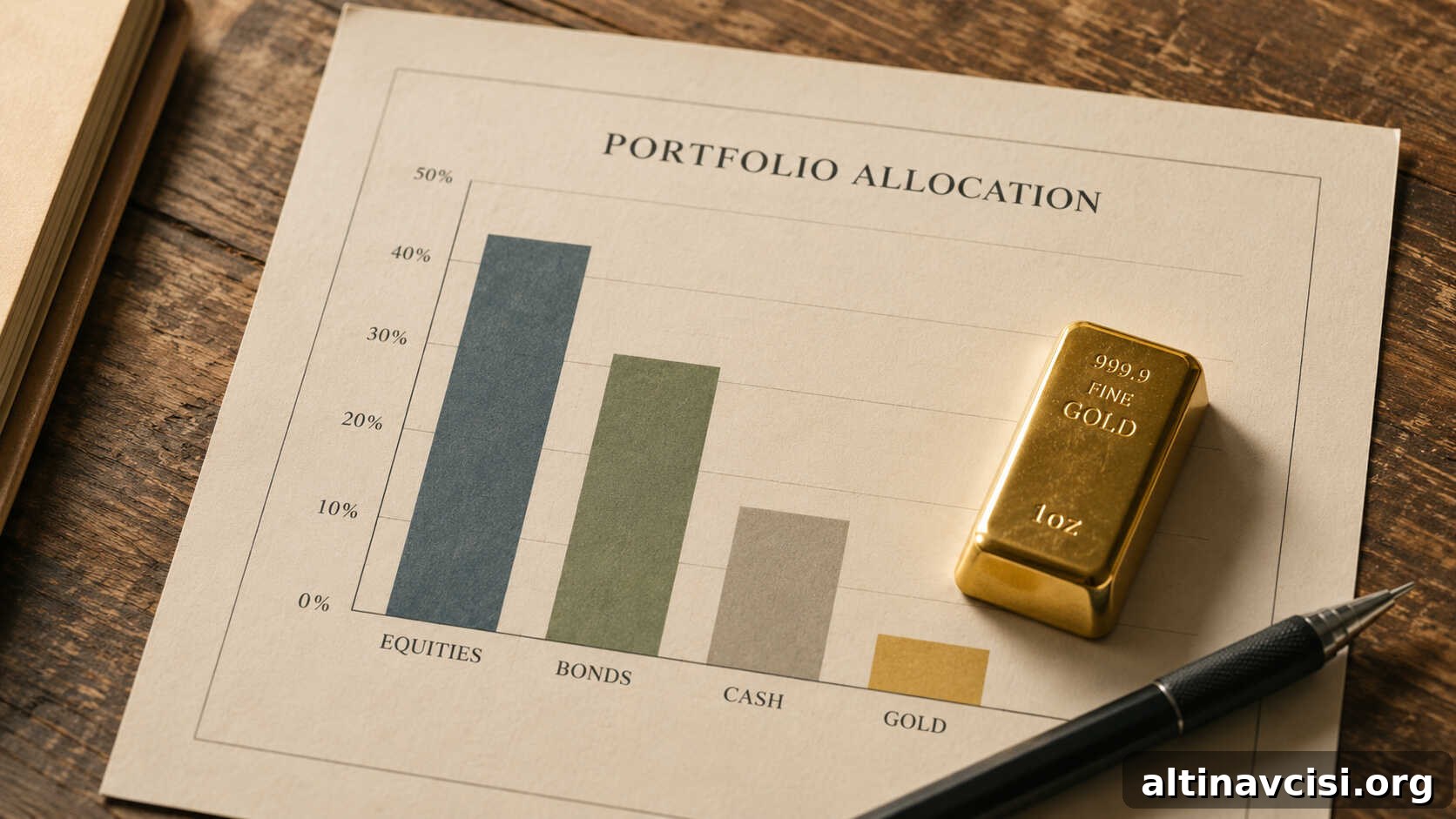
Research generally points to a 5–15% range for individual portfolios, though many investors hold far less.
Data shows that adding gold at 2.5%, 5%, 7.5%, or 10% improved risk-adjusted returns for a standard USD portfolio over the past 20 years while reducing maximum drawdown. Even a 5% allocation notably improved the Sharpe ratio—real historical results across multiple cycles, not theory.
Some institutions advocate higher permanent allocations. Sprott recommends 10% in physical gold. Flexible Plan Investments’ 2025 study identified 18% as the historically optimal allocation with mathematically efficient positions up to 35%. Ray Dalio has cited 15% as his target, describing gold as an optimal diversifier against debt and currency-debasement risk.
Institutional price forecasts also support the case: J.P. Morgan raised its year-end 2026 gold target to $6,300 per ounce, up from $5,055, citing ongoing reserve diversification. If your allocation is below 5%, institutional analysis suggests you may be underexposed.
Consistency matters most. A steady 10% allocation rebalanced annually through volatility typically outperforms larger allocations that are sold at the first drawdown. Gold rewards patience. To determine the right size for your portfolio, consider your goals, risk tolerance, and time horizon.
Stay On Top of Gold & Silver Prices
Get important market alerts sent straight to your inbox.
People Also Ask
Why is gold considered a core portfolio asset and not just a hedge?
A hedge is reactive, used during crises. As a core asset, gold consistently lowers volatility, reduces drawdowns, and protects purchasing power across market cycles. Its long-term correlation with equities is near zero, meaning it provides diversification in normal times as well as during stress.
What are the benefits of including gold in a diversified investment portfolio?
Gold can improve risk-adjusted returns without market timing. Historical analysis shows allocations of 5–10% enhanced Sharpe ratios and reduced maximum drawdowns for standard USD portfolios over a 20-year period. Gold also offers structural protection against inflation, currency debasement, and geopolitical risk.
How does gold perform compared to traditional assets like stocks and bonds?
Stocks typically deliver higher long-term returns, but gold often outperforms during financial stress, high inflation, and currency debasement. In 2025 gold set numerous records and saw a large increase in demand value while markets experienced volatility.
What percentage of a portfolio should be allocated to gold?
Most research converges on 5–15% for individual investors. World Gold Council data shows meaningful improvements at 5%, 7.5%, and 10%. Institutional recommendations range from 10% to 15% for durable diversification, with some studies suggesting higher allocations under certain assumptions.
How does gold’s role change during economic uncertainty or market volatility?
During stress periods gold’s near-zero correlation to equities often becomes mildly negative, helping the asset rise when equities fall. Gold’s lack of credit or counterparty risk and its independence from issuers make it valuable across both crisis and non-crisis environments.
The Shift Has Already Happened — Has Your Portfolio Caught Up?
Institutional behavior and data show a fundamental shift in how serious investors treat gold. Central banks bought 863 tonnes in a single year at record prices. European institutional allocations now mirror sovereign bond holdings, and the 60/40 model’s reliability has weakened. These are observed changes, not forecasts.
Many individual investors remain underallocated. The World Gold Council’s 20-year data indicates that a 5% allocation marks the threshold for meaningful improvement in risk-adjusted returns. Current price pullbacks create entry opportunities for long-term holders who view gold as a permanent portfolio component rather than a trade to time.
Disclaimer: This article is for informational and educational purposes only. It does not constitute investment advice. Consult a qualified financial adviser before making any investment decisions.
SOURCES
CBS News — What Is the Highest Gold Price in History?; WisdomTree — Rethinking the Golden Allocation; World Gold Council — Gold Demand Trends Full Year 2025; National Bank of Poland; TheStreet — J.P. Morgan Revises Gold Price Target for 2026 (via Reuters); GoldSilver industry analysis and related reports.
You may also like:
- Silver vs. Gold: A Clear 5-Year Investment Guide (2026–2031)
- $5,500 Gold by Q1 2027? The Central Bank Risk Driving It
- Why Gold Stabilizes — and Silver Amplifies
- COMEX Silver Coverage Ratio: Is Your Paper Silver Real?
- What the Gold Price Per Ounce Really Tells You
- The Gold Inflation Paradox Most Investors Miss
- Insurance vs. Upside: Balancing Your Portfolio with Gold and Silver
- Gold Bullion vs. Jewelry: Why Serious Investors Choose the Bar