
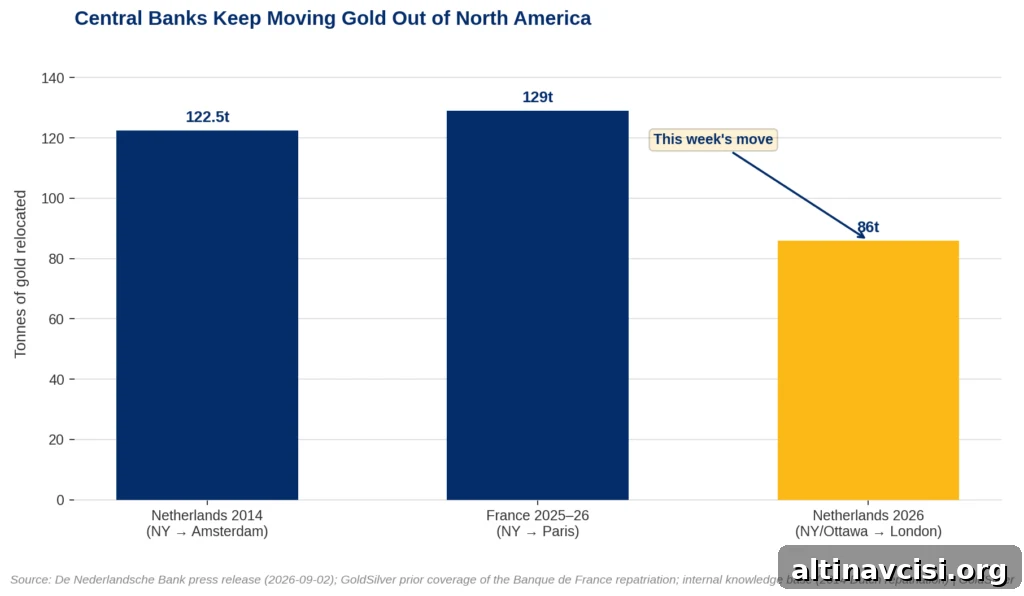
The Dutch central bank relocated 86 tonnes of gold this year—valued at roughly $10 billion—from vaults at the New York Fed and the Bank of Canada to London. This transfer, completed between March and August 2026, follows France’s earlier move out of New York and highlights a growing distinction between gold that is nominally owned and gold that is immediately accessible. Central banks appear increasingly focused on where metal is stored, not just how much they hold.
Key takeaways:
- De Nederlandsche Bank (DNB) moved 86 tonnes of gold—about $10 billion worth—from New York and Ottawa to London between March and August 2026. This followed France’s earlier repatriation of 129 tonnes from the New York Fed.
- DNB framed the relocation as a move to improve tradability and access during crises, not as an expression of distrust toward the United States. Market data from COMEX shows a related trend: the share of registered (deliverable) gold has risen while total inventories remained stable.
- For private holders, the practical lesson is clear: allocated, reachable storage provides tangible access to metal in a way that unallocated claims or certain paper-based exposures do not.
Spot gold was trading near $4,406 an ounce in a light Labor Day session, essentially unchanged, while silver hovered near $66.17 per ounce. Those price levels matter, but the more important development is the strategic choice by a G10-adjacent central bank about the physical location of its bullion holdings.
Why Did the Netherlands Move $10 Billion in Gold to London?
Between March and August 2026, DNB sold about 59 tonnes of gold held in New York and purchased an equivalent amount of London-standard bars. More than 27 tonnes were physically transferred through DNB’s Zeist vault. As a result, London’s share of Dutch reserves rose from 18.1% to 32.1%, becoming the largest single location for the bank’s holdings; New York and Ottawa each fell to roughly 18.5%.
In its September 2 announcement, DNB explained the logic: gold stored in London is widely seen as the most easily tradable and quickest to deploy in a crisis, while gold in New York and Ottawa cannot be mobilized as rapidly. Governor Olaf Sleijpen summarized the point succinctly: the relocation improved the tradability of the Netherlands’ gold reserves. That emphasis on market access, rather than on the security of custodians, drives the choice.

The Edge Every Investor Needs
Smarter precious metals investing starts here. The Nuggets newsletter delivers concise market insight, central bank developments, and practical analysis.
Does This Mean Central Banks Don’t Trust the US?
DNB clearly denied that distrust of the United States motivated the move. The bank’s total gold reserves did not change in volume; the shift was purely a change of custody location. Nonetheless, some observers interpreted the relocation as a vote of no confidence in US custody. That interpretation is inference rather than an explicit claim from DNB. The practical reason DNB offered—improving tradability and immediate access—remains the clearest explanation.
London’s bullion market is the deepest and most active physical marketplace, which means a bar held there can be pledged, swapped, or sold without transatlantic logistics. That advantage alone is significant. Earlier in 2026 the Banque de France completed a similar reallocation by moving 129 tonnes out of New York and purchasing European bars, reinforcing a developing pattern among some European reserve managers to prioritize accessibility.
What Does COMEX’s Own Vault Data Show?
A related shift is visible in market infrastructure. COMEX warehouse data indicate that registered gold—metal carrying an active delivery warrant—rose by about 6.4% over a 30-day period, reaching roughly 15.1 million ounces, while total COMEX inventories remained near 27.4 million ounces. In plain terms, a larger portion of stored metal is being converted from passive eligible inventory into deliverable, registered stock.
That trend mirrors central banks’ focus on access: the market plumbing itself is favoring bullion that can be delivered quickly and legally. This isn’t central banks moving reserves directly, but it reflects the same priority that motivated DNB’s relocation: control and immediate availability rather than remote, passive custody.
Survey data from industry observers also show rising official interest in gold. Reserve managers have signaled increased allocations to the metal, and a growing share of central banks now hold physical gold outright. The notable change is not simply accumulation, but active management of the physical location of holdings.
What Should Individual Gold Owners Take From This?
The practical lesson for individual holders is straightforward: unallocated accounts, certificates, and some ETF structures represent claims on metal, not physical bars you can immediately withdraw. Allocated storage, where specific bars are legally and physically assigned to you, replicates the accessibility that central banks value when they relocate reserves. If immediate access matters to you, allocated, reachable storage is the retail equivalent of the choice DNB made.
Ask a simple question when evaluating storage: if access became critical today, could I actually reach my metal quickly? That test, not marketing language, should guide decisions about how to hold physical gold.
Watch two developments closely. First, whether Germany or other large holders follow with relocations or repatriations; Germany still holds a meaningful portion of its reserves abroad and faces domestic pressure on the topic. Second, whether COMEX’s registered gold continues to rise, signaling further conversion of passive inventories into deliverable metal. These trends—access and deliverability—are more important than the exact mechanics of any single transaction.
Stay On Top of Gold & Silver Prices
Get important market alerts delivered to your inbox.
SOURCES
1. De Nederlandsche Bank — DNB improves tradability of gold reserves (Sept. 2, 2026)
2. Industry coverage of France’s gold repatriation (2026)
3. COMEX / CME Group delivery and stocks data (early Sept. 2026 reporting)
4. OMFIF — Global Public Investor 2026 survey (June 2026)
5. International Monetary Fund — Gold holdings factsheet and reporting
6. Historical reporting on Netherlands’ earlier movements of gold (2014)
Disclaimer: This article is for informational purposes only and does not constitute investment advice. Past performance is not indicative of future results. Consult a qualified financial advisor before making investment decisions.
You May Also Like:
- Gold’s Dip Below $4,400 Didn’t Scare Wall Street. Here’s Why.
- China’s Recent Gold-Buying Spree: Record Purchases and What They Mean.
- How Employment Data Moves and Market Revisions Affect Gold Prices.
- Why Bond Market Behavior Can Tell a Deeper Story Than Price Moves in Gold.