
America now spends more on interest for its national debt than on defending the country. That shift occurred quietly and largely unnoticed by the public — but gold has been signaling it loudly.
On Friday, April 17, 2026, gold closed at $4,867 per ounce, up 1.65% on the day, more than 41% higher than a year earlier, and marking a fourth consecutive weekly gain. Silver finished at $79.60, up 1.52% on the day and roughly 4% for the week, also its fourth straight weekly advance. The US Dollar Index, which measures the dollar against six major currencies, sat near six-week lows in the high 90s.
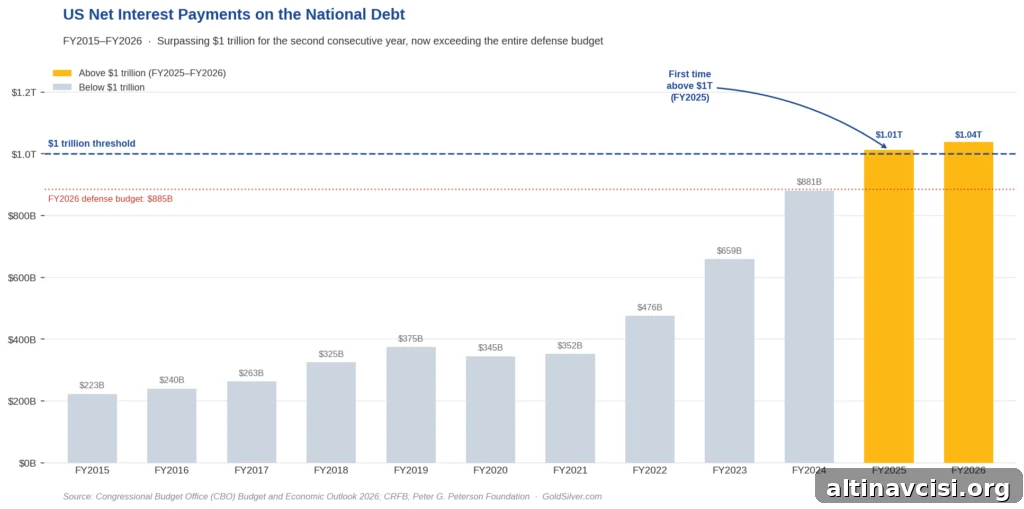
That same week the Congressional Budget Office confirmed the United States will pay more than $1 trillion in net interest on the national debt in fiscal year 2026 — the second year in a row above that threshold.
Why Does $1 Trillion in Annual Debt Interest Matter?
The annual interest bill now exceeds the entire defense budget, which was enacted at $885 billion for fiscal year 2026. It is also larger than what Washington spends on Medicaid and exceeds the combined budgets for transportation, education, and veterans’ benefits. Only Social Security and Medicare are larger federal programs.
Unlike those programs, interest payments produce nothing. Every dollar paid in interest is servicing obligations from past spending: roads go unbuilt, soldiers can go underfunded, patients may miss care. These payments simply reflect the cost of debt already incurred.
The Congressional Budget Office projects interest costs will reach $2.1 trillion annually by 2036. By 2048, net interest is projected to surpass every other budget line item, including Social Security, becoming the single largest federal expenditure. That outcome would reshape fiscal priorities and constrain public policy options.
What Is Fiscal Dominance, and Why Is It Bullish for Gold?
Economists call this condition fiscal dominance: when a government’s debt becomes so large it starts to dictate monetary conditions. In that scenario, borrowing costs and the demands of servicing debt can effectively set interest rates rather than the central bank.
That dynamic is visible today. Ahead of the Federal Reserve meeting on April 28–29, markets priced in better than a 97% probability that the Fed would hold rates at 3.50%–3.75%. That expectation did not stem from subdued inflation — the Consumer Price Index rose to 3.3% in March 2026 from 2.4% in February — nor from robust economic strength — the ISM services employment index fell to 45.2 in March, signaling contraction.
The Fed’s apparent reluctance to move aggressively reflects a constraint: cutting rates risks accelerating inflation, while raising rates would make the already large interest bill even costlier, deepening fiscal strain and slowing an economy that shows weakness in parts. This is not merely policy indecision; it is arithmetic.
The Edge Every Investor Needs
Smarter precious metals investing starts here. The Nuggets Newsletter brings essential market insights, Fed updates, global trends, educational videos, and much more.
How Does the Debt Problem Translate Into Gold and Silver Prices?
Fiscal dominance tends to push real yields lower — real yields being nominal returns less inflation. When real yields are low or negative, precious metals often outperform paper assets. Cash and bonds can lose purchasing power when inflation outstrips their returns; gold and silver do not pay interest, but they cannot be printed or diluted by monetary expansion.
Mine production of gold and silver increases only modestly, roughly 1–2% per year worldwide, independent of government policy. That constrained supply, combined with monetary and fiscal pressure, places gold and silver outside the conventional debt system and gives them distinct appeal as stores of value.
Gold’s roughly 41% gain over the last twelve months is therefore less a surprise than a reflection: the market is measuring the limits of fiscal policy and the erosion of real returns.
There is a valid counterargument: if the Fed were to raise rates aggressively to curb inflation, real yields would rise and gold could face headwinds. That scenario deserves consideration. But a forceful tightening while the nation is already paying $1 trillion a year in interest would dramatically worsen fiscal pressures. Paul Volcker in 1980 could raise rates to double digits because the debt burden was manageable then; today’s much higher debt-to-GDP ratio leaves far less room to maneuver. That structural constraint is what markets — and gold prices — appear to be pricing in.
The $1 trillion milestone was not a single warning shot; it arrived quietly two years ago and has only grown since. If the Fed ever attempts a serious drive to break inflation, the fiscal constraint will become apparent to a much wider audience — and the consequences for markets will be visible beyond the precious-metals sector.
Stay On Top of Gold & Silver Prices
Get important market alerts sent straight to your inbox.
SOURCES
1. Congressional Budget Office — Monthly Budget Review: Summary for Fiscal Year 2025; The Budget and Economic Outlook: 2026 to 2036; The Long-Term Budget Outlook: 2025 to 2055
2. Congressional Research Service — FY2026 Department of Defense Appropriations: In Brief
3. Bureau of Labor Statistics — Consumer Price Index: March 2026
4. Institute for Supply Management — Services PMI Report: March 2026
5. Federal Reserve — FOMC Meeting Calendar 2026; Minutes of the FOMC Meeting, March 17–18, 2026
6. London Bullion Market Association — Gold and Silver Price Data
7. World Gold Council — Gold Supply Data
By the GoldSilver Editorial Team — helping investors understand sound money since 2005. This article is informational and does not constitute financial, investment, or tax advice. Consult a qualified financial advisor before making investment decisions.
You May Also Like:
- 5 Signals That Say Gold’s Bull Case Just Got Stronger
- The Largest Gold ETF Outflow Ever – But China Disagrees
- Silver Market Deficit 2026: Six Years and Getting Worse
- Is the Petrodollar Ending? What the Iran War Means for Gold
- France’s Gold Repatriation Is Done. Germany Is Next
- Gold/Silver Ratio Hits 61.1 — Silver’s Turn to Run
- Silver Holds Near $80 as Iran Ceasefire Revives Rate-Cut Bets
- The Fed Goes Silent in 3 Days – What Does That Mean For Gold?