

Last verified: September 2026
Foreign ownership of US Treasury debt refers to the portion of American government bonds held by investors outside the United States. The Treasury monitors this each month through the Treasury International Capital (TIC) system. Who holds that debt matters: it influences interest rates, liquidity, and the dollar’s credibility over time.
A standard summary lists countries: China buys, Japan holds, and various Gulf states adjust their positions. That description fit well in 2014, but the landscape has shifted considerably since then.
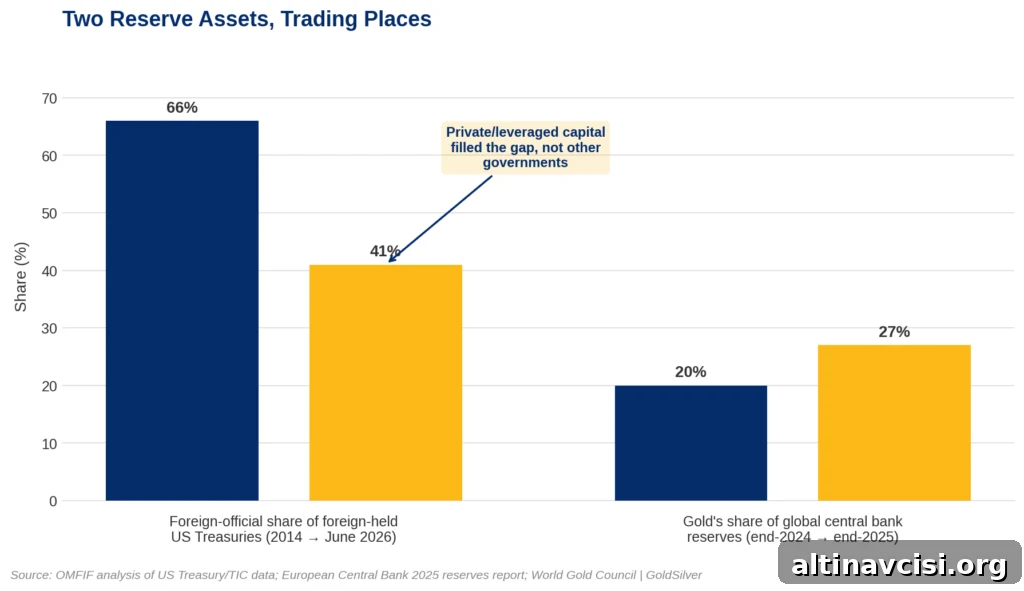
As of June 2026, foreign investors reported holding $9.3 trillion in US Treasury securities. Only about 41% of that sum is recorded as held by foreign official institutions — central banks and sovereign reserve managers — down from roughly two-thirds in 2014. This change is documented in analysis of TIC data and reflects a broader transformation in who is counted as a foreign holder. Increasingly, the remainder is leveraged private capital rather than official reserve balances.
That shift deserves a key nuance often left out: official holders have not dramatically liquidated Treasuries in dollar terms. Their holdings are only about 8% below the 2014 level. Two processes explain the falling official share. First, the market for Treasuries expanded substantially, roughly tripling from around $12.5 trillion to nearly $30 trillion. Second, the reserve-building boom that peaked around 2014, particularly driven by China, slowed and partly reversed. China’s foreign exchange reserves fell by roughly $1 trillion in later years, and no other country fully replaced that accumulation. The result is that the official share of foreign-held Treasuries declined because the broader market grew while reserve accumulation stalled — not because central banks collectively abandoned Treasuries en masse.
Another complication: country-by-country tables can be misleading. Treasury holdings booked in the Cayman Islands reached $453 billion in June 2026, up about 67% since 2022. That position makes the Cayman Islands the sixth-largest reported foreign holder, but this is primarily a reporting artifact. Many US hedge funds run leveraged cash-futures basis trades through Cayman-domiciled vehicles. TIC records where securities are custodied, not who ultimately bears the market risk. As a result, domestically managed, US-sourced trades can appear as “foreign” demand on the balance sheet even though the capital, decision-making, and risk management are American. For anyone asking who really owns US debt today, that distinction changes the picture substantially.
Key Takeaways
- Foreign official institutions, mostly central banks, held roughly two-thirds of foreign-owned US Treasuries in 2014. By June 2026, that share was 41% per TIC-based analysis. Official dollar holdings are only modestly lower than in 2014; the market grew around them.
- Cayman Islands–booked Treasury holdings rose to $453 billion in June 2026 and are largely attributable to US hedge funds running basis trades through Cayman-domiciled vehicles.
- Central banks purchased 863 tonnes of gold in 2025, a continuation of strong gold buying that has shifted reserve composition. In the ECB’s accounting, gold rose to 27% of global official reserves while Treasuries fell to 22% at year-end 2025.
- The Federal Reserve’s research staff note a methodological caveat: comparing world gold holdings (which include US gold) to foreign-held Treasuries mixes different totals. On a foreign-only basis, the assets are closer to a tie than a clear crossover, though the trend toward greater gold allocation is evident.
Short-term gold and silver price movements are noisy day-to-day. This article focuses on a structural shift: official reserve composition has evolved over several years, and that broader change is unlikely to be reversed by a single session of market moves.
Who Actually Owns US Debt Right Now?
Monthly Treasury country tables are factual and useful, but they are only a proxy for the split that matters: policy-driven official reserve holdings versus return-seeking private capital. In 2014, foreign official institutions accounted for the majority of foreign-held Treasuries. Since then, private holders overtook officials in 2023, and that gap has widened. Yet interpreting that change as foreign governments abandoning the dollar reverses the mechanism. A government may choose to diversify reserves into gold or other assets for policy reasons. TIC data, meanwhile, increasingly records leveraged private strategies as “foreign” simply because of legal domicile. The more meaningful distinction today is which type of buyer — patient reserve manager or leveraged arbitrageur — is holding Treasuries.
The Knowledge That Changes Everything

Two essential guides — free. Understand why gold matters and why fiat currencies can fail.
What Is a Treasury Basis Trade, and Why Does It Count as Foreign Demand?
A cash-futures basis trade exploits the price difference between a Treasury bond and its futures contract. A fund borrows cash, purchases the bond, and sells the future to capture the spread, often using substantial leverage. The trade’s managers are typically based in the United States and report to domestic regulators, but for tax or legal reasons the trade is executed through an offshore legal vehicle. TIC data records the custody location, so the position is logged as foreign even though the economic risk and decision-making are domestic. This reporting quirk inflates the reported share of “foreign” holdings while concealing the true nature of the holder.
Has Gold Really Overtaken Treasuries as the World’s Top Reserve Asset?
By the European Central Bank’s 2025 accounting, gold rose to 27% of global central bank reserves at year-end 2025 while Treasuries fell to 22%. That represents the first time since 1996 that gold’s share exceeded Treasuries in that particular dataset. However, the Federal Reserve’s research staff cautioned that mixing global gold holdings (which include US holdings) with foreign-held Treasuries produces an uneven comparison. On a foreign-only basis, the Fed finds the two assets are closer to parity than a full crossover. Still, both perspectives point to a rapid narrowing of the gap and a material shift in reserve preferences.
Why Are Central Banks Buying Gold Instead of More Treasuries?
Central banks bought 863 tonnes of gold in 2025, according to industry data, continuing a multi-year trend of strong official demand. The acceleration in gold buying partially reflects geopolitical and policy concerns: in 2022, major reserve freezes signaled that foreign-held Treasuries can be subject to sanctions or freezes, whereas physical gold stored domestically is less exposed to that kind of sovereign action. Reserve managers seeking diversification and operational security have therefore increased allocations to gold.
What Does a Thinner Official Buyer Base Mean for US Debt Markets?
Total foreign holdings of Treasuries continued to rise to $9.3 trillion by June 2026; the change is in composition. The practical implication is that the buyer of last resort has shifted from patient reserve managers to more financially sensitive, leveraged strategies. A central bank typically holds Treasuries for decades and sells only for policy reasons. A leveraged arbitrage position can unwind rapidly when funding costs change, a repo market tightens, or risk models signal exposure limits. That makes the demand profile less stable, even if aggregate demand remains large. As of September 2026 there was no clear sign of an imminent systemic unwind; the observation is structural rather than a short-term forecast.
What This Means for Gold and Silver Investors
This evolution strengthens the reserve-diversification case for gold. Central banks reducing policy-driven Treasury allocations have been among the largest buyers of gold in recent years, a pattern sustained across multiple monetary cycles. That shifting demand is a more durable signal than any single monthly TIC print. Investors in gold and silver should watch upcoming TIC reports for changes in the official share and World Gold Council data for quarterly shifts in central bank buying patterns.
Stay On Top of Gold & Silver Prices
Get important market alerts sent straight to your inbox.
People Also Asked
Who owns the most US debt?
As of June 2026, the largest reported foreign holders remain Japan and China, though their combined share of foreign-held Treasuries has declined. The more important change is structural: foreign official institutions now make up about 41% of foreign-held Treasuries, down from roughly two-thirds in 2014, with leveraged private capital accounting for much of the remainder.
Has gold really overtaken US Treasuries as the world’s largest reserve asset?
By the ECB’s 2025 accounting, gold surpassed Treasuries on a global reserves basis. The Federal Reserve’s researchers note that on a foreign-only comparison the two assets are nearer a tie. Both assessments indicate a meaningful and rapid narrowing of Treasuries’ lead.
Why has the foreign-official share of US Treasury holdings fallen since 2014?
The shift reflects a combination of market growth and changes in reserve behavior. The global Treasury market expanded substantially, while some reserve accumulation slowed or reversed. Central banks diversified into gold and other assets, contributing to a lower official share without a large-scale forced sale of Treasuries.
If central banks aren’t buying as many Treasuries, who is?
Much of the reported increase is attributable to leveraged private capital operating through offshore-domiciled vehicles, which appear as foreign-held in TIC data. Cayman-booked holdings are a notable example, reflecting arbitrage strategies rather than genuine foreign reserve accumulation.
What is a Treasury cash-futures basis trade, and why does it show up as foreign demand?
It is a leveraged arbitrage between a Treasury bond and its futures contract, often run through offshore legal wrappers for tax or legal reasons. TIC records custody location, so these positions register as foreign even when the funds, managers, and capital are domestic.
How many tonnes of gold did central banks buy in 2025?
Central banks purchased 863 tonnes in 2025, continuing several years of strong official demand, though the annual pace varied compared with earlier peaks.
Does a falling foreign-official share of Treasuries mean the US will struggle to finance its debt?
Not necessarily. Total foreign holdings rose to $9.3 trillion in June 2026; the composition shifted. The change matters for the stability of demand over time rather than for immediate financing capacity.
SOURCES
1. OMFIF – Americas Largest Foreign Creditor Is American (Sept. 2026)
2. World Gold Council – Gold Demand Trends: Full Year 2025 (Jan. 2026)
3. European Central Bank – The International Role of the Euro (June 2026)
4. Federal Reserve Board – Note on reserve asset comparisons (Sept. 2026)
5. Industry coverage on central bank vaulting and reserve location (2026)
Disclaimer: This article is for informational purposes only and does not constitute investment advice. Past performance is not indicative of future results. Consult a qualified financial advisor before making investment decisions.
You May Also Like:
- What Is Junk Silver? The Old Dimes and Quarters Worth Nearly 50x Their Face Value
- Why Is Silver Demand Tied to AI Data Centers?
- The Copper Mine That Isn’t Trying to Mine Silver Just Explained the Whole Deficit
- Inherited Gold IRA: Beneficiary Rules & the Step-Up Basis Gap
- The Cantillon Effect: Why Money Printing Makes Some People Rich First
- Silver Price Outlook September 2026: The Hike Is Priced In. The Positioning Isn’t.
- Gold Is About to Face Its First Rate Hike of the Cycle. Here’s Why It Isn’t Scared.