
In today’s update: The gold market’s center of gravity has shifted from Western finance to national and cultural savers — China has purchased gold for 18 straight months, Russia is selling reserves to fund its war, and Incrementum’s $4,800 target was reached four years early.
As of May 21, 2026, central banks, governments and private holders are reshaping the gold market. This week’s developments make that clear: Liechtenstein-based research confirms a decade target was met early; Russia is creating a gold-focused banking vehicle built on sanctions-era payments rails; China and Russia are moving in opposite directions with the same asset; India’s authorities are publicly asking citizens to curb gold purchases — without success; and Citi now sees $5,000 gold in the near term while growing cautious beyond that. Once-dominant Western price drivers are increasingly observers rather than architects of the market.
Did Incrementum’s In Gold We Trust Just Confirm the Bull Case?
On May 20, 2026, Incrementum AG published the 20th anniversary edition of its In Gold We Trust report, titled Back to the Monetary Future. Co-authored by Ronald-Peter Stöferle and Mark Valek, the 460-page study revisits the firm’s 2020 projection that gold would reach $4,800 per ounce by 2030. That threshold was breached in early 2026 — four years ahead of schedule — prompting the authors to present a more inflationary scenario that targets $8,900 per ounce by the decade’s end. Their core point: gold’s price dynamics are no longer dictated primarily by Western ETF flows or Fed rate expectations. Instead, central bank reserve strategies and household saving patterns across Asia and the Middle East are the primary drivers.
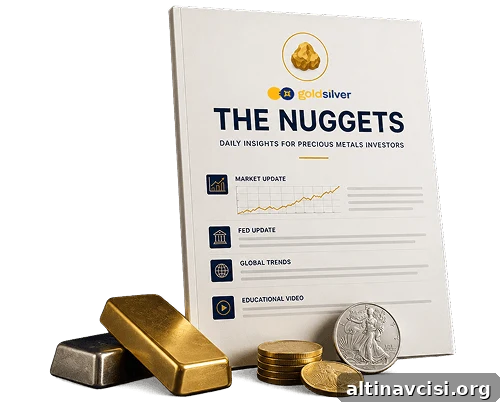
The Edge Every Investor Needs
Smarter precious metals investing starts here. The Nuggets Newsletter delivers market insights, Fed updates, global trends, educational videos, and more.
Why Is Russia Building a Gold Bank?
This week Russia’s Finance Ministry announced plans for a major commercial gold bank, Rosveksel, a newly registered entity largely owned by A7 — a cross-border payments platform linked to sanctioned lender Promsvyazbank. Officials say retail customers will be able to buy gold-backed digital assets for about 120 rubles (roughly $1.68), and the platform will support cross-border settlement in gold-linked instruments. The state’s involvement underscores a strategic shift: when access to the dollar-based financial system is restricted, building a parallel infrastructure around a physical asset that cannot be frozen becomes a policy priority.
Russia Sells, China Buys: What Does the Contrast Tell Us?
Russian central bank data show the Bank of Russia sold about 22 tonnes of gold in Q1 2026 — the largest quarterly reduction since 2002 — as the federal budget deficit widened to 4.6 trillion rubles ($61.3 billion) by March. The National Wealth Fund’s gold holdings fell from over 550 tonnes in 2022 to roughly 160 tonnes today amid escalating military expenditures. By contrast, the People’s Bank of China continued buying, extending an 18-month buying streak in April with an 8-tonne addition, taking official reserves to 2,322 tonnes, about 9% of its foreign exchange holdings. The divergence is stark: Russia is selling because fiscal pressures leave it little choice; China is buying according to a deliberate reserve strategy. Analysts at J.P. Morgan predict global central bank additions could reach 755 tonnes in 2026.
India Holds $3.6 Trillion in Gold — So Why Is It Still Importing More?
Household and temple holdings in India are estimated at around 25,000 tonnes of gold — about $3.6 trillion at current prices, exceeding the combined reserves of many top central banks. Still, India imported 721 tonnes in fiscal 2026, with import bills hitting a record $71.98 billion, up 24% year-on-year. The government raised import duties from 6% to 15% and the prime minister urged citizens to reduce purchases, while denying any plan to monetise temple reserves. Those public appeals reveal a broader reality: gold accumulation at the household and cultural level often reflects limited confidence in the currency, and policy measures have limited ability to quickly reverse that behavior.
Citi Sees $5,000 Soon — So Why Is It Also Turning Bearish?
Gold traded around $4,509, roughly 19% below the January 2026 peak of $5,589. Citi strategist Kenny Hu raised the 0–3 month target to $5,000, citing geopolitical risk, tight physical markets, and uncertainty about central bank independence. Yet Citi adopted a neutral-to-bearish view for the medium term. The explanation is straightforward: April 2026 U.S. CPI rose to 3.8%, the highest since May 2023, reducing expectations for Fed rate cuts this year. ETF flows reflected that shift: the World Gold Council reported ETFs bought about 150 tonnes in January–February but offloaded around 90 tonnes in March as rate-cut pricing unwound. Short-term risk factors push prices higher, while tighter rate expectations weigh on the medium-term outlook.
The East Built a New Map. Western Trading Desks Are Still Reading the Old One.
Taken together, these developments point to a new market architecture. Incrementum’s decade forecast has been reached ahead of schedule, Russia is creating a sanctions-resilient financial alternative centered on gold, China keeps accumulating official reserves, and Indian households continue adding to massive private holdings despite higher import duties and official appeals. Even cautious Western banks now acknowledge near-term upside. Gold trading at $4,509 should be seen not as a temporary pullback but as part of a structural repricing driven by central bank decisions and private saving patterns that are largely independent of short-term Fed signals.
Stay On Top of Gold & Silver Prices
Get important market alerts sent straight to your inbox.
SOURCES
1. Incrementum AG — In Gold We Trust 2020 & 2026 — The Golden Decade / Back to the Monetary Future
2. The Moscow Times — Russia Gold Bank Plans (May 2026) · Central Bank Sales Data (April 2026)
3. Euromaidan Press — Russia National Wealth Fund & Gold Reserves Analysis, March 2026
4. World Gold Council — China Gold Market Update (May 2026) · Q1 2026 ETF Flows Report · India Holdings Estimates
5. J.P. Morgan Global Research — Gold Price Outlook 2026, Central Bank Demand Forecast
6. Reuters · U.S. Bureau of Labor Statistics — Citi Research Note, Jan 2026 · CPI April 2026
7. Government of India — Commerce Ministry FY2026 Trade Data · Finance Ministry Duty Notification · PIB Temple Gold Statement
Disclaimer: This article is for informational purposes only and does not constitute financial or investment advice. Consult a qualified financial adviser before making investment decisions.
You May Also Like:
- Why London Still Sets the Gold Price — and Asia Doesn’t
- Gold Price at ~$4,502: Is the Dip a Buy? BofA Says $6,000
- Gold Didn’t Fall on Iran Peace News. That’s the Point.
- Trump Called Off the Strike. Gold’s Real Risk Is Still $39 Trillion.
- The Gold Market Is Mostly Paper. Dubai Disagrees.
- The Institutions Are Buying. Yields Are Rising. What Does That Tell You?
- Gold Up 40% in a Year. The Moody’s Downgrade Explains Why.
- No Deal, No Premium: Why Silver Fell 7% at the Trump-Xi Summit