Daily News Nuggets | Today’s top stories for gold and silver investors
March 6th, 2026 | Brandon Sauerwein, Editor
Gold Price Outlook: Metals Find Their Footing After January Rout
January delivered sharp losses for gold and silver, with some of the largest single-day declines in recent trading history prompting widespread profit-taking and concern. That initial shock, however, has given way to a notable recovery.
Over the past 30 days, gold has risen roughly 6.5% while silver jumped about 16.6% — both outperforming the S&P 500 and Nasdaq. This rebound appears driven by renewed investor demand amid rising geopolitical tensions and persistent inflationary pressures.
Last Month: Silver Up 16.6%. Gold Up 6.5%. SPY Up 0.54%.
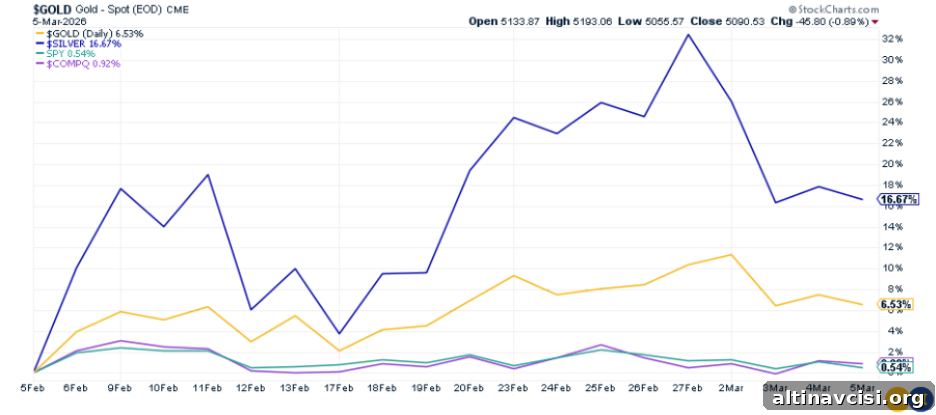
Below we review the outlook for gold, the forces behind the recent rally, and the key indicators investors should monitor next.
Trump Eyes Regime Change in Iran and Cuba
President Trump has openly discussed pursuing regime change in both Iran and Cuba. In Iran, these comments accompany active military measures aimed at degrading missile capabilities, weakening command structures, and hindering nuclear progress. The administration has framed the Iranian government as a long-term security threat and encouraged internal pressure for political change.
In Cuba, the approach centers on intensified sanctions and economic restrictions designed to increase pressure on the government. The end goal appears to be the same: force political change through sustained economic and diplomatic pressure.
Markets are assessing the implications. Historically, prolonged geopolitical campaigns—especially those affecting energy-producing regions—tend to extend uncertainty. That keeps risk assets volatile and bolsters demand for safe-haven assets like gold.

Oil’s 20% Week Is Sending a Warning
U.S. crude recently topped $85 a barrel for the first time in nearly two years, and Brent crude surged more than 20% in a single week — a striking move that signals more than ordinary volatility.
Supply was already constrained before this spike. OPEC+ discipline left little spare capacity, and escalating regional instability and threats to key shipping lanes have squeezed available buffers. The result: the market has limited room to absorb further disruptions.
The effects go beyond headline oil prices. Rising energy costs feed into transportation and manufacturing, pushing consumer prices higher. If the price rise is sustained rather than fleeting, it could rekindle the inflation pressures central banks have been trying to control.
Markets may be underestimating this risk. A temporary oil blip is manageable; a structural supply disruption layered onto existing inflation could force central banks and markets to reassess rates and risk asset valuations.
The Fed Has a New Problem
After two years focused on taming inflation, the Federal Reserve now faces the prospect of energy-driven price pressures restarting that battle. Energy cost increases ripple through supply chains, raise manufacturing expenses, and eventually appear in consumer inflation measures.
That creates a difficult trade-off. If inflation reaccelerates, cutting rates becomes harder to justify. Conversely, keeping policy restrictive while a geopolitical shock slows the economy risks worsening a downturn. Markets have already repriced expectations: traders shifted from pricing in two rate cuts this year to roughly one in the space of days.
Historically, gold performs well in scenarios where inflation remains elevated while the central bank is constrained in its ability to tighten further. That environment—persistent inflation with limited policy flexibility—is increasingly plausible and supports a constructive gold price outlook for the remainder of 2026.
The Edge Every Investor Needs
Smarter precious metals investing starts here. The Nuggets Newsletter delivers market insights, Fed updates, global trends, and educational content.
Gold Is Piling Up in Dubai — and Selling at a Discount
In one of the world’s major trading hubs, dealers are accumulating more physical gold than they can move. Dubai typically functions as a transit point between African producers and buyers across Asia and the Middle East, but recent regional conflicts have clogged the logistics chain.
Airspace restrictions, higher insurance and shipping costs, and port bottlenecks have slowed deliveries. As a result, physical stocks are building up in local vaults, and trading in Dubai is showing discounts to international benchmarks even as global prices remain firm. Spot gold is trading around $5,145 an ounce and silver near $84.35, reflecting strong global demand despite localized dislocations.
This situation highlights a structural truth about precious metals: they are financial assets and physical commodities. When the physical distribution network is disrupted, price behavior can diverge across regions, creating arbitrage and short-term price anomalies.
J.P. Morgan Just Tried to Kill the Gold Bull Case — and Couldn’t
J.P. Morgan Private Bank published an analysis that ran through the common bearish arguments against gold—high prices, crowded positioning, and softening central bank demand—and concluded that those concerns do not overturn gold’s strategic case.
Their assessment: gold remains a meaningful portfolio diversifier. Even after stress-testing the bear case, the bank maintained a bullish stance and projected a target of $6,300 per ounce by late 2026. The bank cites continued central bank reserve diversification away from dollar-denominated assets as a key structural driver that could sustain demand for gold.
Stay On Top of Gold & Silver Prices
Get important market alerts sent straight to your inbox.
You May Also Like
- Gold and Silver Prices Today: Iran, Oil, and a $1.3B Bet
- Gold and Silver Are Climbing While the World Watches Hormuz
- Hormuz, the Fed, and the Battle for Safe-Haven Status
- Gold Prices Surge on Middle East Tensions
- Gold Above $5,200, Silver Above $90 — as Inflation Refuses to Fade