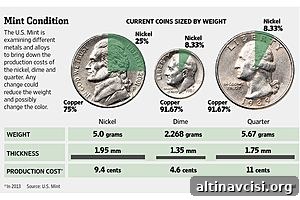
People often wonder what modern U.S. coins are made of and how their composition has changed over time. While most people know that circulating coins no longer contain precious metals, the exact materials and the historical shifts behind these changes are less widely understood. Below is a clear, concise look at how U.S. coin composition evolved and what typical modern coins contain.
Image courtesy of The Wall Street Journal
Early Foundations
Currency and its production were central concerns for the early United States. The Constitution (ratified in 1789) explicitly granted Congress the power to coin money and regulate its value, and prohibited states from making anything other than gold and silver coin legal tender. In April 1792, Congress passed the Coinage Act, which established the U.S. silver dollar as the standard unit of money, created a decimal system (1 dollar = 100 cents), and founded the United States Mint to produce and regulate coinage.
Composition of Early Coins
The Coinage Act standardized the metal weights and purity for the initial set of federal coins. Those early coins relied on gold, silver, and copper because of their durability and resistance to corrosion. The table below summarizes the principal coin types and their metal content as defined by the Act:
| Coin Name | Face Value | Metal Content |
| Eagles | $10 | 16.04 g pure or 17.5 g .920 fine standard gold |
| Half Eagles | $5 | 8.02 g pure or 8.75 g standard gold |
| Quarter Eagles | $2.50 | 4.01 g pure or 4.37 g standard gold |
| Dollars or Units | $1 | 24.1 g pure or 27.0 g .900 fine standard silver |
| Half Dollars | $.50 | 12.0 g pure or 13.5 g standard silver |
| Quarter Dollars | $.25 | 6.01 g pure or 6.74 g standard silver |
| Disme | $.10 | 2.41 g pure or 2.7 g standard silver |
| Half Disme | $.05 | 1.2 g pure or 1.35 g standard silver |
| Cents | $.01 | 17.1 g of copper |
| Half Cents | $.005 | 8.55 g of copper |
Among other provisions, the Act allowed citizens to bring gold and silver bullion to the Mint to be coined free of expense and prescribed harsh penalties for debasing circulating gold or silver coins.
Challenges and Changes
Gold and silver were chosen for coinage because of their durability and corrosion resistance, while copper served as a lower-cost option for small denominations. A key problem with precious-metal coinage is that if the metal value rises above a coin’s face value, people will melt coins for bullion profit. To address that, the government made private gold ownership illegal in 1933 (a ban lifted in 1974). Restrictions on melting silver were briefly in place in the late 1960s, but silver was ultimately removed from circulating coinage in 1964, eliminating the incentive to melt coins for their metal.
Gold and silver coins are still produced today, but primarily as bullion or collectors’ items rather than circulating change. Modern bullion coins have market value tied to metal content rather than face value, so they are not used as everyday currency.
Composition of Modern “Silver” Coins
After 1964, silver was removed from circulating dimes and quarters. Since then, most modern dimes and quarters have been struck from a clad alloy consisting roughly of 91.67% copper with an outer layer of 8.33% nickel bonded to a copper core. Those coins’ intrinsic metal value is below their face value, which prevents widespread melting for profit.
Pennies and Nickels
Pennies and nickels followed different paths. The one-cent piece has seen many changes: pure copper in the earliest years, bronze during much of the 19th and 20th centuries, a zinc-coated steel coin in 1943, and finally the modern copper-plated zinc penny introduced in 1982 (about 97.5% zinc with a thin copper plating). Pennies struck before 1982 are primarily copper and contain more intrinsic metal value (roughly 2.5 cents of copper content).
Nickels were standardized in 1866 as an alloy of 75% copper and 25% nickel and largely remain that composition today. Because the metal value of pre-1982 pennies and current nickels can exceed face value, Congress passed laws in December 2006 prohibiting the melting and bulk export of pennies and nickels. Those rules aim to prevent hoarding or removal of coins from circulation for their metal content.
Speculation persists, with collectors and investors sometimes stockpiling pre-1982 pennies or nickels in the belief they may gain value if minting practices change. These hoarded coins are traded in bulk and occasionally sell for more than face value, but storage and sorting make them less practical as an investment than bullion coins.
Which Coins Contain Silver?
Up until 1964, circulating dimes and quarters were 90% silver. These coins—often called “junk silver” when sold for their metal value—no longer circulate but remain collectible and are sold by weight. A typical $100 face-value bag of 90% silver dimes or quarters contains roughly 71.5 troy ounces of pure silver and is priced according to silver spot price plus any dealer premium. In times of economic stress, historically some businesses accepted silver coins based on metal content, but they are no longer used as standard circulating coinage.
Coins as an Investment
Coins with a defined gold or silver content retain value tied to the market price of those metals, plus any numismatic premium for rarity or condition. Gold and silver remain widely used as a long-term store of value and an inflation hedge. By contrast, pennies and nickels are less attractive investments: they are bulky, expensive to store, and require sorting by date to identify coins with higher intrinsic metal value. Whether pennies or nickels will ever form a liquid market that reliably yields returns above purchase cost is uncertain.