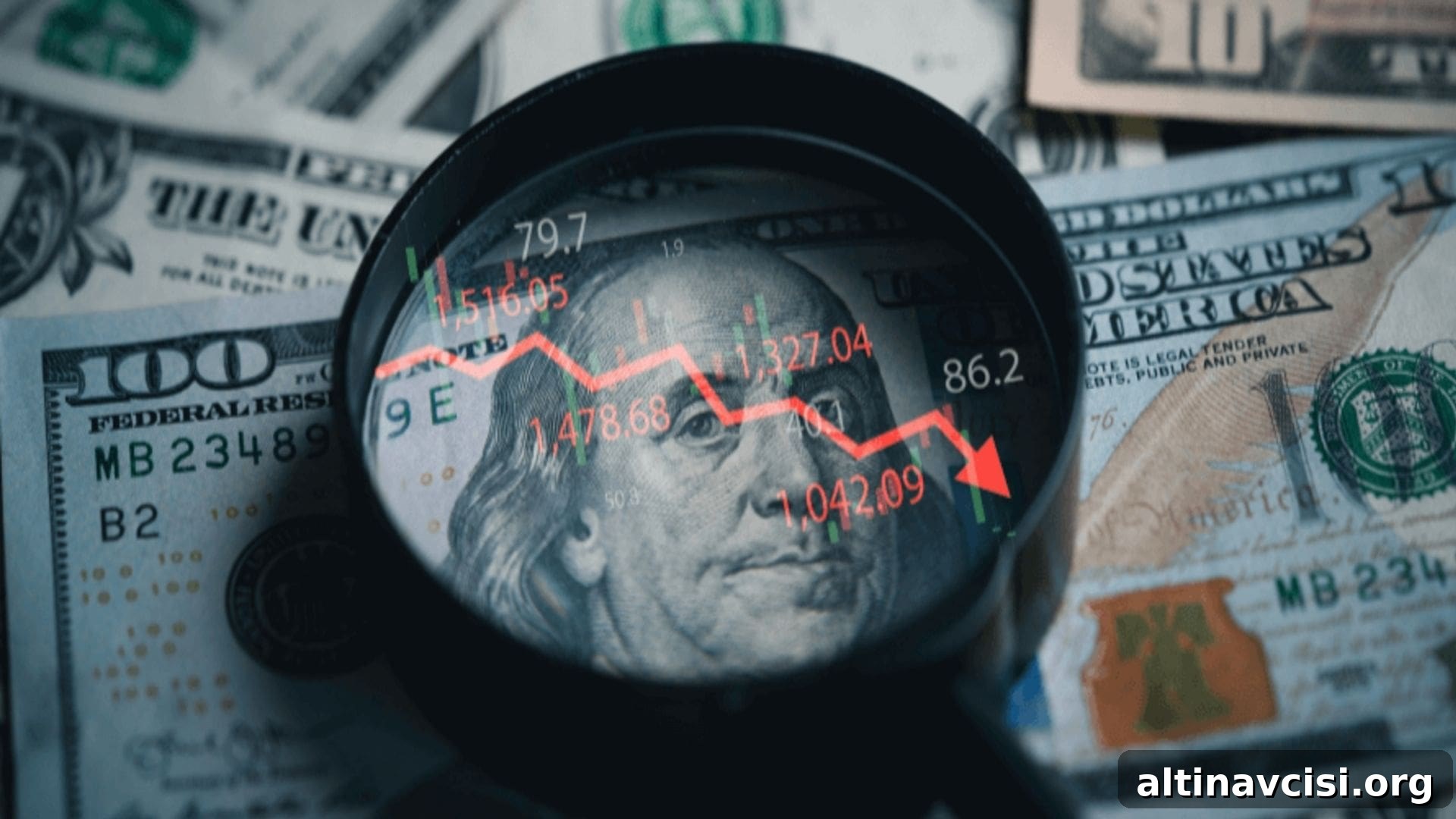
A U.S. recession that was once seen as unlikely has emerged as a real possibility. Financial markets are sending clear warning signs: 10-year Treasury yields have dropped by roughly 70 basis points in recent weeks, and oil prices have fallen below $70 per barrel. These shifts coincide with weaker economic data and mounting uncertainty about trade policies and proposed government reforms.
The current economic slowdown appears to be unfolding in three phases. First, lower-income households are bearing the initial strain: savings are dwindling, credit-card balances are rising, and overall household debt is increasing. Second, businesses have become more cautious, delaying investment and hiring decisions amid policy uncertainty. Third, the recent escalation toward retaliatory tariffs threatens to disrupt global supply chains and further depress demand.
Complicating the outlook is the persistence of inflation even as growth softens. That combination—slowing activity alongside elevated prices—increases the risk of stagflation and creates a difficult dilemma for the Federal Reserve as it seeks to balance employment and price stability.
There are, however, some mitigating factors. Lower energy costs provide relief to both consumers and firms, trimming household fuel bills and input costs for producers. Deregulation could encourage some additional business investment, and advances in technology—particularly in artificial intelligence and robotics—offer potential productivity gains over the medium and long term. Still, these positives so far appear insufficient to offset the growing set of headwinds.
Market-based and survey measures of recession risk have risen notably: where the chance of a downturn was estimated at roughly 10% earlier in the year, current estimates sit closer to 25–30%. As a result, economists are likely to trim their growth forecasts for 2025 well below the current 2.3% consensus, possibly by as much as a full percentage point. That raises urgent questions about whether the U.S. economy is nearing “stall speed,” a point at which growth becomes too weak to sustain momentum without further policy support.
Policymakers face a delicate trade-off. If inflation proves persistent, the Fed may need to maintain tighter policy for longer, increasing the risk that higher borrowing costs will further damp demand. Conversely, easing policy prematurely to support activity could allow inflationary pressures to resurface. In this environment, fiscal decisions around spending, taxation, and trade policy will also play a crucial role in determining the depth and duration of any slowdown.
Household balance sheets will be a key transmission channel. Lower-income families with limited buffers are most vulnerable to income shocks and higher borrowing costs; their retrenchment in spending would subtract from overall demand. For firms, elevated uncertainty reduces the incentive to expand capacity or hire, which in turn weakens labor market momentum and feeds through to consumer confidence.
Global developments matter as well. If tariffs prompt supply-chain disruptions or provoke retaliatory measures, the resulting decline in trade flows could reduce manufacturing output and weigh on global growth. That would further constrain the U.S. recovery through weaker export demand and lower foreign investment.
In summary, the balance of risks has shifted noticeably toward a weaker near-term outlook. While lower energy prices, regulatory relief, and technological advances offer upside potential, the combination of financial-market signals, weakening data, and policy uncertainty has materially increased the chance of a recession. Monitoring incoming economic indicators, corporate spending plans, and trade developments will be essential to assess whether the economy can avoid a deeper downturn or is indeed grinding toward stall speed.