Key Takeaways:
- The July 29 FOMC vote was 9–3. Cleveland’s Beth Hammack, Minneapolis’s Neel Kashkari, and Dallas’s Lorie Logan each preferred a rate increase — the strongest hawkish dissent since September 2016.
- The minutes from that meeting are released tomorrow, August 19 at 2:00 p.m. ET. Pay attention to how explicitly the three dissenters laid out their arguments and whether any majority members signaled sympathy with them.
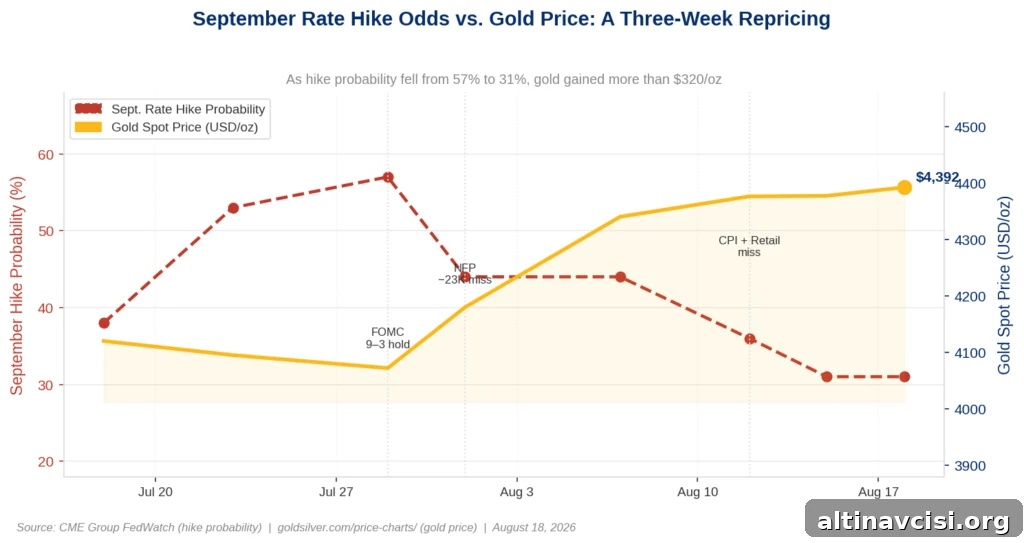
- Odds of a September rate hike have slid from about 57% to roughly one-in-three since the FOMC decision, driven by three weak data reports: a July payrolls decline, softer CPI, and weak retail sales.
- Gold has risen more than $320 from its post-FOMC low. That move reflects a paper-market repricing of rate expectations rather than any immediate change in the long-term structural case for owning physical metal.
- Fed Chair Kevin Warsh’s first Jackson Hole keynote on August 28 is the more important event for policy guidance — it is the only formal opportunity to see his framework before the September 16 FOMC decision.
At the Federal Reserve’s July 29 meeting, the decision to keep rates unchanged passed by a 9–3 margin. Having three officials formally prefer a quarter-point hike is notable: it is the largest cluster of hawkish dissents the Committee has recorded since 2016. The dissenting votes came from Cleveland Fed President Beth Hammack, Minneapolis Fed President Neel Kashkari, and Dallas Fed President Lorie Logan. Fed Chair Kevin Warsh described the internal debate as a vigorous “family fight.”
Tomorrow’s minutes, published Wednesday, August 19 at 2:00 p.m. ET, will reveal how forceful those dissenting arguments were and whether they made any headway with the majority. The headline vote tells only part of the story. What matters for markets is the language used in the minutes — whether the majority defended the decision confidently or appeared to hold together reluctantly.
What Do Three Fed Dissents Actually Signal?
A single dissent at an FOMC meeting is routine; two is notable; three, all aligned in the same direction, signals the highest internal concern short of an actual policy change. Put simply: the Committee voted to pause, yet one-quarter of voting members preferred a hike. That outcome looks less like a unified consensus and more like a narrow majority keeping the Committee’s course against a determined minority.
When the minutes arrive, the critical questions are not whether the dissenters disagreed, but how persuasive their arguments were, and whether any majority members showed signs of drift. Did Chair Warsh need to cajole the majority into holding? Did other governors voice sympathy with the dissent? Those nuances — the choice of words, the balance of views — set the tone for whether September remains alive as a potential hike date.
Why Did September Hike Odds Collapse — and What It Means for Gold
Since the July 29 decision, three consecutive data releases have weakened the case for a September increase:
- July nonfarm payrolls showed a net loss of 23,000 jobs, below consensus and representing an unusual monthly contraction.
- July CPI came in soft, with headline inflation rising only modestly and core inflation easing below some estimates.
- July retail sales fell by 0.6%, missing expectations for a small gain.
Those reports pushed market odds for a September hike down from roughly 57% on the decision day to about one-in-three today. At the same time, spot gold rose from its post-FOMC low to a significantly higher level in a matter of weeks.
The mechanism behind the move in gold is straightforward and often misunderstood in media coverage. Paper gold — futures and ETFs — is sensitive to opportunity cost: when risk-free yields rise, holding non-yielding assets like gold becomes more expensive in opportunity-cost terms. As markets lower the probability of higher near-term yields, that opportunity cost falls, and paper gold prices typically rise. This repricing explains much of the recent lift in gold prices; it does not, however, change the long-term rationale for owning physical metal.
Physical gold’s role — preserving purchasing power against longer-term monetary and fiscal risks — remains a multi-year thesis and does not pivot with every short-term change in Fed expectations. The recent move is best read as a market reaction to shifting rate probabilities, not as a structural shift in the demand for physical bullion.
What Should Gold Investors Watch in Tomorrow’s Minutes?
Five specific signals in the minutes are especially important:
- How the dissenters framed their case: Did Hammack, Kashkari, and Logan emphasize energy-driven inflation risks — for example, disruptions around the Strait of Hormuz — or did they focus on persistent core inflation? Energy-driven arguments are more conditional on oil prices; core inflation arguments are harder to dismiss.
- Governor Christopher Waller’s language: Waller voted to hold but has repeatedly flagged inflation risk. If the minutes suggest he nearly dissented, that would increase the likelihood of a September hike.
- Any reference to a “range of views” within the majority: The minutes communicate internal drift through careful wording. Describing the majority as “generally comfortable” differs meaningfully from saying members are “watching incoming data closely.”
- Energy inflation framing: Geopolitical developments around oil routes and supply risks can reintroduce a hawkish tail risk. If the Committee already considered renewed energy pressure in July, that risk remains alive and would respond quickly to rising oil.
- What is absent: Chair Warsh has removed traditional forward guidance. Therefore, an absence of directional language about the path of rates — deliberate silence where others might offer guidance — can itself be a meaningful signal.
Why Jackson Hole Matters More Than These Minutes
While the minutes offer a timely glimpse into internal debate, Jackson Hole is the larger event for market expectations. Chair Warsh’s keynote on August 28 will be his first major public policy statement at the annual symposium and the only formal window into his policy thinking before the September 16 meeting. Historically, Jackson Hole speeches have been pivotal moments for Fed communication. For investors, that speech could carry more influence on expectations and on precious metals than a single minutes release.
Two scenarios matter for gold. If Warsh emphasizes that the Fed needs sustained progress on core inflation before altering its stance, the September pause becomes more likely and current market repricing could stick. If he instead highlights energy and geopolitical risks — signaling that oil-driven inflation could force policy action — then September could become live again, and the data arriving before the FOMC decision (including the August jobs report and August CPI) would take on extra significance.
What Does Not Change
The near-term downside risk for gold is clear: a hot August jobs report or CPI print could reverse September hike odds, push real yields higher, and cause paper gold to sell off. That is a realistic and straightforward risk, not a prediction.
What remains constant regardless of that scenario is the core reason many investors hold physical gold. A modest rate increase in response to a supply-side oil shock does not address the structural forces that drive long-term monetary debasement and purchasing-power erosion. Large government interest costs, central bank balance-sheet dynamics, and multi-year trends in reserve currency composition are not resolved by a single FOMC vote. For investors focused on those longer-term forces, short-term headline moves and minute-by-minute Fed probability shifts are background noise to a broader, multi-year story.
SOURCES
1. Bureau of Labor Statistics — The Employment Situation, July 2026 (August 7, 2026).
2. CME Group — FedWatch Tool: Federal Funds Rate Probabilities (August 17, 2026).
3. Federal Reserve — Annual Report: Financial Statements, Q3 2025.
4. GoldSilver — Gold and Silver Spot Price Charts (August 18, 2026).
Disclaimer: This article is for informational purposes only and does not constitute investment advice. Past performance is not indicative of future results. Consult a qualified financial advisor before making investment decisions.
You May Also Like:
- Why Is Gold Not Going Up? The Bears Vanished in June
- JP Morgan Just Flagged a Silver Demand Warning. Silver Rose Anyway. Here Is Why
- Gold Needed One Thing to Break $4,400. It Just Got Five of Them.
- Zero Tankers Crossed Hormuz on Sunday. Oil Hit $89. Gold Barely Moved.
- Gold Rebounds to $4,392 as Sentiment Crashes to 51 and Inflation Expectations Rise
- Gold Price and the September Fed Pivot: Five Data Prints Rewrote the Odds This Week