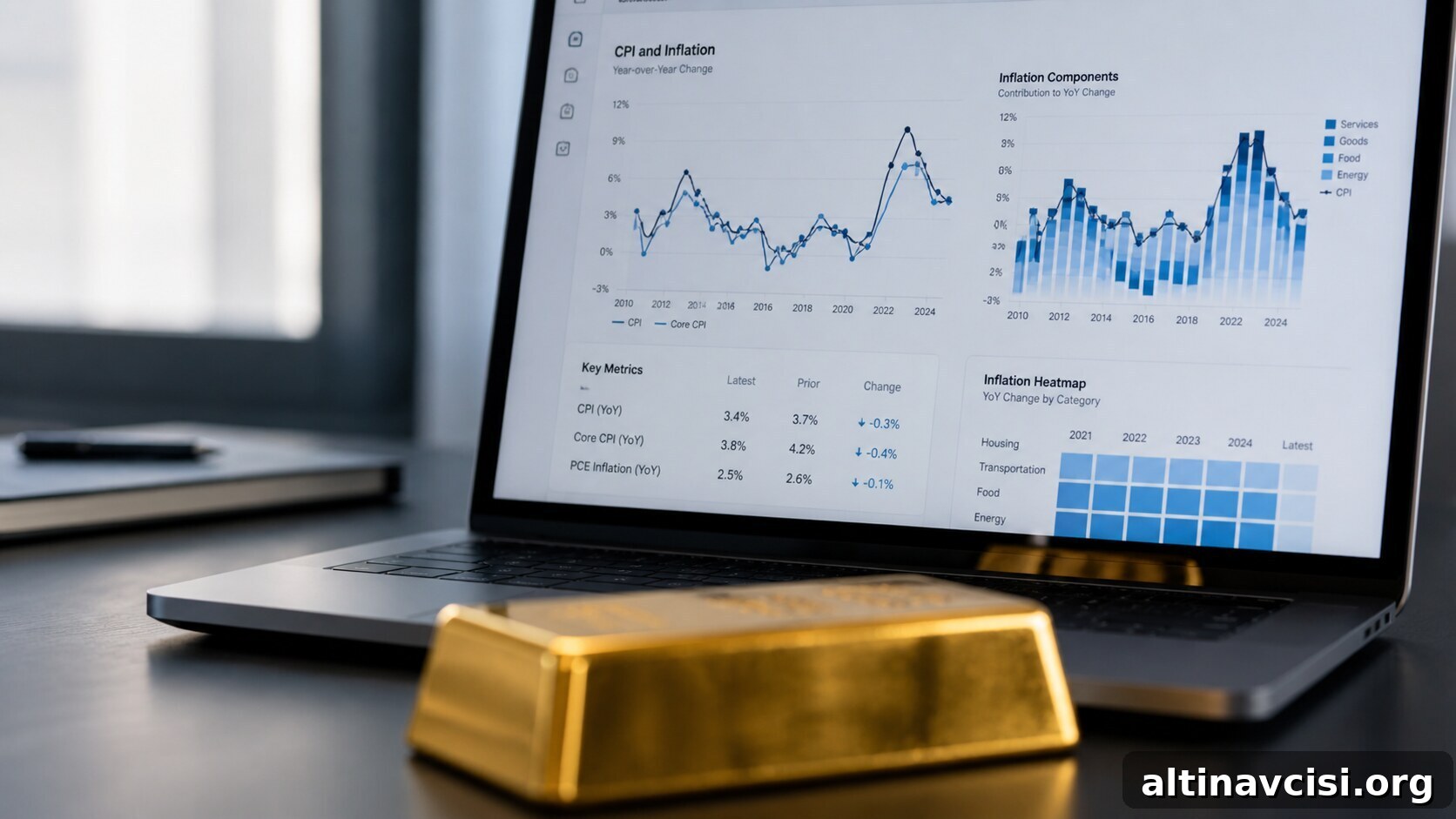
Gold is often assumed to be a straightforward inflation hedge — but the evidence shows that relationship is inconsistent. At times gold far outperforms rising consumer prices; at other times it falls even as inflation accelerates. The real drivers are real interest rates, monetary credibility, and systemic risk. Investors who recognize this nuance make more informed choices than those who react only to headline CPI numbers.
Gold is trading near $4,592 per ounce — up more than 41% year-over-year — while the Federal Reserve’s preferred inflation gauge recently printed 3.5% annually. On the surface this looks like the classic story. Yet gold is about 15% below its January 2026 peak of $5,405, and that selloff coincided with accelerating inflation. That contradiction is the gold inflation paradox: the simple claim that “gold always rises with inflation” doesn’t hold up under scrutiny.
What Is the Gold Inflation Paradox — and Where Does the Idea Come From?
The popular claim is easy to state: when consumer prices rise, gold rises too. That line has become conventional wisdom. But the right question is whether gold reliably tracks CPI on short-term horizons. It does not. Understanding why helps investors avoid simplistic allocation rules.
There is a historical basis for the belief. Gold carries no counterparty risk, cannot be issued at will, and has retained purchasing power across centuries. A dollar from 1971 buys far less today, while an ounce of gold from that year retains much more of its real value. That long-term preservation is real.
However, preserving wealth over decades is different from moving in lockstep with monthly inflation prints. Conflating the two is the source of many mistaken expectations about gold’s short-term behavior.
Your Gold Buying Guide Most investors overpay when they buy gold and again when they sell. This guide explains what to own and why.
When Did Gold and Inflation Actually Move Together?
The 1970s are the origin of the durable link between gold and inflation in many investors’ minds. After the U.S. left the gold standard in 1971, gold traded near $35 per ounce and climbed to roughly $850 by January 1980 — a nominal gain of more than 2,300% while CPI about doubled. That dramatic episode cemented the idea that gold is an inflation hedge.
But that surge occurred in a specific context: oil shocks, large fiscal deficits, a weakly credible central bank, and deeply negative real interest rates. Those conditions drove gold’s extraordinary performance. Treating that decade as a universal rule leads to misplaced expectations.
Why Did Gold Fall During the 1980s — When Inflation Was Still High?
Inflation alone was not the determinant. When Fed Chair Paul Volcker raised the federal funds rate toward 20% by mid-1981, real interest rates rose sharply. Gold began to fall well before inflation had fully cooled: it dropped roughly 65% from its January 1980 peak over the next two years, despite still-elevated CPI. The lesson: rising real rates can overwhelm inflation as a driver of gold prices.
This pattern repeated in 2022. As the Fed moved from near-zero policy rates to around 5.5% — the fastest tightening since the 1980s — gold fell from about $2,000 to $1,600 while inflation reached multi-decade highs. When real rates climb, gold often weakens even amid high CPI.
Why Did Gold Rally While Inflation Was Cooling — 2022 to 2026?
Gold’s advance from late 2022 into early 2026 happened largely as headline inflation cooled. CPI peaked above 9% in mid-2022 and later eased toward low single digits while gold climbed to new highs. Three structural forces powered that rally beyond monthly CPI readings: record central bank purchases, shifts in global reserve preferences that weakened the dollar’s exclusivity, and institutional flows into gold-backed ETFs as fiscal concerns persisted. In short, inflation was present but not the primary cause.
What Actually Drives the Gold Price?
Real interest rates — nominal yields minus inflation — are the most consistent historical driver of gold. When real rates are negative or falling, the opportunity cost of holding non-yielding gold falls, supporting higher prices. That dynamic explains major rallies such as the 1970s and the post-2008 period, when policy rates were depressed and real yields were deeply negative.
At times other factors take precedence: sustained central bank buying, long-term reserve diversification, geopolitical risks, and concerns about monetary or fiscal credibility can create a structural demand floor for gold independent of short-term real-rate movements. In such episodes, gold behaves more like an insurance asset than a mechanical CPI tracker.
What Did the 2026 Correction Reveal?
The early-2026 correction highlighted the paradox. Gold fell roughly 15% from its January peak while core PCE accelerated to 3.5%. Rather than disproving gold’s long-term role, the correction illustrated the real-rate mechanism: geopolitical tensions raised energy prices and inflation expectations, which pushed rate forecasts higher and lifted real yields — increasing the opportunity cost of holding gold and pressuring the price.
Rather than suggesting gold is a faulty hedge, the episode shows that simple inflation narratives miss crucial channels that move the metal.
Should You Own Gold as an Inflation Hedge?
Yes — but with the right expectations. Gold is best viewed as protection against monetary debasement, fiscal risk, and threats to confidence in paper money over years, not as a month-to-month CPI hedge. Since 1971 gold has preserved and extended real wealth more effectively than cash or many fixed-income instruments.
Practically, that means monitoring real interest rates, central bank balance sheets, and fiscal trends rather than reacting only to CPI prints. Gold’s case strengthens when deficits are large and real yields are negative or falling. Conversely, when central banks are aggressively raising rates to restore credibility, gold can face headwinds even if CPI is high.
Central banks have acted on this distinction: since 2022 they have purchased substantial quantities of gold as part of reserve diversification, driven by a broader re-evaluation of the global monetary architecture. That trend is structural and likely to influence markets for years.
Stay On Top of Gold & Silver Prices
Get important market alerts sent straight to your inbox.
People Also Ask
Does gold always go up when inflation is high?
No. Gold declined sharply in the early 1980s even as inflation remained elevated because aggressive rate hikes pushed real yields higher. Real interest rates — nominal rates minus inflation — are the more reliable influence. When real rates rise, gold tends to fall regardless of headline CPI.
What is a gold inflation hedge?
A gold inflation hedge is the idea that owning gold protects purchasing power when consumer prices rise. The concept rests on gold’s scarcity and lack of counterparty risk. In practice, however, gold is more closely linked to real interest rates, central bank behavior, and systemic risk than to month-to-month CPI readings. It hedges monetary disorder more than isolated inflation prints.
Why did gold fall in early 2026 when inflation was rising?
Gold fell around 15% from its January 2026 high while core PCE accelerated. The sequence was straightforward: geopolitical shocks raised energy prices and inflation expectations, which pushed up expected policy rates and real yields. Higher real yields increase the cost of holding non-yielding gold, and the price moved lower as a result.
What really drives the gold price?
Key drivers include real interest rates, central bank demand, dollar strength, geopolitical risk, and confidence in monetary systems. Inflation influences gold through its effect on real yields, but structural demand from central banks and institutions has become an increasingly important factor in recent years.
How much have central banks been buying gold?
Central bank purchases have been substantial. For example, they bought hundreds of tonnes in recent quarters, and annual purchases since 2022 have been meaningfully higher than earlier averages, reflecting a shift toward reserve diversification away from dollar-denominated assets.
Gold Won’t Always Do What You Expect — That’s Not a Bug
Many investors accept a simple rule: inflation up, gold up. History shows that rule is incomplete. Gold fell during tense inflationary episodes and rose at times when CPI was cooling. The pattern is messy because multiple forces — real rates, central bank demand, and systemic risk — interact.
Understanding the gold inflation paradox clarifies those swings. Gold functions as insurance against monetary and fiscal dysfunction. When you recognize that, price corrections are less puzzling: they become part of the asset’s behavior rather than evidence the thesis is broken.
SOURCES
1. CNBC — PCE Inflation Rate March 2026
2. World Gold Council — Gold Demand Trends Q1 2026
3. GoldSilver.com — Gold vs Inflation: What 100 Years of Data Shows
4. Federal Reserve History — Recession of 1981–82
5. Morgan Stanley — Gold Price Rally 2025: Drivers and Opportunities
6. CME Group OpenMarkets — How Does Gold Perform with Inflation, Stagflation and Recession?
7. J.P. Morgan Global Research — Gold Price Predictions 2026
Disclaimer: This article is for informational and educational purposes only. It does not constitute investment advice. Please consult a qualified financial adviser before making any investment decisions.
You may also like:
- Insurance vs. Upside: Balancing Your Portfolio with Gold and Silver
- Gold Bullion vs. Jewelry: Why Serious Investors Choose the Bar
- Gold & Silver IRA: Why Starting Early Costs You Less
- Silver Fair Value: What the Data and History Show
- Gold or Silver Price Dip: Temporary Correction or Trend Reversal?
- What Switzerland’s Gold Freeze Means for Investors
- What History Shows About Buying Gold After a Pullback
- Should You Sell Gold During a Bull Market Pullback?