Daily News Nuggets | Today’s top stories for gold and silver investors
October 17th, 2025
Gold Quietly Outruns the Nasdaq Since 2020
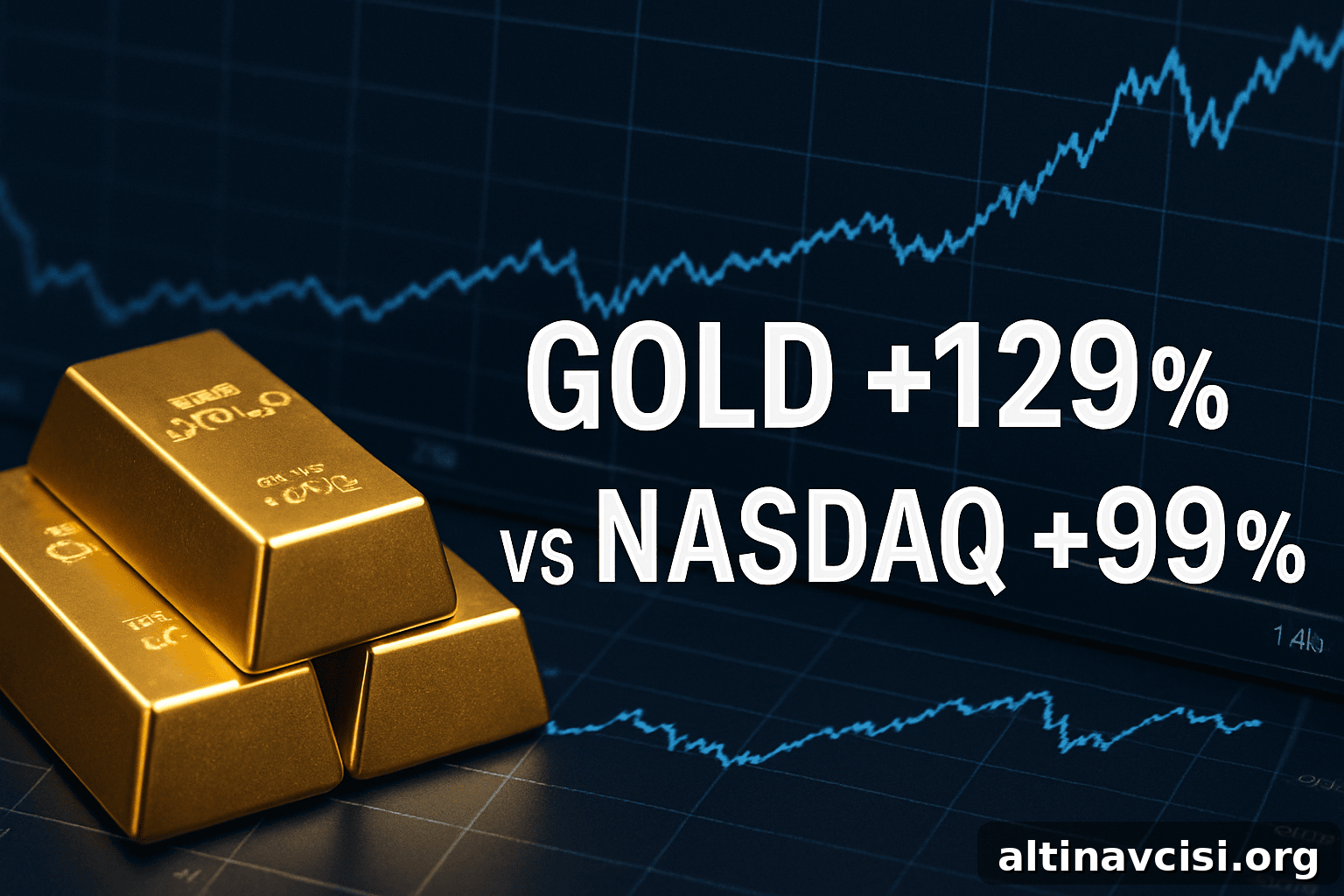
Most investors still think of gold as a conservative, sleepy asset compared with buzzy technology stocks. The reality over the past five years tells a different story: gold has risen roughly 129% versus about 99% for the Nasdaq Composite. That performance highlights gold’s ability to compound returns while maintaining low correlation to equities.
Throughout a cycle marked by interest-rate shocks, bank stress, and geopolitical flashpoints, gold has acted as a defensive growth engine rather than just a stability anchor. It didn’t just keep pace with high-flying tech—it outperformed it. While past results don’t guarantee future gains and start dates influence outcomes, the takeaway is clear: a strategic allocation to gold can contribute meaningfully to long-term portfolio performance, even if it lacks headline-grabbing drama.
That defensive case is being tested in current market conditions, and the next sections explain why that matters for investors.
Bank Stocks Tumble as Haven Bids Surge
Financial shares fell sharply Thursday as stress among U.S. regional banks spilled into European markets, lifting volatility and sparking a broad risk-off move. The shift pushed gold to fresh highs above $4,370 per ounce while Treasury yields declined as traders priced in a greater chance of Fed rate cuts.
This pattern follows a familiar liquidity-scare playbook: bank strains undermine confidence in equities, the dollar weakens, and safe-haven assets like gold attract demand. If pressure on regional lenders continues or widens, the flight-to-quality trade should remain a supportive force for bullion, prompting Wall Street strategists to re-evaluate and, in some cases, raise price targets.
HSBC: Gold’s ‘Bull Wave’ Could Crest at $5,000 by 2026
HSBC released a bold forecast this week, projecting that gold could reach $5,000 per ounce in the first half of 2026. The bank points to ongoing central-bank purchases, persistent geopolitical risks, the potential for lower U.S. interest rates, and renewed investor inflows into ETFs as key drivers.
HSBC also lifted its average price forecasts for 2025 and 2026 while warning of heightened volatility. The implication is straightforward: significant upside remains possible, but the path will likely be uneven. Even in bullish trends, gold can experience sharp swings, so careful position sizing and risk management remain essential as momentum builds.
At the same time, political dysfunction in Washington adds another layer of macro uncertainty that could influence the trajectory of prices.
Shutdown Hits Day 17: Data Blackouts Deepen
The partial U.S. government shutdown entered its 17th day, making it one of the longest funding lapses in recent history. The Senate is not expected to reconvene until Monday, and the next scheduled vote to reopen government operations is set for Oct. 20. The shutdown is freezing critical functions and delaying the release of economic data that markets rely on to assess growth and inflation.
When economic reporting is interrupted, the Fed and investors face greater uncertainty. That opacity tends to favor assets that don’t depend on cash flows, counterparties, or government statistics—physical gold and silver among them. The longer data blackouts continue, the harder it becomes to read the economic picture, and markets typically dislike that lack of visibility.
IMF Flags Elevated Financial-Stability Risks
The IMF’s latest Global Financial Stability Report warns that stretched asset valuations, pressures in sovereign-bond markets, and vulnerabilities within nonbank finance make the global system sensitive to sudden shocks. The risk is not limited to share prices; it extends to the market plumbing—funding and currency channels that can seize up quickly when uncertainty spikes.
In practice, that means leverage is elevated, liquidity cushions are thin, and correlations across asset classes can increase sharply during stress episodes. Diversification can become less effective exactly when investors need it most.
For portfolio managers and individual investors, the IMF’s message is a reminder to stress-test allocations and maintain true ballast. Historically, gold has served as both a liquidity reserve and a tail-risk hedge when market volatility clusters. It’s not always exciting, but it can preserve capital and provide optionality when financial plumbing tightens.