Key Takeaways
- For most first-time buyers with $1,000 or more, gold is the best starting point — it offers lower volatility, stronger liquidity, simpler storage, and greater flexibility.
- Silver is usually the smarter second purchase rather than the first — it can deliver higher upside in a bull market, but its greater volatility makes it easier to hold once you’ve already experienced gold’s steadiness through corrections.
- Budget is frequently overlooked — below $1,000, silver avoids the premium distortion that comes with buying fractional gold coins.
If you’re asking “should I buy gold or silver first?”, the short answer for most people is gold. That said, budget, goals, storage, and liquidity needs can change the choice. Rather than a blanket rule, use a clear framework.
Below is a practical framework to guide your decision.
Why Does It Matter Which Metal You Buy First?
Gold and silver are both monetary metals that have preserved purchasing power across inflation cycles and political changes for millennia. The question isn’t which metal is better in abstract terms, but which one is the right entry point for your situation.
Both metals protect against the same core issue: fiat currencies lose purchasing power over time. Since the end of the dollar’s direct convertibility to gold in 1971, the dollar has lost a significant portion of its purchasing power. Over decades, gold and silver prices have reflected that loss: gold has moved from a fixed price in the early 1970s to far higher levels today, and silver has likewise risen substantially. The precise historical numbers vary by data source, but the long-term trend is clear: physical precious metals store real value over long periods.
The Knowledge That Changes Everything

Two essential guides — yours free. Learn why gold matters and why fiat currencies face long-term pressures.
In short, both metals work, but they behave differently. Your first purchase shapes how you view the position and how likely you are to hold through volatility. The right first buy makes holding easier; the wrong one can lead to panic-selling.
Gold vs. Silver vs. Dollar — Cumulative Return Since 1971
Indexed to 100 at 1971. The dollar line shows purchasing power decreasing as inflation compounds.
Source: Historical spot price and CPI series.
The 4-Question Framework
Answer these four questions in order. The decision will follow.
Question 1: What Is Your Starting Budget?
Budget is often the most important factor and where many beginner guides go wrong.
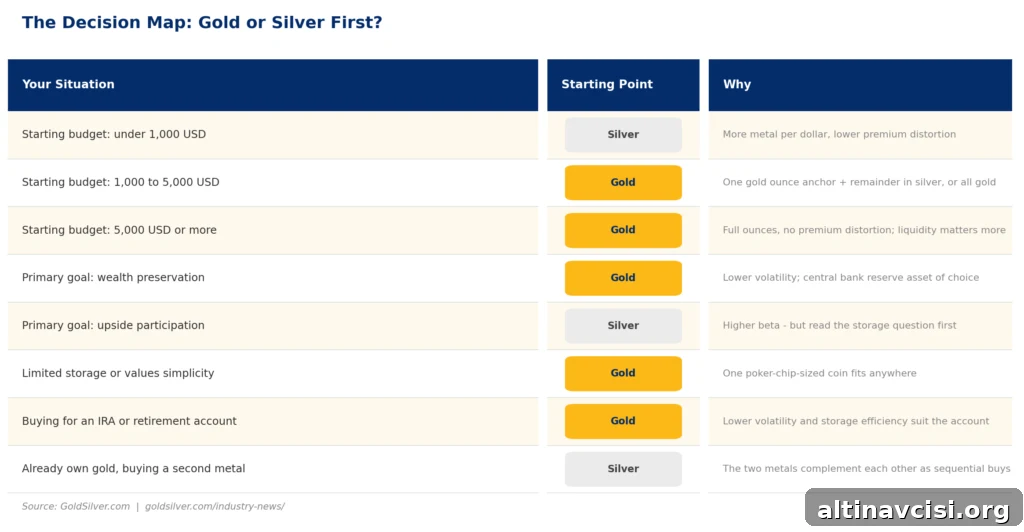
Under $1,000: Start with silver. At current relative prices, a small budget buys a tiny fraction of an ounce of gold and you pay high premiums on fractional gold coins. The same money typically buys many ounces of silver, giving you more metal per dollar and a cleaner introduction to physical ownership.
$1,000–$5,000: Either metal can work. Many buyers use this range to buy a single one-ounce gold coin as an anchor and add silver for growth exposure.
$5,000+: Lead with gold. At larger amounts, you can buy whole ounces without premium distortion, and gold’s liquidity and lower volatility become more valuable as the dollar amount rises.
Question 2: What Do You Need This Metal To Do?
Match the metal to your objective.
Wealth preservation: Gold is the cleaner tool. It’s widely held by central banks and tends to move less in turbulent markets.
Upside exposure: Silver typically offers larger percentage moves in both directions. It can outperform gold in strong rallies but also falls further during corrections. Many first-time buyers think they want upside but actually need the stability that gold provides.
Question 3: Does Storage Kill the Silver Argument?
Physical weight matters. Silver is bulkier per dollar of value than gold. That creates two costs: higher vault storage per dollar and a larger physical footprint if you plan to keep metal at home. If storage space, vault fees, or insurance complexity are concerns, gold is simpler to store and insure.
Question 4: How Easy Is It To Sell?
Consider exit strategy. Gold is highly liquid worldwide — a one-ounce gold coin is instantly recognizable and has a tighter bid-ask spread. Silver is also liquid but bulkier: selling large amounts typically requires more transactions or a larger counterparty. For simplicity and cleaner exits, gold has an advantage for most beginners.
The Decision Map
Four questions, one result. The explanations above show the rationale for each outcome.
Should You Just Buy Both?
Eventually, yes — it’s usually about sequence, not exclusion. Gold serves as the monetary anchor and tends to preserve value; silver is both an industrial and monetary metal that can provide growth during later stages of a bull market. They function best together, with gold as the foundation and silver layered in for upside.
The gold-silver ratio — how many ounces of silver buy one ounce of gold — helps calibrate balance between the metals. A very high ratio suggests silver is cheap relative to gold; a low ratio suggests the opposite. Use the ratio as a guide after you’ve established a gold anchor.
Own the anchor first. Then build your silver position.
Stay On Top of Gold & Silver Prices
Get important market alerts sent straight to your inbox.
People Also Ask
What percentage of a portfolio should be in precious metals?
A common professional recommendation is 5–15% of a portfolio in physical precious metals, with 10% as a typical midpoint. Within that allocation many advisers suggest a split of roughly 70–80% gold and 20–30% silver, shifting toward more silver for growth-focused allocations. More important than hitting a specific number is sizing a position you can hold through a 20–30% drawdown without panic.
Should I buy silver coins or silver bars?
Start with coins and add bars later. Sovereign coins carry higher premiums but are instantly recognizable and easy to sell. Bars become more cost-efficient once you’re buying larger amounts, typically above a certain dollar threshold where lower premiums matter more. Begin with coins for liquidity and simplicity, then add bars when storage and buying scale make them worthwhile.
Does it matter which gold coin I buy — Eagle, Maple Leaf, or Krugerrand?
For investment purposes the practical differences are small. All are recognized one-ounce coins accepted by dealers worldwide. Some are .9999 fine, others are alloyed for durability, but premiums and liquidity are comparable. Choose the coin you can source at the tightest spread from a reputable dealer.
Is gold or silver better for a retirement account?
Gold is generally a better fit for a self-directed precious metals IRA because of its lower volatility and smaller storage footprint per dollar. Silver is permitted but its bulk and higher storage costs make it less efficient inside tax-advantaged retirement vehicles. If you value silver’s upside, consider holding it in a taxable account where you control sizing and timing.
Does timing matter for a first purchase, or should I just start?
Start. Trying to time the perfect entry often leads to never buying. The structural case for physical precious metals as protection against currency debasement doesn’t depend on perfect timing. Dollar-cost averaging removes timing risk and helps you accumulate more when prices fall. Beginning matters more than pinpointing an exact entry moment.
Where Do You Go From Here?
Most people overthink this choice. The variables are straightforward: budget, goal, storage, liquidity. Work through them honestly and the answer often points to starting with gold.
For most beginners, a one-ounce sovereign coin (American Eagle, Canadian Maple Leaf, or Krugerrand) stored securely at home or in professional vault storage is a sensible first step. After you establish that anchor, you’ll be better placed to add silver with confidence.
Decisions made from urgency or confusion often lead to regret. Those who build long-term wealth with precious metals act from clarity and a plan.
Start with that.
When you’re ready to make your first purchase, create a free account with your preferred dealer to access live pricing, vault storage options, and product availability so you can act on your timetable rather than under pressure.
SOURCES
Historical price and inflation series, industry reports, and public data sources inform the points made in this article.
Disclaimer: This article is for informational and educational purposes only and does not constitute investment advice. Consult a qualified financial adviser before making investment decisions.
You may also like:
- Gold Reserves by Country: The 2026 Rankings
- Gold Portfolio Allocation: Why Wall Street Is Rewriting the 60/40
- What Does the SILVER Act Mean for Precious Metals Investors?
- What Backs the US Dollar? Not Gold. Not Silver.
- Why Is Gold Valuable? The 5,000-Year Answer Most Investors Get Wrong
- 72% of Family Offices Hold No Gold. What They’re Missing.
- Silver Industrial Demand: Solar, EVs, and the Supply Gap